
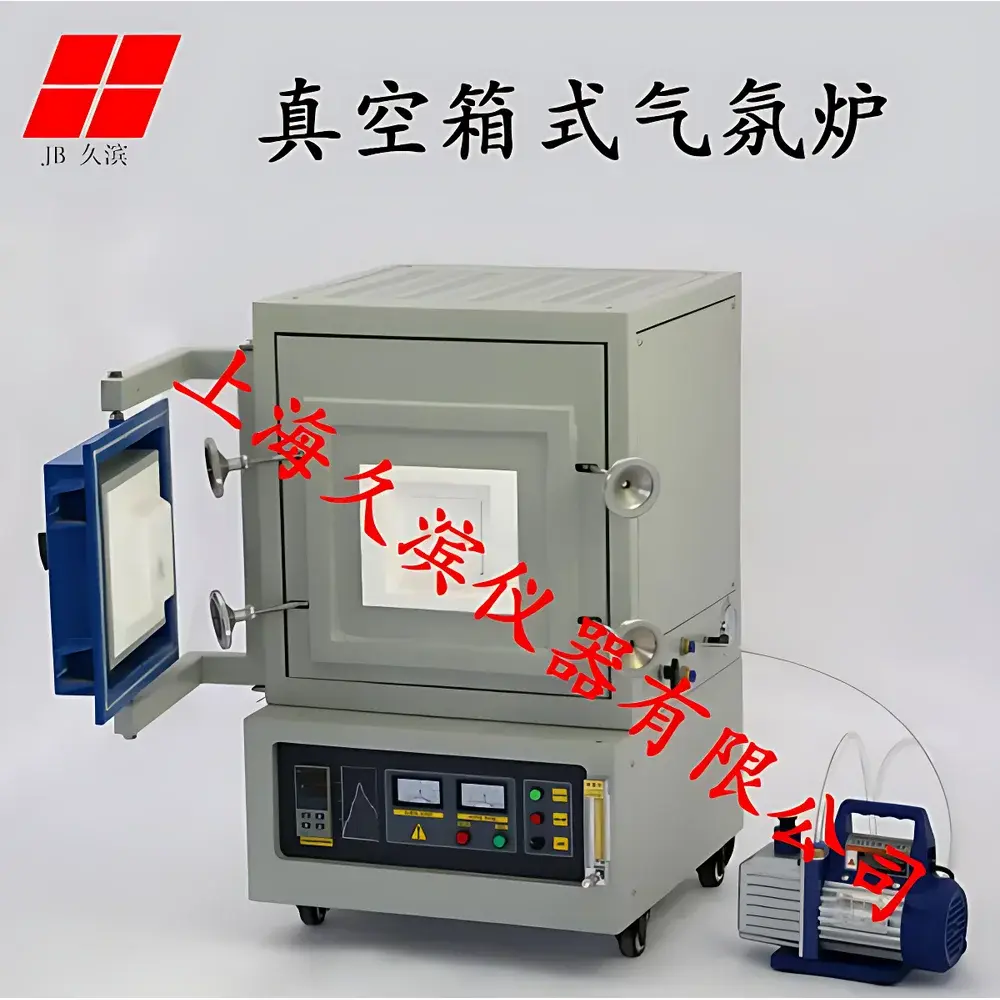
JB-1650 Vacuum Atmosphere Box Furnace by Jiubin Instruments
| Brand | Jiubin Instruments |
|---|---|
| Origin | Shanghai, China |
| Model | JB-1650 |
| Furnace Type | Box-type |
| Max Temperature | 1650 °C |
| Temperature Uniformity | ±1 °C |
| Heating Rate | 0–10 °C/min (recommended) |
| Heating Element | Silicon Molybdenum (MoSi₂) Rods |
| Internal Chamber Dimensions | 600 × 400 × 300 mm (D × W × H) |
| Chamber Material | High-purity Al₂O₃ polycrystalline ceramic fiber (>92% Al₂O₃) |
| Thermocouple Type | Type B |
| Power Rating | ~20 kW |
| Voltage | 380 V AC |
| Vacuum Level (Cold) | –0.1 MPa |
| Gas Inlets | 2 independent ports with float-type flowmeters (0–2 L/min) |
| Control System | Yudian intelligent PID programmable controller (30-segment ramp/soak) |
| Safety Protections | Over-temperature, thermocouple break, over-current, over-voltage, and deviation alarms |
Overview
The JB-1650 Vacuum Atmosphere Box Furnace is a high-temperature, dual-mode thermal processing system engineered for precision materials synthesis, sintering, annealing, and controlled-atmosphere heat treatment in research laboratories and pilot-scale production environments. Designed around a robust box-type architecture, it integrates vacuum capability (up to –0.1 MPa cold vacuum) with flexible gas introduction (dual independent inlets), enabling operation under inert, reducing, oxidizing, or reactive atmospheres—including N₂, Ar, O₂, CO, and custom gas mixtures. Its core heating mechanism relies on silicon molybdenum (MoSi₂) rods mounted in a two-sided configuration, delivering uniform radiant heat distribution across the 600 × 400 × 300 mm chamber. The furnace achieves a maximum rated temperature of 1650 °C—optimized for routine use up to 1550 °C to ensure long-term thermal stability and element longevity. Temperature control is governed by a Yudian-brand intelligent PID controller with 30-segment programmability, supporting automated ramp-soak-cool profiles and real-time deviation compensation.
Key Features
- High-temperature capability: Rated to 1650 °C with ±1 °C control accuracy over the full operating range (room temperature to 1550 °C)
- Dual-mode environment control: Integrated vacuum system (–0.1 MPa base pressure) + two independently regulated gas inlets with calibrated float-type flowmeters (0–2 L/min)
- Thermally optimized chamber: Polycrystalline alumina ceramic fiber insulation (>92% Al₂O₃), engineered for low thermal conductivity, high thermal shock resistance, and minimal energy loss
- Structurally reinforced design: Step-jointed monolithic furnace chamber adhering to mechanical load distribution principles—ensures dimensional stability and uniform thermal expansion during repeated cycling
- Advanced safety architecture: Comprehensive protection suite including over-temperature cutoff, thermocouple break detection, current/voltage anomaly monitoring, and temperature deviation alarm
- User-centric interface: Full-color LED display with intuitive navigation; one-touch profile execution; automatic start/stop sequencing without operator supervision
Sample Compatibility & Compliance
The JB-1650 accommodates a broad spectrum of sample forms—including powders, pellets, crucibles (graphite, alumina, molybdenum), thin films on substrates, and small-volume metallurgical specimens—within its spacious 72 L internal volume. Its sealed chamber and dual-gas manifold support ASTM E1112 (vacuum heat treatment), ISO 9001-compliant process documentation, and GLP-aligned experimental traceability when paired with external data logging. While not inherently 21 CFR Part 11 compliant, the system’s programmable controller supports audit-ready parameter logging (via optional RS485/Modbus export), facilitating integration into GMP-regulated workflows where electronic records are required. All structural and electrical components conform to IEC 61000-6-3 (EMC emission) and IEC 61000-6-2 (immunity) standards.
Software & Data Management
The embedded Yudian controller provides native 30-segment programmable logic with auto-tuning PID coefficients, adjustable ramp rates (0–10 °C/min), and soak dwell functionality. Real-time temperature curves and setpoint tracking are viewable on the front-panel display. For extended data capture, the furnace features RS485 serial output compatible with Modbus RTU protocol—enabling seamless connection to SCADA systems, LabVIEW environments, or third-party LIMS platforms. Optional software packages support CSV export of time-stamped temperature logs, profile validation reports, and event-triggered alarm histories—critical for method transfer, equipment qualification (IQ/OQ), and regulatory audits.
Applications
- Sintering of advanced ceramics (e.g., SiC, ZrO₂, AlN) and refractory metals under vacuum or controlled partial pressure
- Graphitization and high-temperature annealing of carbon-based composites and CVD precursors
- Oxidation studies of metallic alloys using precise O₂ partial pressure control
- Thermal reduction of metal oxides (e.g., NiO, Co₃O₄) in CO/N₂ atmospheres for catalyst precursor synthesis
- Heat treatment of optical crystals (e.g., YAG, sapphire) requiring low-contamination, uniform thermal gradients
- Pre-sintering and debinding cycles for powder metallurgy and MIM feedstocks
FAQ
What is the recommended maximum continuous operating temperature?
The furnace is rated for 1650 °C, but sustained operation above 1550 °C accelerates MoSi₂ element degradation. For optimal service life and repeatability, ≤1550 °C is advised.
Can the furnace be used for hydrogen atmosphere processing?
Yes—provided appropriate gas-handling protocols are followed (leak-checked lines, explosion-proof venting, and H₂-compatible seals). Note: Hydrogen service requires additional safety interlocks not included as standard.
Is the thermocouple replaceable in situ?
Yes—the Type B thermocouple is accessible via a dedicated port on the rear wall and can be replaced without disassembling the insulation or chamber structure.
Does the system include vacuum pump oil and maintenance guidance?
A single-stage rotary vane vacuum pump is supplied with initial oil fill and a maintenance schedule. Recommended oil change intervals are every 500 operational hours or per manufacturer specifications.
How is temperature uniformity validated across the chamber?
Uniformity is verified per ASTM E220 at three axial positions (center, top, bottom) and two radial points (front/back) at 1200 °C and 1500 °C—typical deviation is ≤±3 °C within the central 60% volume.



