
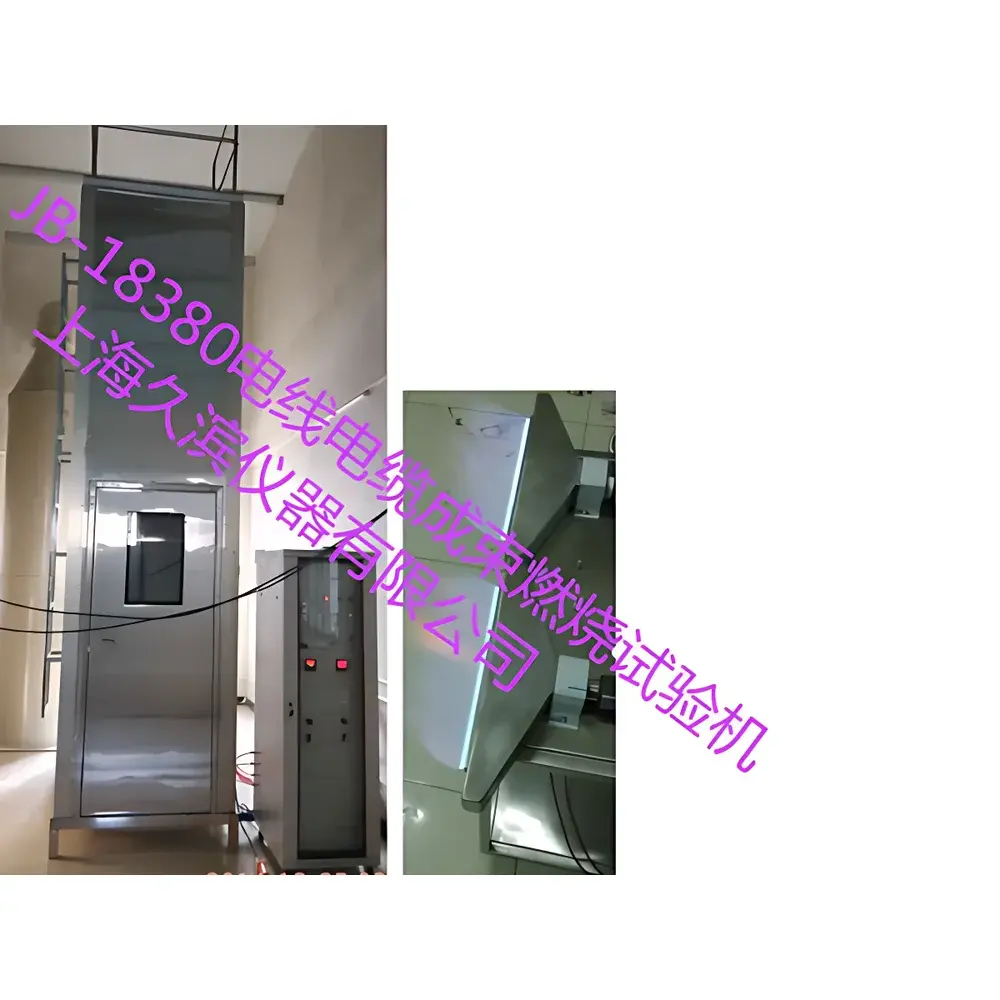
JB-18380 Bundled Cable Vertical Flame Propagation Test Chamber (Jiubin Instruments)
| Brand | Jiubin Instruments |
|---|---|
| Origin | Shanghai, China |
| Model | JB-18380 |
| Chamber Internal Dimensions | 1000 × 2000 × 4000 mm (W × D × H) |
| Air Inlet | 800 × 400 mm @ 5 m³/h |
| Exhaust Opening | 300 × 1000 mm |
| Adjustable Burner Height | 600 ± 5 mm |
| Air Flow Regulation | 4.5–10 m³/min ±5% |
| Propane Flow Control | 5–20 L/min ±1% (via pressure regulator & gauge) |
| Compressed Air Flow | 50–100 L/min ±1% (rotameter-controlled) |
| Anemometer Range | 0.05–5 m/s ±2% |
| Timer Range | 0–60 min ±0.5 s (auto gas cutoff) |
| Internal Thermocouple | 0–100 °C ±1% |
| Dual Stainless Steel Ladder Assemblies | 500 ±5 mm & 800 ±5 mm wide × 3500 ±10 mm high, 9-step |
Overview
The JB-18380 Bundled Cable Vertical Flame Propagation Test Chamber is an engineered solution for evaluating the flame propagation resistance of vertically installed cable bundles under controlled fire exposure conditions. Designed in strict accordance with the physical test requirements of GB/T 18380.31–36–2008 and IEC 60332-3-21:2000, this chamber implements the standardized “vertical tray flame test” methodology—where multiple cables are arranged in a defined bundle on a steel ladder and subjected to simultaneous impingement from two calibrated propane burners. The core measurement principle relies on visual assessment of char height following a prescribed 20-minute exposure period, enabling quantitative classification of flame retardancy performance for low-smoke halogen-free (LSHF), PVC, PE, and cross-linked polymeric cable constructions. Its robust double-walled stainless steel enclosure, insulated with 70 mm rockwool panels, ensures thermal stability, minimal heat loss, and repeatable boundary conditions across successive test cycles—critical for inter-laboratory comparability and regulatory acceptance.
Key Features
- Double-layer stainless steel combustion chamber (1000 × 2000 × 4000 mm internal dimensions) with 70 mm rockwool insulation for thermal integrity and operator safety
- Dual independently adjustable propane burners compliant with GB/T 18380.3 geometry and flame output specifications, each equipped with integrated Venturi-type gas mixing units
- Precisely dimensioned stainless steel ladders: two configurations provided—500 ±5 mm and 800 ±5 mm wide × 3500 ±10 mm high, both with nine horizontal steps for standardized cable bundling
- Controlled ventilation system: regulated air inlet (800 × 400 mm, 5 m³/h) and exhaust opening (300 × 1000 mm) to maintain consistent draft conditions during testing
- High-accuracy flow control architecture: propane (5–20 L/min ±1%), compressed air (50–100 L/min ±1%), and total chamber airflow (4.5–10 m³/min ±5%) managed via calibrated rotameters, pressure regulators, and digital gauges
- Integrated instrumentation suite: NIST-traceable anemometer (0.05–5 m/s ±2%) for top-exhaust velocity verification; Class II thermocouple with digital display (0–100 °C ±1%) for real-time chamber wall temperature monitoring
- Programmable digital timer (0–60 min ±0.5 s) with automatic fuel-gas shutoff upon test completion—ensuring repeatability and eliminating manual intervention errors
- Ergonomic access design: built-in steel stairway and handrails for safe positioning and observation at the chamber’s upper inspection zone
Sample Compatibility & Compliance
The JB-18380 accommodates bundled configurations of power cables, communication cables, optical fiber cables, and hybrid assemblies up to the maximum ladder width (800 mm). Sample mounting follows IEC 60332-3-21 Annex A guidelines: cables are evenly distributed across ladder rungs without overlapping or compression, with total bundle cross-sectional area not exceeding 30% of the ladder’s open area. The system supports full compliance verification for product certification against national and international fire safety regulations—including CCC (China Compulsory Certification), CE marking (under EN 50399 and EN 60332-3), and UL 1685 (Vertical Tray Flame Test). All operational parameters—including burner positioning (600 ±5 mm above ladder base), gas mixture ratios, and airflow profiles—are validated per ASTM E603 practice for fire test apparatus calibration, ensuring data admissibility in third-party accreditation audits (e.g., CNAS, UKAS).
Software & Data Management
While the JB-18380 operates as a hardware-integrated manual test platform, its instrumentation interface supports external data logging via analog 4–20 mA outputs (available on request) for temperature and airflow signals. All critical test parameters—including start time, flame duration, propane pressure, air flow rate, and final char length—are recorded manually in accordance with GLP-compliant test report templates aligned with ISO/IEC 17025:2017 Clause 7.8. The chamber includes dedicated documentation fields for operator ID, sample identification, environmental conditions (ambient temperature/humidity), and observer signatures—facilitating traceability and audit readiness. For laboratories implementing electronic record systems, raw data can be imported into LIMS platforms supporting CSV or Excel ingestion, satisfying FDA 21 CFR Part 11 requirements when paired with appropriate user authentication and audit trail modules.
Applications
- Flame spread evaluation of bundled low-voltage and medium-voltage power cables for building infrastructure projects
- Pre-certification screening of new jacketing compounds (e.g., LSZH, EPR, XLPE) prior to formal type testing
- Quality assurance testing in cable manufacturing facilities for batch release verification
- Comparative fire performance studies between halogenated and halogen-free cable materials
- Technical support for fire safety engineering assessments in transit systems (subways, airports) and data centers
- Training and demonstration of vertical flame test methodology for laboratory personnel and regulatory inspectors
FAQ
Does the JB-18380 meet IEC 60332-3-24 requirements for Category C testing?
Yes—the chamber’s dual-burner configuration, ladder dimensions, and airflow control range satisfy the more stringent Category C (highest flame intensity) test conditions specified in IEC 60332-3-24:2018.
Can the system be upgraded to support automated data acquisition?
Optional analog signal outputs and RS-485 Modbus RTU interfaces are available for integration with SCADA or custom LabVIEW-based acquisition systems.
What maintenance intervals are recommended for the Venturi mixers and burners?
Burner nozzles and mixer orifices should be inspected and cleaned every 50 test cycles or quarterly—whichever occurs first—to prevent carbon buildup and flow deviation.
Is calibration certification included with delivery?
A factory-issued calibration report covering anemometer, thermocouple, and flowmeter accuracy is supplied; field recalibration services are available through authorized Jiubin service partners in APAC and EMEA regions.
How is flame position verified before each test?
Burner alignment is confirmed using a certified laser alignment tool and reference gauge block set—procedures documented in the operator manual per ISO/IEC 17025 Clause 6.4.10.



