
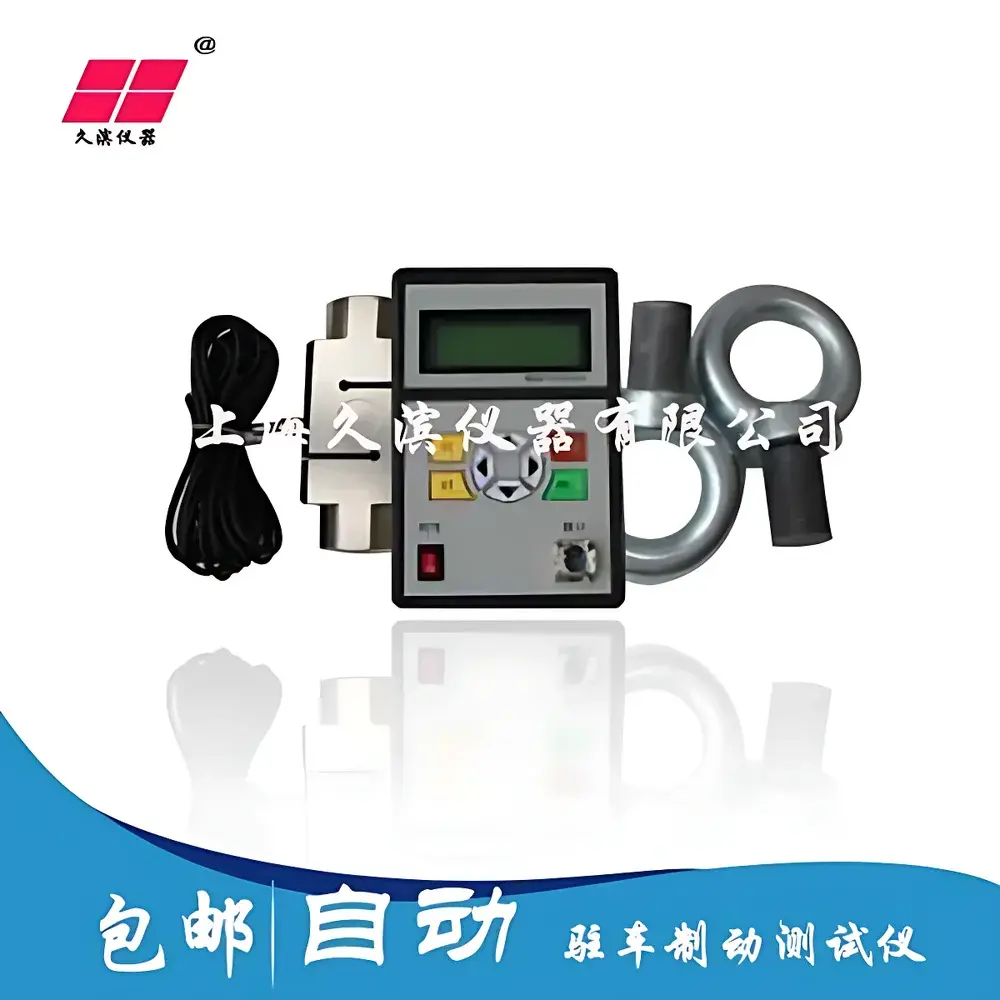
JB-221 Parking Brake Performance Tester by Jiubin Instruments
| Brand | Jiubin Instruments |
|---|---|
| Origin | Shanghai, China |
| Manufacturer Type | Authorized Distributor |
| Origin Category | Domestic (China) |
| Model | JB-221 |
| Pricing | Upon Request |
| Power Supply | 8.4 V Ni-MH Battery Pack |
| Measurement Range | ≤100 kN (sensor-dependent, scalable) |
| Resolution | 10 N |
| Accuracy | ±5% |
| Communication Interface | Standard 9-pin RS232 (TXD on Pin 3, RXD on Pin 2, GND on Pin 5) |
Overview
The JB-221 Parking Brake Performance Tester is an engineered field-testing instrument designed to evaluate the holding force of automotive parking brake systems under controlled, flat-surface conditions—eliminating dependence on physical grade-based road tests. It operates on the principle of direct mechanical force transduction: a high-capacity load cell measures the tensile or compressive force generated when the parking brake is engaged, while a calibrated mechanical conversion mechanism replicates the equivalent static frictional resistance normally developed on a standardized 20% (11.3°) incline as mandated by GB 7258–2017 and GB 21861–2014. This approach ensures metrological traceability to national roadworthiness testing standards without requiring dedicated slope infrastructure—making it especially suitable for urban vehicle inspection stations with spatial constraints.
Key Features
- High-stability 100 kN capacity load cell with 10 N resolution and ±5% full-scale accuracy—certified for repeatability in repetitive field deployments.
- Integrated 8.4 V nickel-metal hydride (Ni-MH) rechargeable battery pack enabling ≥8 hours of continuous operation per charge; supports hot-swap capability during extended inspection shifts.
- Dot-matrix LCD display with real-time dynamic update of instantaneous and peak parking brake force values; visual and audible alarm triggers automatically upon reaching threshold compliance limits defined in GB 21861 Annex E.
- Standardized 9-pin D-sub RS232 interface compliant with TIA/EIA-232-F specifications—enabling bidirectional communication with host PCs, central inspection management systems, or automated test benches.
- Modular peripheral support: optional external thermal micro-printer (IEEE 1284 parallel or TTL-level serial) and auxiliary LED display units for multi-operator environments or public-facing inspection bays.
Sample Compatibility & Compliance
The JB-221 is validated for use across light-duty passenger vehicles (M1), light commercial vehicles (N1), and medium-duty trucks (N2) up to 12,000 kg GVWR. It accommodates both drum and disc parking brake actuation mechanisms—including cable-pull, lever-activated, and electronically assisted park brake systems—via interchangeable mechanical couplers and adjustable anchoring fixtures. All measurement procedures align with the test sequence and pass/fail criteria outlined in Clause 6.17 of GB 21861–2014 (“Road Vehicle Safety Technical Inspection Procedures”) and Clause 7.10.3 of GB 7258–2017 (“Technical Conditions for Safe Operation of Motor Vehicles”). While not certified to ISO/IEC 17025 for accredited calibration laboratories, its sensor module supports third-party verification against national standard force reference machines (e.g., CNAS-accredited Class 0.3 load cells).
Software & Data Management
The JB-221 does not embed proprietary firmware-based analysis software but functions as a deterministic serial data source. Its ASCII-formatted output stream includes timestamped records structured as: [YYYYMMDD],[HHMMSS],[Force_N],[Status_Flag]. This raw protocol enables seamless integration into existing inspection software platforms compliant with China’s Ministry of Public Security (MPS) Type Approval requirements for motor vehicle testing equipment. When connected to a Windows/Linux host, data can be logged using generic terminal emulators (e.g., PuTTY, Tera Term) or ingested directly into SQL-backed inspection databases via Python/Node.js serial parsers. Audit trails—including operator ID, vehicle VIN (manually entered), and test duration—are maintained externally in accordance with GB/T 26765–2011 (“General Technical Requirements for Intelligent Transport Systems – Vehicle Inspection Data Exchange”)
Applications
- Periodic safety inspections at municipal motor vehicle inspection stations (MVIS) operating under MPS regulatory oversight.
- Pre-delivery quality assurance checks in OEM after-sales service centers and authorized dealer workshops.
- Calibration validation and field verification of parking brake actuators during chassis dynamometer-based durability testing.
- Technical training and certification programs for automotive inspectors conducted by provincial traffic police academies.
- Supporting GLP-aligned documentation workflows where force measurement metadata must be archived alongside photographic evidence and VIN-matched reports.
FAQ
Does the JB-221 require annual recalibration?
Yes. Per GB/T 5624–2019 (“Maintenance and Calibration of Motor Vehicle Testing Equipment”), load cell verification must be performed at least once per year using certified deadweight standards traceable to NIM (National Institute of Metrology, China).
Can the JB-221 measure electronic parking brakes (EPB)?
It supports EPB systems only in manual override mode—where the electronic actuator is disengaged and mechanical linkage is accessed via service port or caliper release tool. Fully automated EPB evaluation requires complementary CAN bus diagnostic modules.
Is RS232 the only communication option?
Yes—the device implements RS232 exclusively. USB or Bluetooth adapters are not supported natively and may introduce timing jitter incompatible with real-time force capture.
What environmental conditions affect measurement stability?
Operation is rated for 0–40 °C and ≤85% RH non-condensing. Load cell drift exceeding ±2% FS may occur below 5 °C or above 35 °C unless thermally stabilized via ambient pre-conditioning.
How is traceability to national standards documented?
Each unit ships with a factory calibration certificate referencing CNAS-accredited reference standards (e.g., NIM-FS-2022-XXXX), including temperature-compensated linearity and hysteresis error curves across the 0–100 kN range.





