
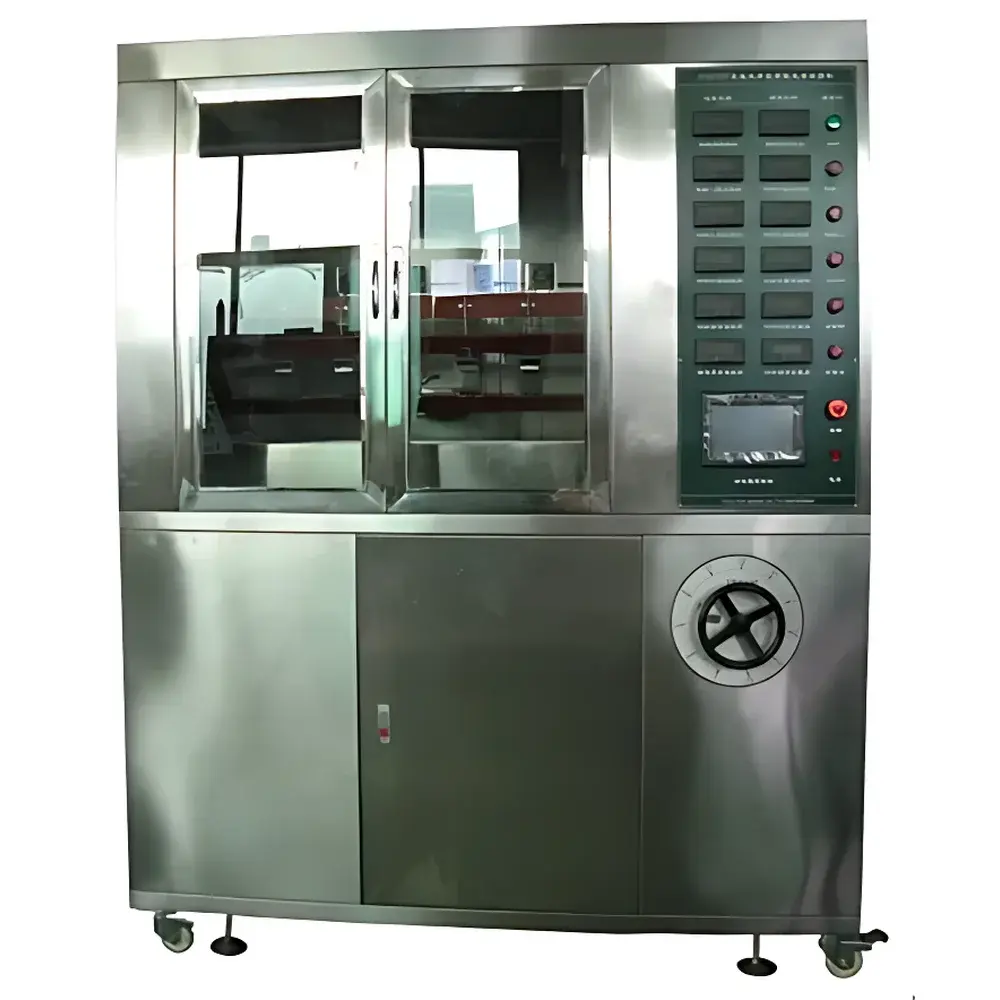
JB-Brookfield JB-8427 High-Voltage Tracking and Erosion Tester
| Brand | JB-Brookfield |
|---|---|
| Model | JB-8427 |
| Origin | Shanghai, China |
| Electrode Material | Stainless Steel (304/316) |
| Electrode Spacing | 50.0 mm ± 0.1 mm |
| Test Voltage Range | AC/DC 100–6000 V (continuously adjustable) |
| Voltage Stability | ±1% |
| Current Cutoff Threshold | 60 mA |
| Test Duration | Up to 6 h |
| Droplet Accuracy | ±0.5% |
| Dropping Rate | 0.00185–20 mL/min (via precision peristaltic pump) |
| Control System | Siemens PLC + Weinview HMI touchscreen |
| Reporting | Automated test report generation with thermal printer output |
| Chamber Volume | 0.56 m³ |
| Enclosure | Brushed SUS304 stainless steel |
| Contaminant Reservoir | Sealed 316 stainless steel tank |
| Dimensions (L×W×H) | 1300 × 700 × 1800 mm |
| Weight | Approx. 200 kg |
Overview
The JB-Brookfield JB-8427 High-Voltage Tracking and Erosion Tester is an engineered solution for evaluating the comparative resistance of insulating materials to electrical tracking and surface erosion under contaminated, humid conditions. It operates on the principle of applying sustained high-voltage stress across a sloped test specimen while metered droplets of conductive contaminant solution (e.g., ammonium chloride or sodium formate) are dispensed at defined intervals. Under these conditions, leakage current paths may develop, leading to carbonized conductive tracks—termed “electrical tracking”—and eventual material degradation. The JB-8427 replicates real-world failure mechanisms observed in outdoor insulators, printed circuit board substrates, transformer bushings, and appliance housings exposed to industrial or coastal environments. Designed in strict conformance with GB/T 6553–2003 and IEC 60587:1984, it supports standardized determination of Comparative Tracking Index (CTI) and Proof Tracking Index (PTI), essential metrics for material classification per IEC 60112 and UL 746A.
Key Features
- Wide-range high-voltage output: AC/DC 100–6000 V, continuously adjustable via precision autotransformer (5 kVA capacity) and high-stability regulated power supply (±1% voltage stability, 6000 W output)
- Calibrated electrode assembly: 0.5 mm thick stainless steel electrodes (ASTM F2170-compliant material specification), fixed at 50.0 mm ± 0.1 mm spacing with micrometer-level repeatability
- High-accuracy contamination delivery: LeFever-type peristaltic pump system delivering 0.00185–20 mL/min with flow error < ±0.5%, enabling precise replication of IEC-specified drop volumes and timing intervals
- Dual-mode operation: Selectable AC or DC high-voltage output, supporting both standard tracking evaluation and specialized DC endurance testing protocols
- Five independent test stations: Enables parallel evaluation of up to five specimens under identical environmental and electrical conditions, improving statistical robustness and throughput
- Integrated safety architecture: Automatic voltage cutoff at 60 mA leakage current, grounded stainless steel enclosure (SUS304), sealed 316 stainless contaminant reservoir, and interlocked chamber access
- Industrial-grade control: Siemens S7-series PLC coupled with Weinview MK series HMI touchscreen interface; supports parameter logging, real-time current/voltage monitoring, and programmable test sequences
Sample Compatibility & Compliance
The JB-8427 accommodates rigid flat or slightly inclined (23° ± 1°) specimens up to 100 mm × 100 mm × 12 mm (L×W×T), including thermosets (e.g., epoxy, phenolic), thermoplastics (e.g., PBT, PET, PC), laminates (e.g., FR-4), and ceramic composites. Specimen mounting fixtures ensure consistent tilt angle and electrode alignment per IEC 60587 Clause 6. All electrical and mechanical subsystems comply with IEC 61000-4 electromagnetic compatibility requirements and meet CE machinery directive (2006/42/EC) structural safety provisions. The instrument satisfies traceability requirements for GLP and ISO/IEC 17025-accredited laboratories when operated within documented SOPs—including calibration of voltage, current, and volumetric dispensing systems at intervals aligned with ISO/IEC 17025:2017 Clause 6.5.
Software & Data Management
While the JB-8427 operates via embedded PLC/HMI without external PC dependency, its control firmware supports full data export via USB interface in CSV format. Logged parameters include applied voltage, real-time leakage current (sampled at 10 Hz), cumulative drop count, elapsed test time, and pass/fail status per specimen. The thermal printer outputs timestamped reports containing operator ID, calibration certificate IDs, environmental ambient readings (if optional sensors installed), and final CTI/PTI classification per IEC 60112 Annex B. Audit trails are retained in non-volatile memory for ≥10,000 test cycles and support FDA 21 CFR Part 11-compliant electronic signatures when integrated into validated LIMS environments via Modbus TCP gateway.
Applications
- Material qualification for electrical enclosures used in IP55+ rated industrial equipment
- CTI verification of PCB substrate laminates prior to RoHS-compliant production release
- Comparative screening of flame-retardant additives in polymeric insulation systems
- Accelerated aging assessment of silicone rubber composite insulators for utility transmission lines
- Regulatory submission testing for UL recognition (UL 746A), CSA C22.2 No. 0.3, and EN 60695-2-10/11/12 series standards
- Root cause analysis of field failures linked to pollution-induced surface tracking in photovoltaic junction boxes
FAQ
What standards does the JB-8427 directly support?
It is fully compliant with GB/T 6553–2003, IEC 60587:1984, IEC 60112:2020, and UL 746A Annex G for CTI/PTI determination.
Can the instrument perform DC-only tracking tests?
Yes—high-voltage output is switchable between AC and DC modes, with DC polarity selectable and ripple factor maintained below 3% at full load.
Is third-party calibration documentation available?
Factory calibration certificates (traceable to NIM, China) are provided for voltage, current, and volumetric dispensing subsystems; annual recalibration is recommended per ISO/IEC 17025.
How is specimen inclination angle controlled and verified?
Fixed-angle mounting brackets maintain 23° ± 1° per IEC 60587; angle verification is performed using certified digital inclinometer during installation and routine maintenance.
Does the system support automated pass/fail decision logic?
Yes—the PLC executes real-time comparison against GB/T 6553–2003 Clause 4.1.2: if leakage current remains below 60 mA for the full 6-hour duration at specified test voltages (2.5/3.5/4.5 kV), the result is auto-classified as “pass.”



