
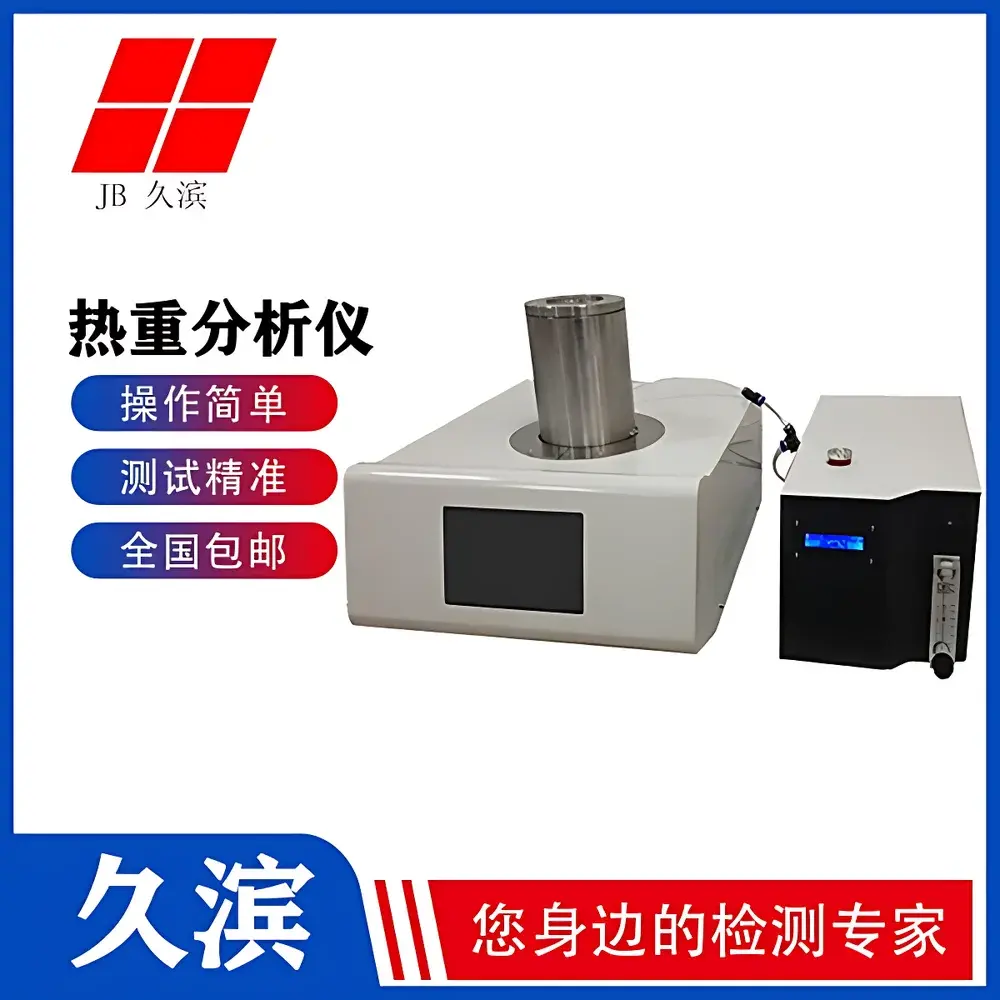
JB-TGA-1450 Thermogravimetric Analyzer
| Brand | Jiubin Instruments |
|---|---|
| Temperature Range | Ambient to 1450 °C |
| Temperature Resolution | 0.1 °C |
| Temperature Stability | ±0.1 °C |
| Heating Rate | 1–80 °C/min |
| Cooling Time | 15 min (from 1000 °C to 100 °C) |
| Balance Capacity | 1 mg–2 g (expandable to 30 g) |
| Mass Sensitivity | 0.01 mg |
| Isothermal Hold Time | 0–300 min |
| Atmosphere Control | Dual-gas manifold with mass flow regulation (inert, oxidative, reductive, static, dynamic) |
| Data Interface | USB |
| Power Supply | AC 220 V, 50 Hz |
| Dimensions (L×W×H) | 489 × 400 × 343 mm |
Overview
The JB-TGA-1450 Thermogravimetric Analyzer is an engineered thermal analysis instrument designed for precise, real-time monitoring of mass change as a function of temperature or time under controlled atmospheric conditions. Based on the fundamental principle of thermogravimetry—where sample mass is continuously measured during programmed thermal cycles—the system enables quantitative assessment of thermal stability, decomposition kinetics, volatilization behavior, oxidation/reduction reactions, moisture loss, and compositional evolution. Its operational range extends from ambient temperature to 1450 °C, making it suitable for high-temperature applications in advanced ceramics, refractory metals, catalysts, and inorganic functional materials. The instrument employs a high-stability microbalance coupled with a precisely regulated furnace and dual-gas atmosphere management system, ensuring reproducible data acquisition across diverse material classes including polymers, elastomers, pharmaceuticals, composites, and metallurgical samples.
Key Features
- High-temperature capability up to 1450 °C with ±0.1 °C temperature stability and 0.1 °C resolution, enabling accurate phase transition and decomposition onset detection.
- Programmable heating, isothermal, and cooling profiles—including ramp rates from 1 to 80 °C/min and customizable hold durations up to 300 minutes.
- Integrated dual-gas manifold with digital mass flow control for seamless switching between inert (N₂, Ar), oxidative (air, O₂), reductive (H₂, CO), static, or dynamic atmospheres.
- High-sensitivity microbalance with 0.01 mg resolution and scalable capacity (standard 1 mg–2 g; optional extension to 30 g) for broad sample mass adaptability.
- Rapid cooling performance: 900 °C reduction in ≤15 minutes (1000 °C → 100 °C), minimizing turnaround time between sequential runs.
- Large-character LCD interface with native Chinese-language support for intuitive local operation; all firmware and calibration parameters stored internally.
- Robust mechanical architecture with thermally shielded balance chamber and optimized furnace geometry to minimize convection-induced mass drift.
Sample Compatibility & Compliance
The JB-TGA-1450 accommodates solid powders, granules, fibers, thin films, and small metallic specimens (typically 1–50 mg, depending on volatility and expected mass loss). Crucible options include platinum, alumina, and quartz—selected based on chemical compatibility and maximum service temperature. The system supports method development aligned with international thermal analysis standards, including ASTM E1131 (standard test method for compositional analysis by TGA), ISO 11358 (plastics — thermogravimetry), and USP (residual solvents). While not pre-certified for 21 CFR Part 11 compliance, its USB-based data export architecture allows integration into validated laboratory information management systems (LIMS) when paired with audit-trail-enabled third-party software. Routine calibration verification follows GLP-aligned procedures using certified reference materials (e.g., NiO for oxidation onset, calcium oxalate monohydrate for multi-step decomposition).
Software & Data Management
The included proprietary TGA software provides automated experiment setup, real-time mass/temperature curve visualization, derivative (DTG) calculation, peak identification, and baseline correction tools. Raw data are saved in ASCII-compatible .txt format for interoperability with MATLAB, OriginLab, or Python-based kinetic modeling packages (e.g., Kinetics Neo, PyKinetic). USB connectivity enables direct transfer to secure network drives or centralized QA databases. Software updates are distributed free-of-charge via encrypted download portal, with version history and release notes traceable for internal validation documentation. Export modules support PDF report generation with embedded metadata (operator ID, timestamp, instrument serial number, calibration status), satisfying basic documentation requirements for ISO/IEC 17025-accredited laboratories.
Applications
- Determination of polymer degradation onset temperature and char yield for flame-retardant formulation screening.
- Quantification of filler content (e.g., CaCO₃, SiO₂) and organic/inorganic ratio in composite matrices.
- Assessment of catalyst thermal stability and active-phase sintering behavior under simulated regeneration conditions.
- Moisture and solvent residue profiling in pharmaceutical intermediates per ICH Q5C guidelines.
- Multi-step decomposition analysis of metal oxalates, carbonates, and hydrates for stoichiometric validation.
- Investigation of oxidation kinetics in high-entropy alloys and refractory carbides.
- Residue ash content measurement in lubricants, coatings, and rubber compounds per ASTM D4294 and ISO 629.
FAQ
What crucible materials are compatible with the JB-TGA-1450 at 1450 °C?
Platinum-rhodium (90/10) and high-purity alumina crucibles are rated for continuous use up to 1450 °C. Quartz is limited to ≤1100 °C and incompatible with alkali-containing samples.
Can the system perform simultaneous TGA-DTA measurements?
No—the JB-TGA-1450 is a dedicated thermogravimetric platform. For simultaneous thermal analysis, a separate DTA or DSC module would be required, though data synchronization via external trigger is technically feasible.
Is calibration traceable to NIST or other national standards?
Factory calibration uses reference materials with traceable certificates; end-users must perform periodic verification using in-house certified standards per their internal SOPs.
Does the software support kinetic analysis (e.g., Flynn-Wall-Ozawa, Kissinger methods)?
Basic DTG peak analysis is included; advanced model-fitting requires export to external kinetic software—no built-in isoconversional or reaction-order solvers are provided.
What maintenance intervals are recommended for optimal long-term stability?
Furnace insulation inspection every 12 months; balance recalibration before each high-precision campaign; gas line filter replacement every 6 months under continuous use.



