
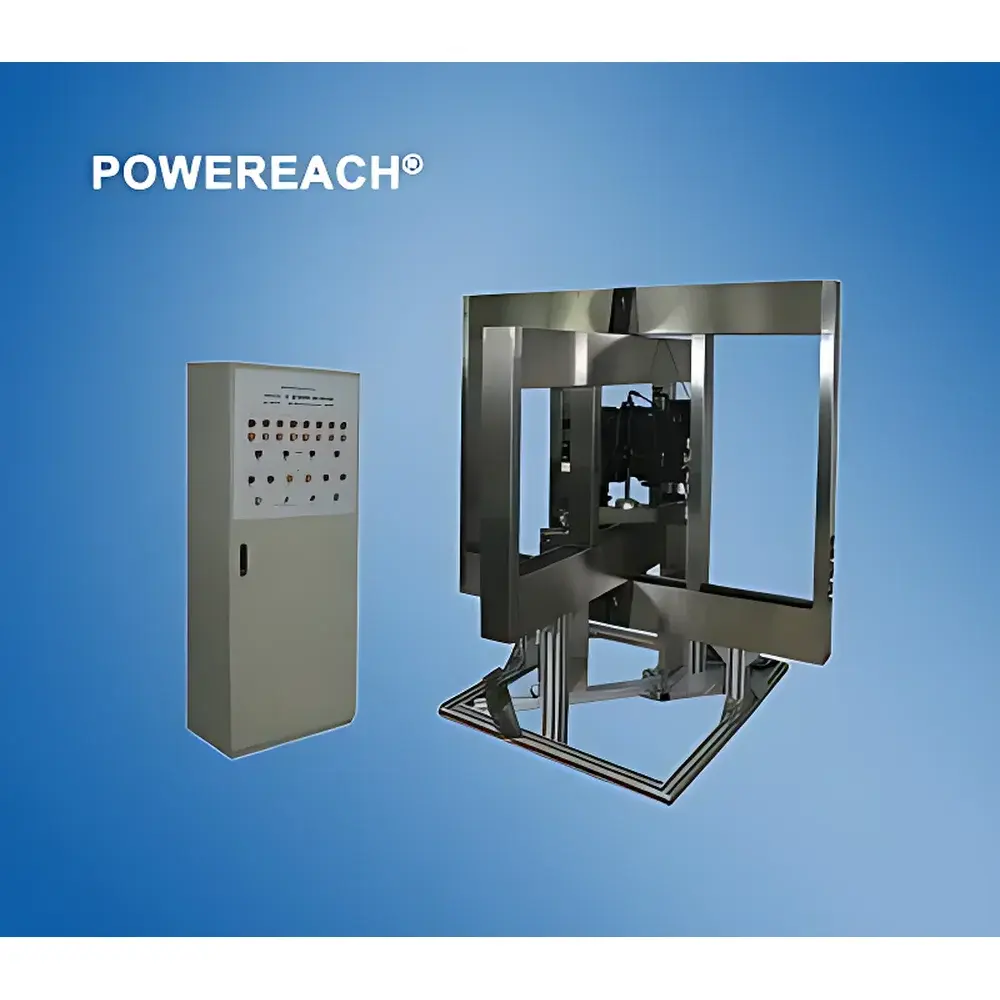
JDS05C 3D Multiaxial Mechanical Testing System for Composite and Fabric Materials
| Origin | Beijing, China |
|---|---|
| Manufacturer Type | Authorized Distributor |
| Origin Category | Domestic (China) |
| Model | JDS05 |
| Quotation | Upon Request |
| Max. Axial Tensile Load | 5000 N |
| Sensor Resolution | 1 N (with overload protection) |
| Uniaxial Extension Range | 300 mm |
| Crosshead Speed | 0.8–2.0 mm/s |
| Extension Resolution | 0.02 mm |
| High-Speed CCD Imaging | 30–200 fps |
| Operating Environment | 8–30 °C, RH < 80% |
| Control PC | Dual-core 2.4 GHz, 1 GB RAM, 120 GB HDD, DVD±RW, 17″ LCD, dedicated GPU, Windows XP |
| Output | HP A4 monochrome laser printer |
Overview
The JDS05C 3D Multiaxial Mechanical Testing System is an engineered platform designed specifically for the quantitative characterization of anisotropic mechanical behavior in textile architectures, nonwovens, thin-film composites, and hybrid laminates under simultaneous multiaxial loading conditions. Unlike conventional uniaxial tensile testers governed by ASTM D5035 or ISO 13934-1, this system implements a tri-directional force application architecture: two orthogonal in-plane tension axes (X and Y) coupled with a perpendicular out-of-plane puncture (Z-axis) mode. Its core measurement principle relies on synchronized load-cell transduction (±1 N resolution), precision electromechanical actuation, and real-time optical deformation mapping—enabling direct correlation between applied stress states and evolving microstructural response. The system is purpose-built for research laboratories and quality control facilities requiring compliance with textile-specific standards including ISO 13936-2 (tear resistance), ASTM D3787 (burst strength), and GB/T 7742.1 (fabric bursting strength), while supporting method development aligned with GLP documentation requirements.
Key Features
- Triaxial mechanical testing capability: independent dual-axis tensile loading (up to 5000 N per axis) combined with vertical puncture testing (up to 2000 N)
- High-fidelity force measurement: calibrated load cells with ±1 N resolution and integrated mechanical overload protection to safeguard sensor integrity during abrupt failure events
- Precise displacement control: uniaxial extension range of 300 mm with 0.02 mm positional resolution, enabling accurate strain quantification for low- and high-elongation materials
- Programmable crosshead velocity: adjustable from 0.8 to 2.0 mm/s to accommodate standard quasi-static protocols (e.g., ISO 13934) as well as accelerated fatigue cycling
- Real-time optical monitoring: dual-mode digital imaging system comprising wide-field overview and localized high-magnification observation, synchronized with a high-speed CCD camera capturing 30–200 frames per second
- Dedicated industrial control workstation: preconfigured with Windows XP SP3, dual-core CPU, discrete graphics processing unit, and integrated data acquisition interface compliant with USB 2.0 and RS-232 protocols
Sample Compatibility & Compliance
The JDS05C accommodates diverse specimen geometries—including single fibers, yarn bundles, woven/knitted fabrics, nonwoven mats, elastomeric membranes, and fiber-reinforced polymer laminates—via interchangeable gripping systems: pneumatic clamps for natural fibers, serrated mechanical jaws for high-modulus synthetics (e.g., aramid, carbon), and custom-designed fixtures for brittle or low-diameter specimens (e.g., nanocellulose films). All test methods adhere to internationally recognized textile testing standards, including but not limited to ISO 9073 (nonwovens), ASTM D5587 (tongue tear), and ISO 13936-1 (grab tensile). Data traceability meets audit-ready requirements under ISO/IEC 17025:2017, with timestamped metadata, operator ID logging, and raw signal export in CSV and ASCII formats suitable for third-party statistical analysis.
Software & Data Management
The proprietary control and analysis software provides intuitive GUI-based test configuration, real-time force–displacement curve visualization, and automated parameter extraction—including initial modulus, yield point, maximum load,断裂 energy (area under curve), elongation at break, and puncture displacement threshold. All test sequences are scriptable and repeatable; calibration certificates are digitally embedded and version-controlled. Raw video streams from the high-speed camera are time-stamped and indexed against load/displacement channels, enabling frame-accurate correlation of macroscopic deformation onset with microstructural events (e.g., yarn slippage, fiber pull-out, matrix cracking). Exported datasets include full metadata headers compliant with FAIR principles (Findable, Accessible, Interoperable, Reusable), facilitating integration into LIMS environments and supporting 21 CFR Part 11-compliant electronic signatures when deployed with validated authentication modules.
Applications
- Characterization of biaxial tensile stiffness and Poisson’s ratio in technical textiles used in airbag fabrics, geotextiles, and medical implants
- Quantitative evaluation of fabric burst resistance under dynamic loading for protective clothing certification (e.g., EN 343, NFPA 1971)
- Failure mechanism analysis of composite reinforcements during forming simulations (e.g., draping-induced shear instability)
- Accelerated fatigue testing of smart textiles incorporating conductive threads or phase-change materials under cyclic multiaxial strain
- Correlation of structural parameters (weave density, crimp angle, fiber orientation distribution) with macroscopic mechanical response via DIC-assisted strain field mapping
- Validation of finite element models for textile composites using experimentally derived constitutive inputs
FAQ
What standards does the JDS05C support for textile mechanical testing?
The system supports method implementation per ISO 13934-1/-2 (tensile), ISO 13936-1/-2 (tear), ASTM D3787 (burst), GB/T 7742.1 (burst), and ASTM D5587 (tongue tear), with customizable protocol templates.
Can the system perform true simultaneous 3D loading, or are axes operated sequentially?
It enables true concurrent biaxial tension + puncture loading via independent servo-controlled actuators, with synchronized data acquisition across all three force channels.
Is Windows XP compatibility a limitation for modern IT infrastructure?
While the base configuration ships with Windows XP for legacy driver stability, the system supports hardware abstraction layer (HAL) migration to Windows 10 IoT Enterprise upon request, with updated DAQ drivers and TLS 1.2–compliant reporting modules.
How is calibration traceability maintained?
Each load cell is supplied with NIST-traceable calibration certificate; annual recalibration services include uncertainty budgeting per ISO/IEC 17025 Annex A.3 and digital certificate archiving.
Does the system support digital image correlation (DIC) analysis?
Yes—the high-speed CCD interface outputs uncompressed AVI streams compatible with commercial DIC packages (e.g., VIC-2D, ARAMIS); optional on-board strain computation module available as add-on.





