
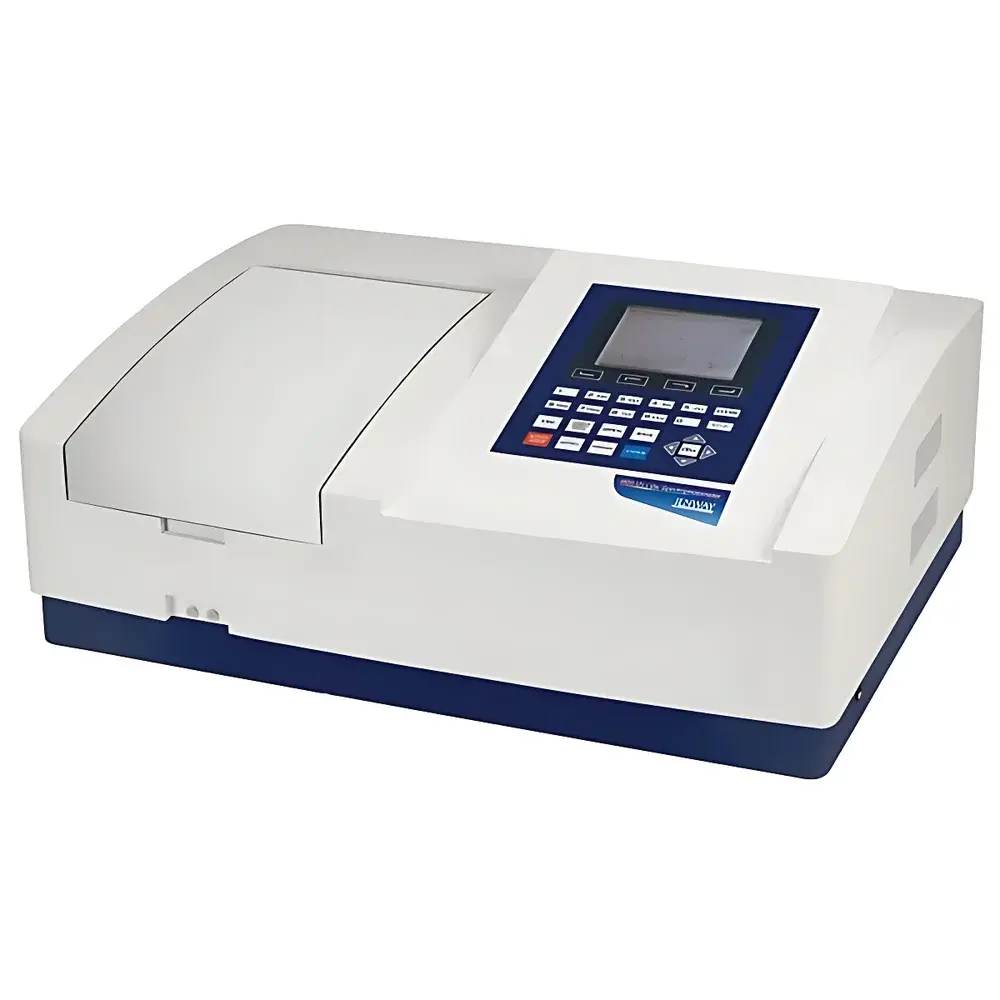
Jenway 6850 Double Beam UV-Vis Spectrophotometer
| Brand | Jenway |
|---|---|
| Origin | United Kingdom |
| Model | 6850 |
| Optical Design | Double Beam |
| Detector Type | Silicon Photodiode |
| Wavelength Range | 190–1100 nm |
| Wavelength Accuracy | ±0.3 nm (at 0.5/1 nm SBW), ±0.5 nm (at 2/4/5 nm SBW) |
| Wavelength Repeatability | ±0.2 nm |
| Spectral Bandwidth | Variable (0.5, 1, 2, 4, 5 nm) |
| Stray Light | <0.05% T at 220 nm and 360 nm |
| Photometric Range | –0.3 to 3.0 A / 0 to 200% T |
| Photometric Accuracy | ±0.002 A (0–0.5 A), ±0.3% T (0–100% T) |
| Photometric Repeatability | ±0.001 A (0–0.5 A), ±0.002 A (0.5–1.0 A), ±0.15% T (0–100% T) |
| Noise | 0.0005 A |
| Baseline Stability | ±0.001 A/h at 500 nm after 15 min warm-up |
| Data Interfaces | USB, Parallel |
| Power Supply | 220/110 V, 50/60 Hz, 120 VA |
| Dimensions (W×D×H) | 600 × 450 × 200 mm |
| Weight | 22 kg |
Overview
The Jenway 6850 Double Beam UV-Vis Spectrophotometer is a precision-engineered analytical instrument designed for high-fidelity absorbance, transmittance, and concentration measurements across the ultraviolet, visible, and near-infrared spectral regions (190–1100 nm). Utilizing a true double-beam optical architecture with two independent silicon photodiode detectors, the 6850 continuously compares sample and reference beam intensities in real time—effectively compensating for lamp drift, electronic fluctuations, and environmental variability. This configuration ensures exceptional baseline stability (<±0.001 A/h), low noise performance (0.0005 A RMS), and high measurement reproducibility—critical for regulated environments including pharmaceutical QC, clinical diagnostics, and academic research laboratories. The system integrates a deuterium arc lamp for UV output and a tungsten-halogen lamp for visible/NIR coverage, with automatic lamp switching between 325–370 nm. Its variable spectral bandwidth (0.5, 1, 2, 4, or 5 nm) enables method-specific resolution tuning—supporting both high-resolution identification (e.g., narrow-band nucleic acid peak discrimination) and high-throughput screening (e.g., broad-band protein assays) without hardware modification.
Key Features
- True double-beam optics with simultaneous dual-detector acquisition for real-time reference correction and enhanced photometric stability
- Variable spectral bandwidth selection (0.5, 1, 2, 4, 5 nm) optimized for application-specific resolution requirements
- High-accuracy wavelength calibration traceable to NIST-traceable standards; certified compliance with European Pharmacopoeia (Ph. Eur.) monographs for spectrophotometric assay validation
- Integrated graphical user interface with intuitive touchscreen navigation and on-board method storage (up to 100 user-defined protocols)
- USB and parallel port connectivity for direct data export, firmware updates, and peripheral integration (e.g., barcode readers, thermal printers)
- Comprehensive preconfigured analysis modes: photometry, concentration, multi-wavelength quantitation (up to 20 wavelengths via PC software), kinetic monitoring (0.1 s–12 h intervals), full-spectrum scanning (100–2000 nm/min), and derivative spectroscopy
- Onboard DNA/RNA and protein analysis modules—including A260/A280, A260/A230 ratio calculation, 260-nm blank correction, and extinction coefficient-based concentration derivation per USP & EP guidelines
Sample Compatibility & Compliance
The 6850 accommodates standard 10 × 10 mm rectangular cuvettes (quartz, glass, or plastic) in fixed-position sample and reference holders. Optional accessories extend compatibility to microvolume platforms (e.g., 1–2 µL capillary cells), flow cells (for HPLC fraction analysis), temperature-controlled holders (±0.1 °C stability), and solid-sample reflectance attachments. All operational parameters—including wavelength calibration, photometric linearity, stray light, and baseline flatness—are validated against ISO 9001–certified manufacturing protocols and meet the instrumental performance criteria defined in Ph. Eur. 2.2.25, USP , and ASTM E275. For regulated laboratories, IQ/OQ documentation packages are available, supporting compliance with FDA 21 CFR Part 11, EU Annex 11, and GLP/GMP audit requirements. The system supports full electronic audit trails when used with Jenway Prism PC software in secure mode.
Software & Data Management
Jenway Prism PC software (v5.x, Windows 2000–Windows 10 compatible) is supplied as standard and serves as the central hub for method development, instrument control, and regulatory-compliant data handling. It provides preloaded, validated templates for nucleic acid purity assessment (A260/A280, A260/A230), Bradford/Lowry/BCA protein assays, enzyme kinetics (Michaelis–Menten fitting), and Beer–Lambert-based quantitation with multi-point calibration (up to 10 standards + blank). Data processing includes peak detection, area-under-curve integration, spectral subtraction, smoothing (Savitzky–Golay), baseline correction, and derivative transformation. Results are stored in encrypted .jws project files with metadata tagging (operator ID, timestamp, instrument serial number, method version). Export options include CSV, PDF, and XML formats—fully compatible with LIMS and ELN systems. Prism supports 21 CFR Part 11-compliant user authentication, electronic signatures, and immutable audit logs when deployed on domain-authenticated workstations.
Applications
The Jenway 6850 delivers robust performance across diverse analytical workflows. In pharmaceutical quality control, it validates raw material identity (UV fingerprinting), assays active pharmaceutical ingredients (APIs) per ICH Q2(R2), and monitors degradation kinetics under stress conditions. In clinical biochemistry, it supports routine assays for total protein, albumin, bilirubin, creatinine, and enzymatic activity (e.g., LDH, ALT) using standardized colorimetric endpoints. Academic and industrial research labs employ its high-resolution scanning capability for characterizing novel dyes, quantum dots, and plasmonic nanoparticles—leveraging its 0.1-nm wavelength increment and low stray light (<0.05% T) for accurate bandgap determination. Its kinetic module enables real-time monitoring of ligand-binding events, polymerization reactions, and cell viability assays (e.g., MTT reduction). The instrument is routinely deployed in food safety testing (nitrate/nitrite quantification), environmental analysis (COD, phosphate), and nanomaterial synthesis QA/QC.
FAQ
Does the 6850 support GLP-compliant data integrity?
Yes—when used with Jenway Prism PC software in secure mode and configured with domain-level user management, it meets ALCOA+ principles and supports full 21 CFR Part 11 compliance, including electronic signatures, role-based access control, and immutable audit trails.
Can I perform nucleic acid quantitation without external calculations?
Yes—the onboard and Prism software modules automatically compute concentration (µg/mL), purity ratios (A260/A280, A260/A230), and A320 turbidity correction per EN ISO 20395 and Thermo Fisher technical bulletins.
What validation documentation is provided?
Standard delivery includes factory calibration certificates for wavelength and photometric accuracy. Optional IQ/OQ qualification kits—complete with test protocols, acceptance criteria, and execution records—are available for GxP-regulated installations.
Is temperature-controlled cuvette handling supported?
Yes—via optional Peltier-based thermostatted cell holders (–10 °C to +110 °C, ±0.1 °C stability), enabling enzyme kinetics, protein denaturation studies, and temperature-dependent binding assays.
How is stray light performance verified during routine use?
Prism software includes automated stray light verification routines per Ph. Eur. 2.2.25, using sodium nitrite (220 nm) and potassium chloride (360 nm) filters. Results are logged with pass/fail status and deviation values.
Related Products






