
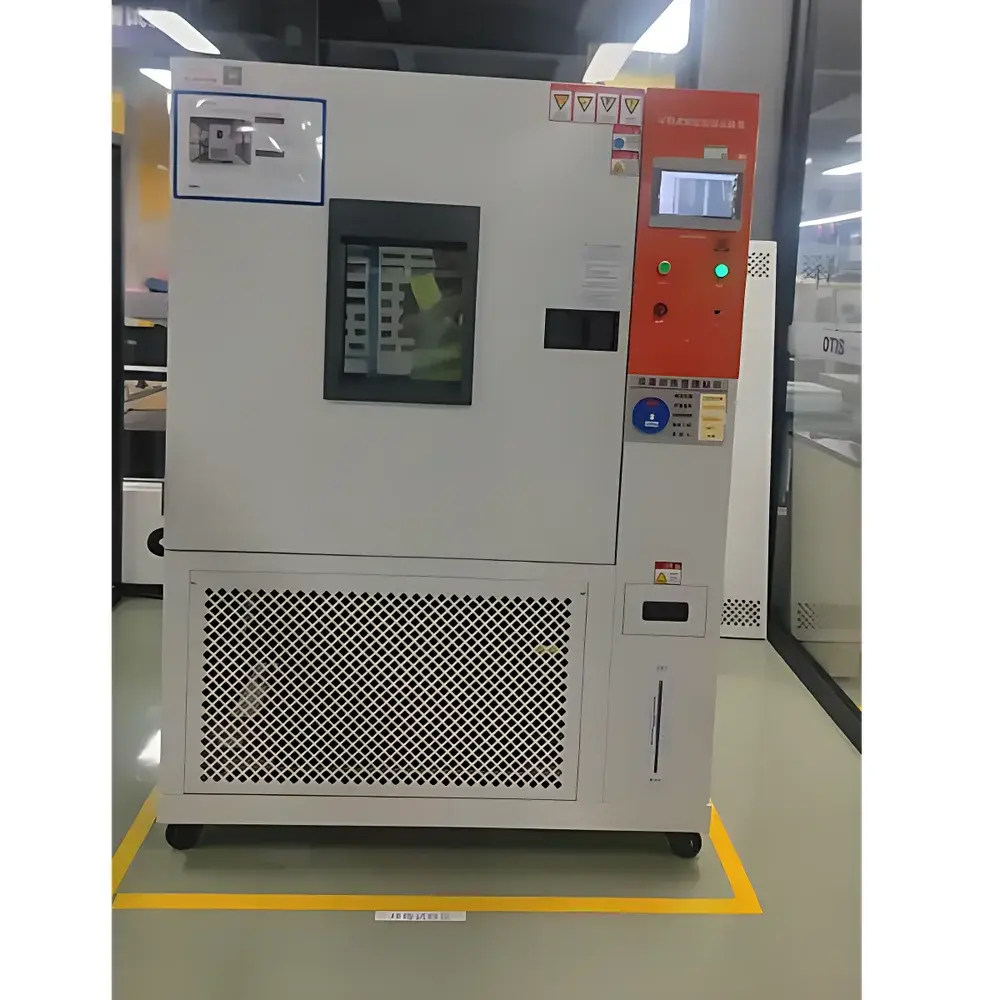
JH-Jianhu Temperature and Humidity Controlled Environmental Test Chamber
| Brand | Jianhu |
|---|---|
| Origin | Shanghai, China |
| Model | JH-Thermal Management Temperature & Humidity Chamber |
| Type | Upright |
| Cooling Method | Air-Cooled |
| Temperature Range | 15–45 °C |
| Humidity Range | 30–98 % RH |
| Temperature Uniformity | ≤±2 °C |
| Temperature Fluctuation | ±1 °C (high-temp), ±2 °C (low-temp) |
| Humidity Uniformity | ≤±3 % RH |
| Humidity Fluctuation | ±3 % RH |
| Heating Rate | 1.0–3.0 °C/min |
| Interior Dimensions | Customizable |
Overview
The JH-Jianhu Temperature and Humidity Controlled Environmental Test Chamber is an upright, air-cooled laboratory-grade environmental test system engineered for precise, repeatable simulation of controlled thermal and hygrometric conditions. Designed in accordance with ISO 16750-4 (road vehicles), IEC 60068-2-1 (cold), IEC 60068-2-2 (dry heat), and IEC 60068-2-78 (damp heat, steady state), this chamber employs dual-loop PID control architecture—separate feedback loops for temperature and relative humidity—to ensure dynamic stability under varying load conditions. Its core measurement principle relies on high-stability platinum resistance thermometers (Pt100 Class A) and capacitive polymer humidity sensors traceable to NIST standards, enabling real-time closed-loop regulation with minimal hysteresis. The chamber’s thermal management system integrates a high-efficiency scroll compressor, finned-tube evaporator, and precision expansion valve, while humidity is regulated via steam humidification and refrigerated dehumidification—eliminating condensation-induced drift and ensuring long-term calibration integrity. It is not intended for sterilization or explosive atmospheres, but rather for non-destructive environmental stress screening, material conditioning, and pre-test stabilization in R&D and QA laboratories.
Key Features
- Upright structural design optimized for floor-space efficiency and ergonomic access to the test chamber interior
- Air-cooled refrigeration system with low-GWP R134a refrigerant, compliant with EU F-Gas Regulation (EU) No 517/2014
- Dual independent PID controllers—one for temperature, one for relative humidity—minimizing cross-coupling effects during ramp-and-soak profiles
- High-resolution 7-inch TFT touchscreen interface with multi-language support (English, German, Japanese, Chinese), password-protected parameter editing, and real-time trend graphing
- Internal chamber constructed from 304 stainless steel with seamless welding and electropolished finish to prevent microbial retention and corrosion
- Insulation layer composed of 100 mm thick polyurethane foam (density ≥40 kg/m³, thermal conductivity ≤0.022 W/m·K) for low heat leakage and energy-efficient operation
- Integrated over-temperature, over-humidity, and sensor-failure safety interlocks meeting IEC 61000-6-2 EMC immunity requirements
Sample Compatibility & Compliance
The chamber accommodates a broad range of non-volatile, non-corrosive samples—including polymer films, PCB assemblies, pharmaceutical packaging, optical lenses, and biological reference standards—within customizable internal dimensions (standard base volume: 150 L; scalable up to 1000 L upon request). All internal airflow patterns are validated per ISO 16750-4 Annex C for uniformity, with horizontal laminar flow distribution ensuring ≤±2 °C and ≤±3 % RH spatial deviation across the working volume. The system complies with GLP (Good Laboratory Practice) documentation requirements and supports audit-ready data logging per FDA 21 CFR Part 11 when paired with optional validated software modules. It meets CE marking requirements under the Low Voltage Directive (2014/35/EU) and Electromagnetic Compatibility Directive (2014/30/EU), and its construction adheres to EN 61000-3-2 harmonic current emission limits.
Software & Data Management
The chamber operates natively with embedded firmware supporting programmable test profiles (up to 99 segments), cycle repetition, and alarm-triggered event logging. Optional PC-based software (JH-LogSuite v3.2) provides full 21 CFR Part 11 compliance: electronic signatures, role-based user permissions, immutable audit trails, and encrypted binary data export in CSV and PDF formats. Raw sensor data—including timestamped Pt100 resistance values and capacitance-derived RH readings—is stored locally on industrial-grade SD card (16 GB, rated for -40 °C to +85 °C) with automatic rollover and CRC-32 error checking. Remote monitoring is supported via Ethernet (TCP/IP) or RS485 Modbus RTU, enabling integration into centralized lab infrastructure management systems (LIMS) without proprietary gateways.
Applications
- Accelerated aging of lithium-ion battery electrolytes under elevated humidity (per UL 1642 Annex B)
- Conditioning of ASTM D618-compliant plastic specimens prior to tensile testing
- Stabilization of reference standards for mass spectrometry and HPLC calibration
- Environmental stress screening (ESS) of automotive ECUs per AEC-Q200 Rev D
- Long-term storage validation of hygroscopic APIs per ICH Q5C guidelines
- Pre-conditioning of optical coatings and photovoltaic encapsulants prior to UV exposure testing (IEC 61215)
FAQ
What is the maximum allowable sample mass for thermal stability during rapid temperature transitions?
Thermal inertia limitations depend on chamber volume and heating/cooling capacity. For standard 225 L units, stable ramp rates (≤2.5 °C/min) are maintained with ≤15 kg of aluminum-equivalent thermal mass. Load-specific validation is recommended for >10 kg non-metallic samples.
Does the chamber support automated calibration verification using external reference probes?
Yes—via the “Calibration Mode” in firmware v2.4+, which allows simultaneous readout of up to three externally connected PT100 probes (IEC 60751 Class A) for as-found/as-left verification against internal sensors.
Is humidity control validated at low temperatures (e.g., 15 °C / 30 % RH)?
Yes—humidity performance is certified across the full operating envelope, including the lower corner point (15 °C / 30 % RH), verified using chilled-mirror hygrometry (Dew-Point Accuracy ±0.2 °C) per ISO 18434-1.
Can the system be integrated into a facility-wide BMS using BACnet MS/TP?
Not natively—BACnet requires optional gateway hardware (JH-BAC-IF1). Standard communication is Modbus RTU or TCP/IP with register mapping provided in the Integration Manual Rev. 4.2.
What maintenance intervals are specified for humidity sensor recalibration?
Capacitive RH sensors require annual field recalibration using saturated salt solutions (LiCl, MgCl₂, K₂SO₄) per ISO 4618. Full chamber performance verification (uniformity, fluctuation) is recommended every 12 months or after 2000 operational hours, whichever occurs first.



