
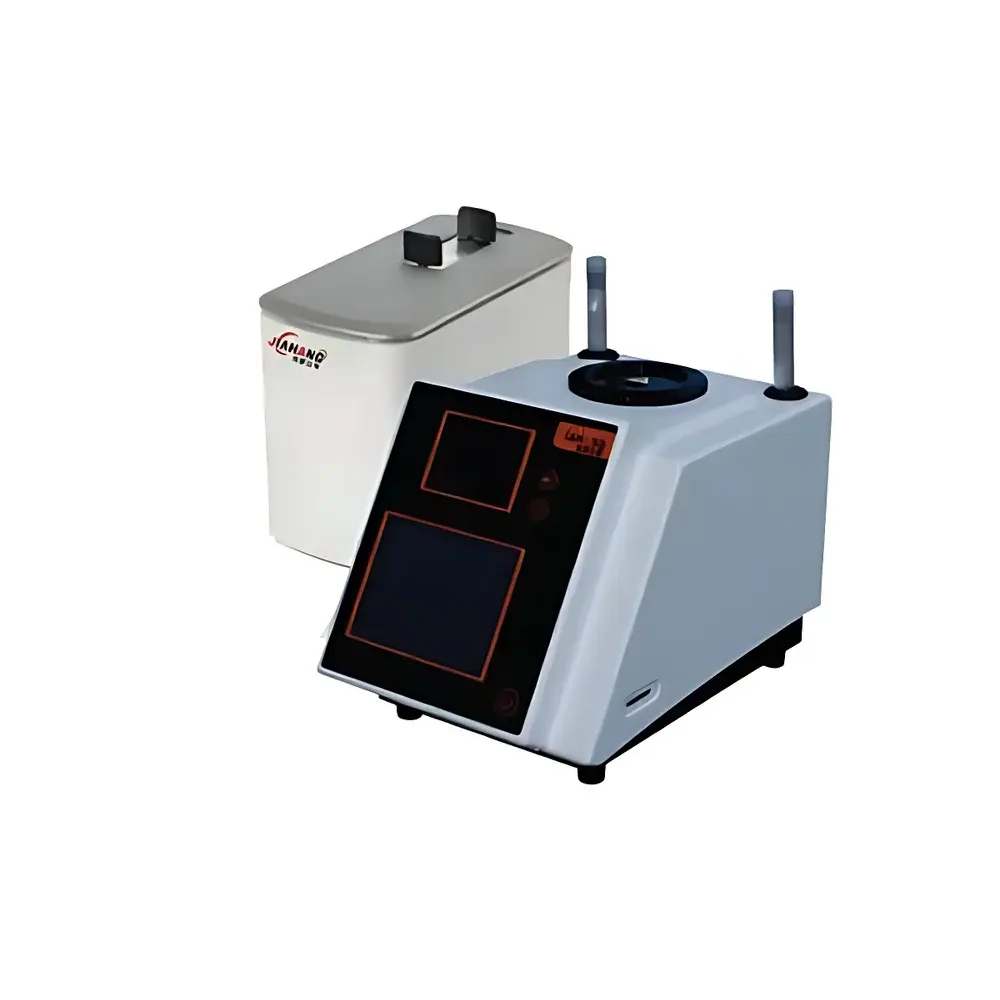
JHD70 Automatic Melting Point Apparatus
| Origin | Shanghai |
|---|---|
| Manufacturer Type | Distributor |
| Origin Category | Domestic (China) |
| Model | JHD70 |
| Price Range | USD 4,200 – 7,000 |
| Temperature Range | Ambient to 400 °C |
| Heating Rate | 0.1–20 °C/min |
| Temperature Accuracy | ±0.1 °C |
| Temperature Resolution | 0.1 °C |
| Sample Capacity | 4 capillaries per run (2 simultaneously analyzed) |
| Display | Dual-color LCD (3.5″ + 5.6″), >2.5× optical magnification |
| User Accounts | 15 |
| Predefined Methods | 100 |
| Data Interfaces | USB, RS232, Ethernet |
| GLP Compliance | Yes |
| Power Supply | 220 V, 50 Hz, 120 W |
| Standards Compliance | ASTM D3204, D3461, D3954, D6090 |
Overview
The JHD70 Automatic Melting Point Apparatus is a dual-function thermal analysis instrument engineered for precise, reproducible determination of both melting point and softening point across a broad spectrum of organic and polymeric materials. Utilizing high-stability Peltier-based heating control and real-time digital video monitoring, the system captures phase transition behavior—such as crystal lattice collapse, viscous flow onset, or sintering deformation—with sub-degree thermal resolution and synchronized visual verification. Unlike conventional capillary-based analog units, the JHD70 integrates automated image analysis algorithms that detect morphological changes (e.g., meniscus formation, shrinkage, sagging, or droplet detachment) without operator intervention, ensuring objective endpoint identification aligned with pharmacopeial and industrial test protocols.
Key Features
- Real-time high-definition video capture (1080p) with >2.5× optical magnification, enabling full visualization of sample morphology evolution during thermal ramping
- Dual-sample simultaneous analysis capability (2 capillaries per batch), with up to 4 samples loaded and queued for sequential measurement—reducing throughput time while maintaining inter-run consistency
- Precise temperature control architecture delivering ±0.1 °C accuracy across the full 0–400 °C operating range and programmable heating rates from 0.1 to 20 °C/min
- 100 preconfigured test methods compliant with ASTM, ISO, DIN, and European Pharmacopoeia standards—including dedicated protocols for pharmaceutical APIs, bituminous binders, thermoplastics, waxes, and resin systems
- GLP-compliant data management: electronic signatures, audit trail logging, user role-based access (15 accounts), and tamper-proof method locking
- Triple-interface connectivity (USB, RS232, Ethernet) supporting LIMS integration, remote calibration validation, and centralized instrument fleet monitoring
Sample Compatibility & Compliance
The JHD70 accommodates standard 1.0 mm OD × 100 mm length glass capillaries and supports direct loading of powdered, crystalline, granular, or semi-solid specimens without pretreatment. Its thermal platform design ensures uniform heat distribution and minimal thermal lag, critical for accurate detection of narrow-melting-range compounds (e.g., active pharmaceutical ingredients per USP ). The instrument meets regulatory requirements for analytical instrumentation used in GMP environments: full compliance with 21 CFR Part 11 (electronic records/signatures), Annex 11 (computerized systems), and ISO/IEC 17025 documentation traceability. Validation packages—including IQ/OQ/PQ templates and metrological traceability certificates to NIM (National Institute of Metrology, China)—are available upon request.
Software & Data Management
The embedded firmware and optional PC software provide full lifecycle data governance. Each test generates a timestamped report containing raw thermal curve data (temperature vs. time), annotated video frames at key transition points, derivative dT/dt plots for inflection detection, and pass/fail flags against user-defined specification limits. All data are stored in encrypted SQLite databases with automatic backup to external media or network drives. Audit trails record every parameter modification, method selection, result override, or user login event—retained for ≥36 months per GLP retention policies. Export formats include PDF (signed), CSV (for statistical process control), and XML (for enterprise ERP/LIMS ingestion).
Applications
The JHD70 serves as a primary qualification tool in quality control laboratories across multiple regulated sectors. In pharmaceutical development, it verifies polymorphic stability and excipient compatibility during formulation screening. In polymer science, it characterizes thermal transitions of polyolefins, polyesters, and engineering resins—supporting ISO 306 (Vicat) and ASTM D1525 correlation studies. Industrial users apply it to assess thermal integrity of asphalt binders (ASTM D36/D3461), wax blends in cosmetics, rosin derivatives in adhesives, and curing profiles of epoxy prepolymers. Its dual-detection logic also enables softening point evaluation of food-grade gums, edible fats, and encapsulation matrices under ISO 4625-2 conditions.
FAQ
Does the JHD70 support method validation per ICH Q2(R2)?
Yes—the system provides full traceability of calibration standards (NIST-traceable reference materials), repeatability testing reports, and linearity assessment tools required for analytical procedure validation.
Can video recordings be exported for regulatory submission?
Yes—individual frame sequences or time-stamped MP4 clips (H.264 encoded) can be exported with embedded metadata (operator ID, method name, instrument serial number, and calibration status).
Is third-party calibration certification included?
Factory calibration is performed using certified reference substances (e.g., indium, tin, zinc) with uncertainty budgets reported per ISO/IEC 17025; accredited on-site calibration services are available through authorized partners.
How does the JHD70 handle samples with low thermal conductivity or irregular morphology?
The instrument employs adaptive image thresholding and multi-region edge detection to identify transition endpoints even in opaque, fibrous, or agglomerated samples—validated against manual observer consensus per ISO 13322-2 guidelines.
What cybersecurity measures are implemented for network-connected operation?
Firmware includes TLS 1.2 encryption for web interface access, configurable firewall rules via Ethernet port, and disabled default credentials—aligned with IEC 62443-3-3 Level 1 requirements for laboratory devices.



