
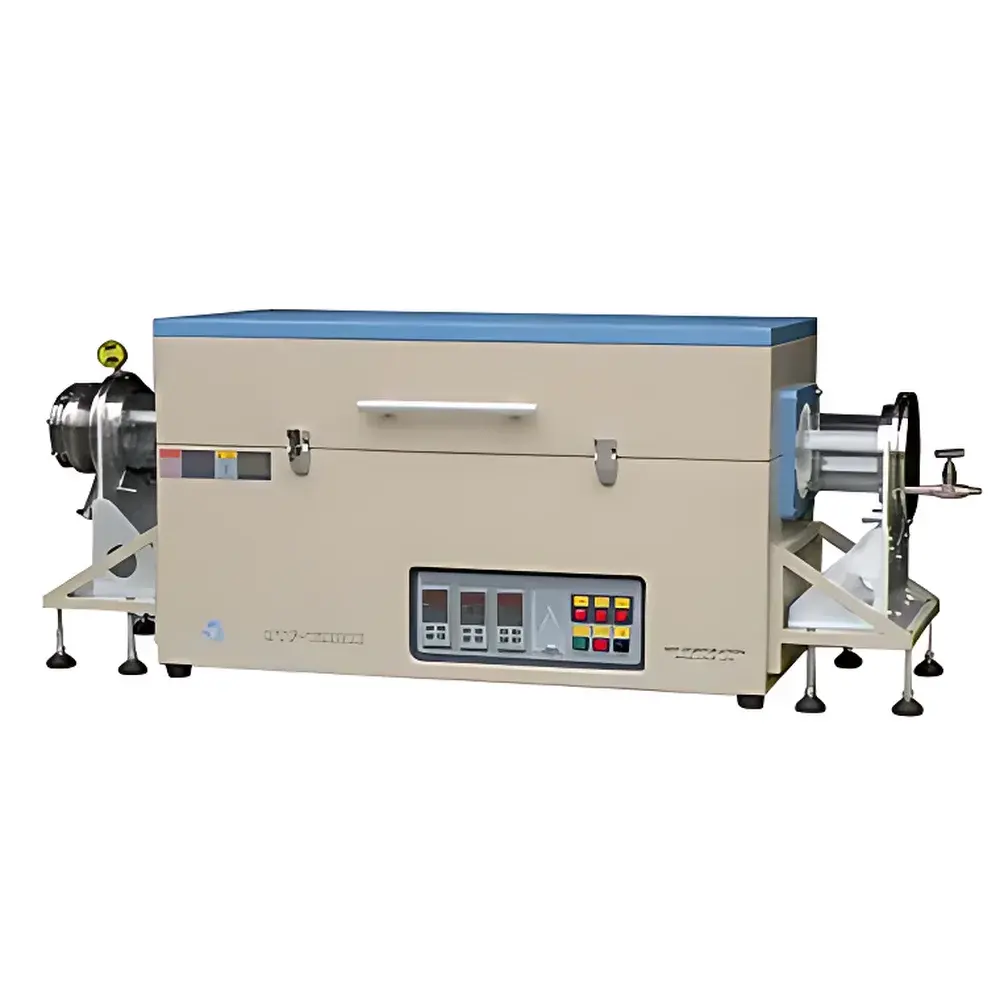
KJ GROUP OTF-1200X-III-D5-4 Dual-Tube Triple-Zone High-Temperature Tube Furnace for Graphene CVD Synthesis
| Brand | KJ GROUP |
|---|---|
| Origin | Liaoning, China |
| Manufacturer Type | Authorized Distributor |
| Country of Origin | China |
| Model | OTF-1200X-III-D5-4 (Graphene CVD Application) |
| Power Supply | AC 220 V, 50/60 Hz, 7 kW (40 A circuit breaker required) |
| Quartz Tube Dimensions | Outer tube Ø130 × 1480 mm (ID Ø122 mm) |
| Heating Zones | Three independent zones (Zone I: 229 mm |
| Zone II | 457 mm |
| Zone III | 229 mm) |
| Total heated length | 900 mm |
| Uniform Temperature Zone | 625 mm (when all zones set identically) |
| Max Operating Temperature | 1200 °C (continuous) |
| Max Ramp Rate | 20 °C/min |
| Temperature Control Accuracy | ±1 °C |
| Chamber Atmosphere | Argon ≥99.99% purity (6 mm double ferrule fitting provided) |
| Cooling | Integrated recirculating chiller (deionized/purified water) |
| Compliance | CE certified |
| Dimensions (W×D×H) | 1030 × 430 × 580 mm |
| Net Weight | 90 kg |
Overview
The KJ GROUP OTF-1200X-III-D5-4 is a precision-engineered dual-tube triple-zone tube furnace designed specifically for controlled chemical vapor deposition (CVD) synthesis of two-dimensional materials—most notably monolayer and few-layer graphene on catalytic metal foils (e.g., Cu or Ni). Its architecture implements a concentric dual-quartz configuration: the sample substrate is mounted on the inner tube, while reactive precursor gases flow in the annular gap between outer and inner tubes. This geometry enables precise spatial separation of gas-phase reaction zones and substrate thermal environments—critical for achieving uniform nucleation density, layer continuity, and defect minimization in graphene films. The furnace supports full thermal profiling across three independently controlled heating zones, allowing gradient temperature programming essential for staged CVD processes such as annealing, carbon decomposition, and controlled cooling. With a maximum continuous operating temperature of 1200 °C and ±1 °C PID stability, it meets the stringent thermal requirements of high-fidelity CVD protocols aligned with ASTM E2913 (Standard Guide for CVD Process Characterization) and ISO/IEC 17025-compliant lab environments.
Key Features
- Dual-quartz tube system: Outer tube (Ø130 mm, 1480 mm L) and inner tube (Ø102 mm, 1540 mm L) configured to isolate substrate heating from gas delivery—enabling independent optimization of surface kinetics and gas residence time.
- Triple-zone PID control: Three programmable controllers support up to 30-segment ramp-hold thermal profiles, facilitating multi-stage CVD sequences (e.g., pre-anneal at 1000 °C, growth at 1050 °C, post-growth quench).
- High-emissivity alumina-coated furnace chamber: Internally coated with imported high-purity Al₂O₃ refractory layer to enhance radiative heat transfer efficiency and suppress thermal degradation of insulation over extended operation.
- Optimized gas routing interface: Vacuum-rated CF-style flanges with integrated dual-path gas inlets—allowing simultaneous introduction of Ar carrier gas into the annulus and rapid N₂/Ar purge through the inner tube for substrate quenching (cooling rates >50 °C/s achievable).
- Integrated recirculating chiller: Pre-installed closed-loop water cooling unit compatible with deionized or purified water—eliminates dependency on facility water lines and ensures stable thermal management during high-power operation.
- CE-certified electrical architecture: Compliant with EN 61000-6-3 (EMC emission) and EN 61000-6-2 (immunity), with reinforced grounding, 40 A dedicated circuit protection, and fail-safe overtemperature cutoff.
Sample Compatibility & Compliance
The OTF-1200X-III-D5-4 accommodates standard 25–100 mm wide metal foils (Cu, Ni, Pt) mounted directly onto the inner quartz tube via ceramic clips or custom holders. Its design supports both horizontal and slight tilt orientations to promote laminar gas flow across the substrate. The furnace satisfies key regulatory prerequisites for academic and industrial R&D labs: it operates within ambient conditions specified by ISO 14644-1 Class 8 cleanroom-compatible environments (25 ±15 °C, 55 ±10% RH, ≤1000 m altitude); its argon purging protocol aligns with USP analytical instrument qualification for inert-atmosphere systems; and its thermal reproducibility supports GLP-compliant process documentation when paired with validated data logging hardware.
Software & Data Management
Temperature programs are configured locally via the front-panel 7-inch TFT touchscreen interface with real-time graphing and event-triggered alarms. Optional RS485/Modbus RTU output enables integration with LabVIEW™, MATLAB®, or SCADA platforms for automated run logging, remote monitoring, and audit-trail generation per FDA 21 CFR Part 11 requirements (when used with compliant third-party software and electronic signature modules). All thermal profiles—including actual vs. setpoint deviation logs—are exportable as CSV files for traceability and statistical process control (SPC) analysis.
Applications
- CVD synthesis of graphene, h-BN, MoS₂, and other 2D transition metal dichalcogenides (TMDs) on polycrystalline metal substrates.
- Thermal annealing and reduction of transparent conductive oxides (TCOs) for photovoltaic electrode fabrication (e.g., ITO, FTO, AZO).
- Controlled pyrolysis of polymer precursors for carbon nanomaterials (e.g., carbon nanotubes, porous carbon films).
- Post-deposition thermal treatment of thin-film batteries (LiCoO₂, NMC cathodes) and solid-state electrolytes (LLZO, LATP).
- Fundamental studies of surface diffusion, carbon segregation, and interfacial reaction kinetics under ultra-high-purity inert atmospheres.
FAQ
What vacuum level is achievable with the standard configuration?
The furnace includes a KF-40 vacuum flange and is compatible with turbomolecular pumps; base pressure of ≤5×10⁻³ mbar is attainable using a 12 m³/h dry scroll pump (not included).
Can the inner tube be replaced with a ceramic or silicon carbide tube?
Yes—custom inner tubes (e.g., SiC or high-purity alumina) can be installed upon request; dimensional compatibility must be verified prior to ordering.
Is the chiller’s cooling capacity sufficient for sustained 1200 °C operation?
The integrated chiller maintains ≤35 °C coolant outlet temperature at full 7 kW load, ensuring thermal stability of the furnace shell and flange seals during continuous high-temperature runs.
Does the system support automated gas switching between multiple precursors?
Not natively—but optional MFC-based gas distribution manifolds (e.g., 4-channel mass flow controller module with PLC interface) are available as an add-on for sequential or mixed-gas delivery.
Are calibration certificates provided with shipment?
A factory-as-tested temperature uniformity report (per zone) and thermocouple calibration certificate (NIST-traceable Type S) are included with each unit.



