
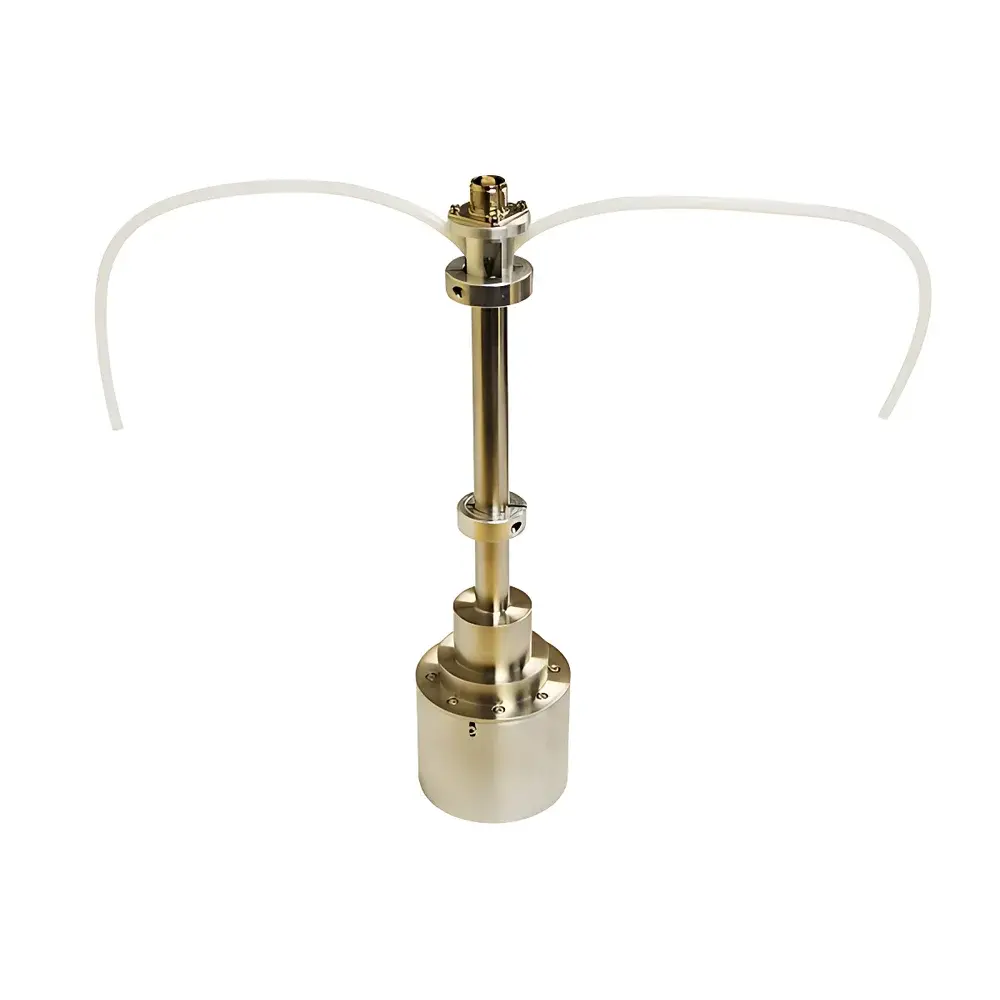
KJ GROUP HVMSS-SPC-2 2-Inch High-Vacuum Magnetron Sputtering Head
| Brand | KJ GROUP |
|---|---|
| Origin | Liaoning, China |
| Manufacturer Type | Authorized Distributor |
| Product Origin | Domestic (China) |
| Model | HVMSS-SPC-2 |
| Pricing | Upon Request |
| Anode Shield Diameter | 3.5" |
| Target Diameter | 2" (50.8 mm) |
| Max Non-Magnetic Target Thickness | 6.35 mm (1/4") |
| Max Magnetic Target Thickness | 1.59 mm (1/16") |
| Magnet Type | NdFeB Rare-Earth Permanent Magnets |
| Target Utilization | ~30% |
| Max DC Power | 1000 W |
| Max RF Power | 500 W |
| Max Sputtering Current | 3 A |
| Operating Voltage Range | 100–1000 V |
| Chamber Base Pressure Range | 5–100 mtorr |
| Cooling | 6.35 mm OD Tubing, 0.8 GPM Flow Rate, Inlet Temp <20 °C |
Overview
The KJ GROUP HVMSS-SPC-2 is a precision-engineered 2-inch high-vacuum magnetron sputtering head designed for laboratory-scale thin-film deposition systems. It operates on the principle of magnetron sputtering—where a plasma is confined near the target surface by a closed-loop magnetic field, enhancing ionization efficiency and enabling stable, low-pressure operation (5–100 mtorr). The head integrates a ring-shaped NdFeB permanent magnet assembly optimized via finite-element electromagnetic simulation to deliver high magnetic flux density (>1.2 kG at target surface) and uniform field distribution—critical for consistent plasma confinement and improved film uniformity across substrates up to 4 inches in diameter. Constructed from vacuum-compatible 304 stainless steel and high-purity alumina ceramics, the HVMSS-SPC-2 meets ISO 10110 optical surface finish standards for internal components and complies with ASTM F2784-21 for vacuum flange interface integrity. Its modular design supports integration into both custom-built and commercial UHV systems rated to ≤1×10⁻⁷ Torr base pressure.
Key Features
- Vacuum-rated construction using electropolished 304 stainless steel and hermetically sealed ceramic insulators for long-term outgassing stability and compatibility with aggressive process chemistries (e.g., O₂, N₂, Ar/O₂ mixtures).
- Finite-element-optimized NdFeB magnet array with passivated nickel-copper coating to resist corrosion from deionized water coolant (inlet temperature <20 °C, flow rate ≥0.8 GPM), extending operational lifetime beyond 10,000 hours under continuous use.
- Standard HN-type RF/DC feedthrough interface compliant with IEEE Std 202-2020, supporting direct coupling to commercial RF generators (13.56 MHz) and DC power supplies without impedance-matching network modification.
- Tool-less target mounting mechanism with kinematic alignment pins ensures repeatable target positioning; no recalibration or height adjustment required during target replacement.
- Anode shield with 3.5-inch outer diameter provides defined plasma boundary control, minimizing arcing and secondary electron emission—improving process reproducibility and reducing particulate generation.
- Integrated water-cooling channel geometry validated per ASME B31.9 for low-pressure liquid cooling circuits, accommodating standard 1/4″ OD tubing with Swagelok®-compatible compression fittings.
Sample Compatibility & Compliance
The HVMSS-SPC-2 accommodates conductive (e.g., Al, Ti, Cu, Cr), semi-conductive (e.g., ITO, ZnO), and insulating targets (e.g., SiO₂, Al₂O₃, Ta₂O₅) when paired with RF excitation. Magnetic targets—including Fe, Ni, Co, and their alloys—are supported within thickness constraints (≤1.59 mm) to maintain effective magnetic circuit closure. All wetted surfaces conform to USP Class VI biocompatibility requirements for materials in contact with ultrapure water. The unit satisfies mechanical interface specifications outlined in ISO-KF 40 (DN40) and CF-35 flange standards, ensuring seamless integration with common vacuum chambers. Documentation includes full RoHS 2011/65/EU and REACH SVHC compliance reports.
Software & Data Management
While the HVMSS-SPC-2 is a hardware-only component, it is fully interoperable with industry-standard vacuum system controllers (e.g., MKS 974A, Pfeiffer TPG300) and power supply communication protocols (RS-485 Modbus RTU, Ethernet/IP). When integrated into GLP/GMP environments, its operational parameters—including voltage, current, pressure, and coolant flow—can be logged with timestamped audit trails compliant with FDA 21 CFR Part 11 requirements using third-party SCADA platforms such as Ignition SCADA or LabVIEW-based DAQ systems. Optional digital I/O expansion modules support interlock signaling for chamber safety interlocks and emergency shutdown sequencing.
Applications
This sputtering head is routinely deployed in academic and industrial R&D settings for fabricating functional thin films including: transparent conducting oxides for flexible electronics; hard wear-resistant coatings (TiN, CrN) on MEMS devices; magnetic tunnel junctions (CoFeB/MgO/CoFeB) for spintronic prototypes; and dielectric barrier layers in multilayer photonic structures. Its stable low-power operation (<1000 W DC / 200 deposition cycles in accordance with ISO 9001:2015 internal calibration procedures.
FAQ
Can the HVMSS-SPC-2 be used with pulsed DC power supplies?
Yes—it supports bipolar and unipolar pulsed DC waveforms up to 300 kHz repetition rate and 50% duty cycle, provided the power supply features active arc suppression and fast current-limiting response (<1 µs).
Is the anode shield removable for cleaning or replacement?
Yes—the anode shield is secured with four M4 stainless steel screws and can be removed without disassembling the magnet assembly or breaking vacuum.
What vacuum flange types are compatible with the standard mounting interface?
The unit ships with a CF-35 (Conflat) flange; optional KF-40 (ISO-KF) and ISO-LF 63 adapters are available upon request.
Does KJ GROUP provide target bonding services for this sputtering head?
Yes—indium, eutectic solder, and epoxy-based target bonding services are offered with certified thermal cycling validation (−40 °C to +150 °C, 50 cycles) and shear strength testing per ASTM D1002.
Is there documentation available for vacuum bake-out procedures?
Yes—a detailed bake-out protocol (including ramp rates, hold times, and residual gas analysis thresholds) is included in the Installation & Maintenance Manual (Rev. 3.2, 2024).



