
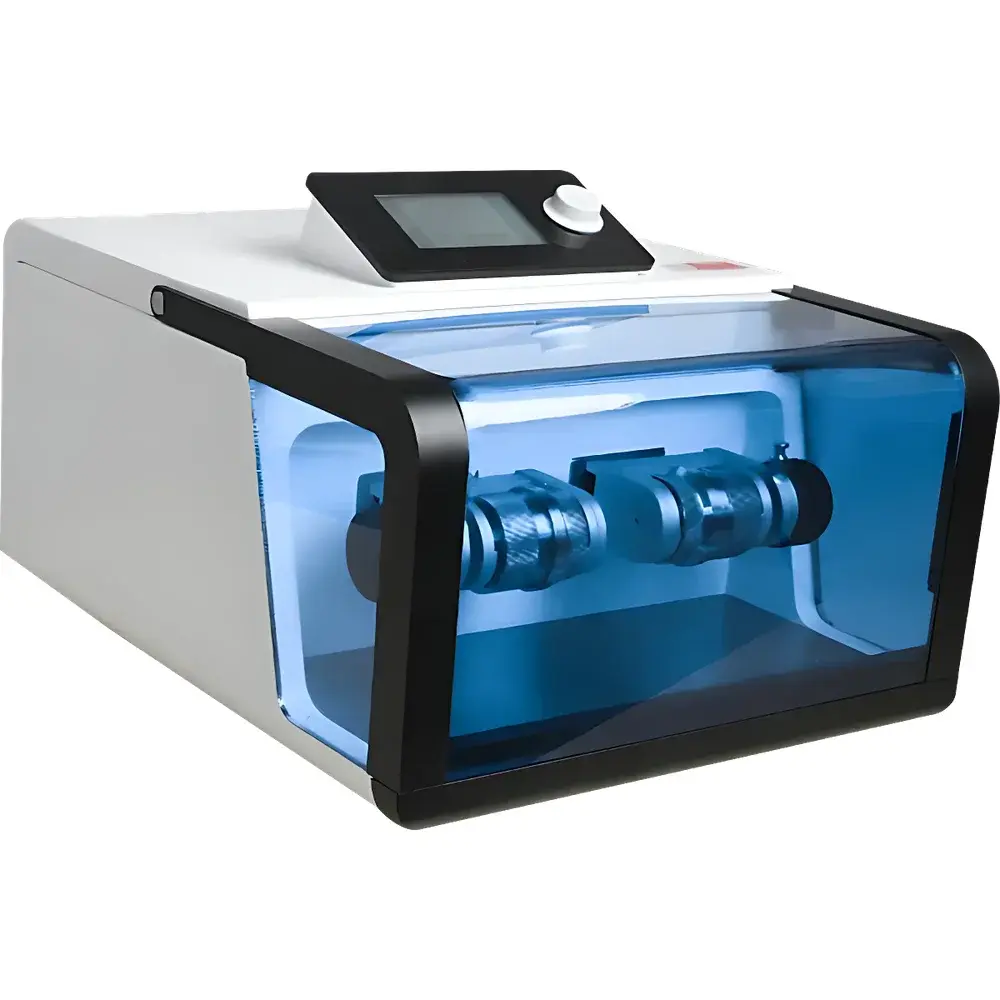
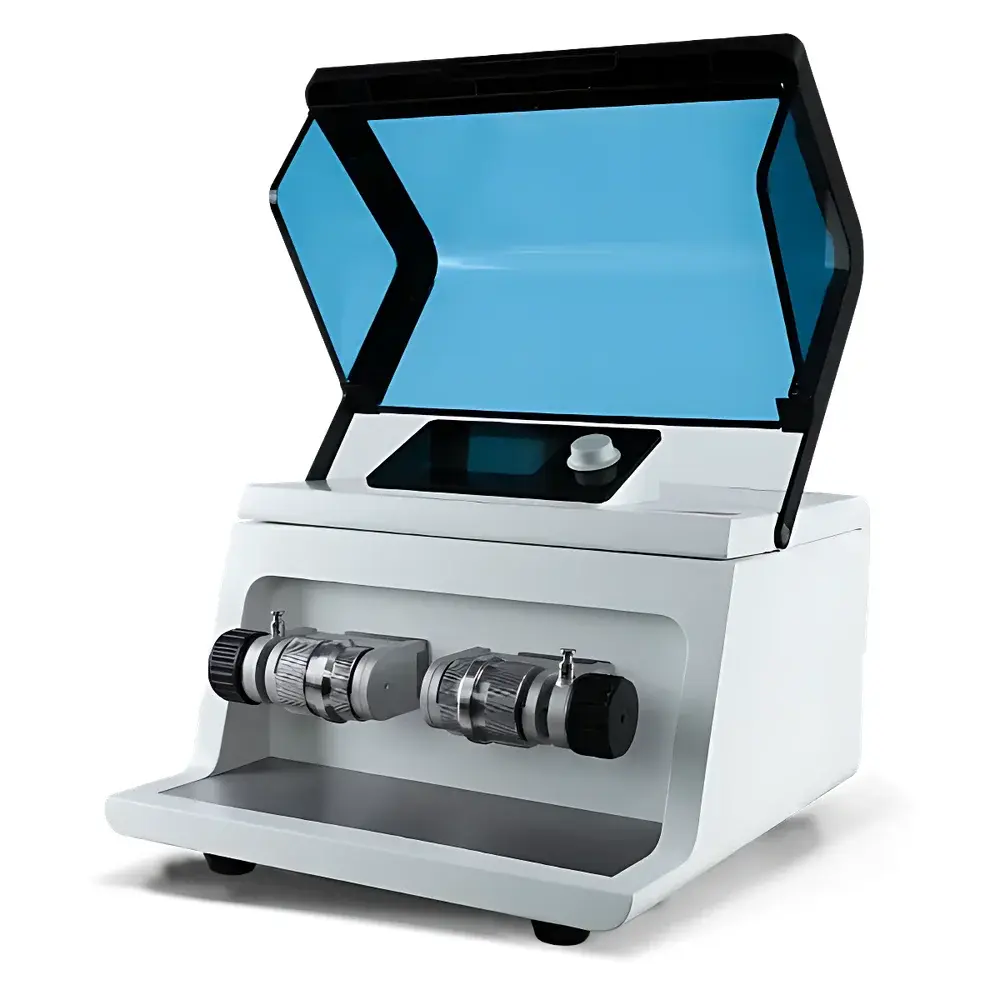
JHT IM600 High-Energy Multifunctional Ball Mill
| Brand | JHT |
|---|---|
| Origin | Shanghai, China |
| Model | IM600 |
| Instrument Type | High-Energy Vibratory Ball Mill |
| Sample Compatibility | Hard, brittle, fibrous, biological, and temperature-sensitive materials |
| Max. Feed Size | < 10 mm |
| Final Particle Size | ≤ 5 µm |
| Batch Capacity | 2 × 30 mL (grinding jars) or 8 × 50 mL (conical centrifuge tubes) |
| Operating Speed | Up to 2100 rpm |
| Oscillation Mode | Horizontal reciprocating motion |
| Cooling Options | Integrated air-cooling fan |
| Grinding Modes | Dry, wet, and cryogenic grinding |
| Programmability | 99 user-defined protocols |
| Data Export | USB & RJ45 interfaces |
| Compliance | Designed for GLP-compliant workflows |
Overview
The JHT IM600 High-Energy Multifunctional Ball Mill is an engineered vibratory mill designed for reproducible, high-intensity mechanical activation of solid-state materials under controlled laboratory conditions. It operates on the principle of horizontal reciprocating oscillation—where grinding jars undergo rapid back-and-forth motion at frequencies up to 2100 rpm—transferring kinetic energy via inertial impact from grinding media (e.g., stainless steel, zirconia, or tungsten carbide balls) to the sample. This mechanism enables efficient particle size reduction, homogenization, cell lysis, and mechanochemical synthesis without solvent mediation. Unlike planetary ball mills, the IM600’s linear oscillation path delivers direct, unidirectional impact forces ideal for sensitive biological matrices and thermally labile compounds. Its architecture supports extended operation (up to 99 hours), precise parameter control, and compatibility with in situ analytical techniques—making it a core platform for materials science, pharmaceutical development, environmental analysis, and synthetic chemistry laboratories.
Key Features
- Three operational modes: dry grinding, wet grinding, and cryogenic grinding—enabling broad sample adaptability including heat-sensitive, hydrated, or volatile substances.
- Programmable control interface with touchscreen and rotary knob; supports 99 independent protocols and 80 cascaded cycle sequences for complex multi-step mechanochemical workflows.
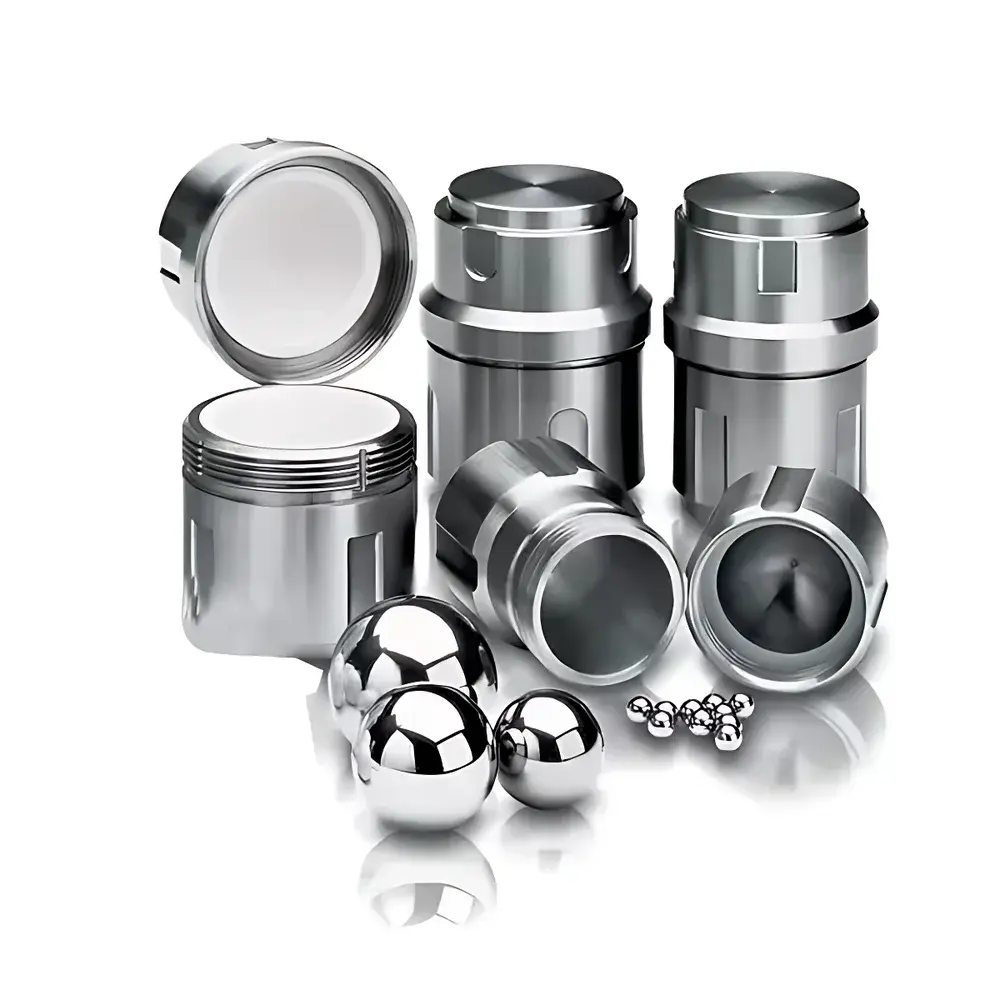
- Dual-position grinding station accommodating either two 30 mL grinding jars or eight 50 mL conical centrifuge tubes (Falcon-style), with optional adapters for 24 × 2 mL, 9 × 5 mL, 4 × 30 mL, or 96 × 0.2 mL formats.
- Integrated air-cooling system maintains motor thermal stability during prolonged operation—critical for maintaining consistent rotational performance over multi-hour runs.
- Cryogenic grinding capability via liquid nitrogen pre-cooling of stainless-steel jars; compatible with certified PPE (goggles, tongs) and insulated containers for safe low-temperature processing.
- Calibration-enabled time and speed parameters ensure inter-laboratory reproducibility—essential for method validation and regulatory submissions.
- Transparent PMMA grinding jars enable real-time Raman spectroscopic monitoring during milling, facilitating mechanistic studies of phase transitions, reaction intermediates, and crystallinity evolution.
Sample Compatibility & Compliance
The IM600 processes diverse material classes—including alloys, ceramics, minerals, polymers, plant tissues (e.g., cannabis flowers), animal bone, soil, sludge, pharmaceutical tablets, and microbial cells—without cross-contamination when using chemically inert jar materials (zirconia, PTFE, agate). For biological applications, glass beads in centrifuge tubes achieve efficient lysis of yeast, bacteria, and microalgae for nucleic acid and protein extraction. The instrument meets foundational design criteria for Good Laboratory Practice (GLP) environments: traceable parameter logging, secure data export (PDF), and hardware-level speed/time calibration. When paired with validated third-party software, it supports electronic signatures and audit trails compliant with FDA 21 CFR Part 11 and ISO/IEC 17025 documentation standards.
Software & Data Management
Data acquisition and protocol management are handled via embedded firmware with dual connectivity options: USB 2.0 for local file transfer and RJ45 Ethernet for networked lab integration. All executed protocols—including speed profiles, duration, pause intervals, and cycle counts—are timestamped and stored internally. Reports export automatically as encrypted PDF files containing operator ID, date/time stamps, raw parameter settings, and system diagnostics. Optional software modules support CSV-based batch reporting, trend analysis across repeated experiments, and integration with LIMS platforms via standardized API endpoints. No cloud storage or remote telemetry is enabled by default—ensuring full data sovereignty per institutional IT policies.
Applications
- Mechanochemistry: Solvent-free synthesis of metal–organic frameworks (MOFs), co-crystals, and catalytic precursors; scalable reaction screening under inert or controlled-atmosphere conditions.
- Materials Science: Amorphization of crystalline APIs, grain refinement of metallic powders, and defect engineering in 2D materials.
- Life Sciences: High-yield disruption of Gram-positive bacteria, fungal spores, and fibrous plant tissues; preparation of subcellular fractions for proteomics and metabolomics.
- Environmental & Geochemical Analysis: Homogenization of heterogeneous soils, sediments, and fly ash prior to XRF, ICP-MS, or leaching assays.
- In Situ Spectroscopy: Real-time Raman monitoring through PMMA jars to track reaction kinetics, polymorphic transformations, and intermediate formation during milling.
FAQ
What is the maximum continuous operating time?
The IM600 supports uninterrupted operation for up to 99 hours—suitable for long-duration mechanochemical syntheses and aging studies.
Can the instrument perform grinding under inert atmosphere?
Yes—stainless-steel and PTFE jars can be sealed and purged with argon or nitrogen prior to milling, enabling oxygen- and moisture-sensitive reactions.
Is calibration traceable to national standards?
Speed and timer calibration functions are user-accessible and repeatable; external verification using NIST-traceable tachometers and stopwatches is recommended for ISO 17025 accreditation.
How does cryogenic grinding improve RNA integrity?
Rapid liquid nitrogen pre-cooling embrittles cellular structures while suppressing RNase activity—preserving transcriptome fidelity during tissue homogenization.
Are grinding jars autoclavable?
Stainless-steel, zirconia, and PTFE jars are autoclavable (121°C, 20 min); PMMA jars are not heat-sterilizable but tolerate ethanol and UV decontamination.



