
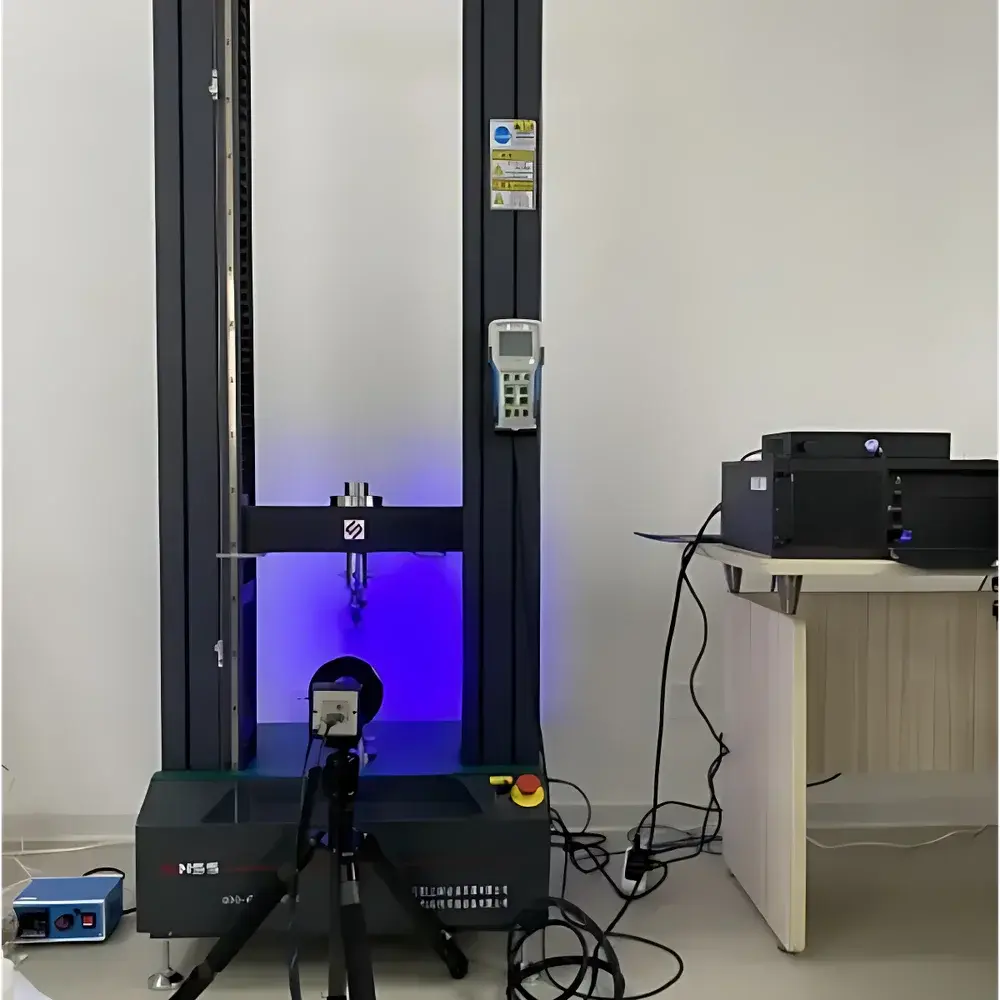
Jianhu DV-UTM Series Electronic Universal Testing Machine for Electronics Industry
| Brand | Jianhu |
|---|---|
| Origin | Shanghai, China |
| Manufacturer Type | Authorized Distributor |
| Product Category | Domestic |
| Model | DV-UTM Series |
| Price Range | USD 850 – 8,500 |
| Instrument Type | Electromechanical Universal Testing Machine |
| Load Capacity | 0.02 N to 300 kN |
| Load Accuracy | ±0.5% |
Overview
The Jianhu DV-UTM Series Electronic Universal Testing Machine is an electromechanical force-testing platform engineered for high-reproducibility mechanical characterization of miniaturized, low-stiffness, and geometrically complex components prevalent in modern electronics manufacturing. It operates on a closed-loop servo-controlled load frame architecture, utilizing precision ball-screw actuation and strain-gauged load cells to deliver traceable force application and displacement control per ISO 7500-1 (Class 1) and ASTM E4 calibration standards. Unlike hydraulic or manually loaded systems, the DV-UTM series employs digital motion control with real-time PID feedback, enabling consistent ramp rates, dwell periods, and cyclic loading profiles essential for evaluating solder joint integrity, chip underfill adhesion, flexible printed circuit board (FPCB) tensile strength, and display module peel resistance. Its design prioritizes operational robustness in cleanroom-adjacent production labs and QC environments where space, operator training bandwidth, and integration with enterprise quality systems are critical constraints.
Key Features
- Modular load frame architecture supporting interchangeable load cells (0.02 N to 300 kN) with automatic recognition and calibration coefficient mapping
- High-resolution encoder-based crosshead displacement measurement (resolution: 0.1 µm) synchronized with load data acquisition at up to 1 kHz sampling rate
- Touch-enabled HMI with preconfigured test methods compliant with ASTM D882 (thin films), ASTM D3039 (composites), ISO 179 (impact-modified plastics), and IPC-TM-650 (electronic materials)
- Motor-driven wedge-action and pneumatic side-action grips with adjustable clamping pressure—optimized for fragile substrates including polyimide films, glass-reinforced PCB laminates, and die-attach adhesives
- Integrated environmental enclosure option (temperature range: −40 °C to +150 °C) compatible with thermal-mechanical stress testing per JEDEC JESD22-A104
- USB and Ethernet interfaces supporting direct data export to CSV, XML, or proprietary .jht format; optional OPC UA server for MES/SCADA integration
Sample Compatibility & Compliance
The DV-UTM Series accommodates specimens ranging from 0.1 mm thick flex circuits to 25 mm × 25 mm ceramic substrate packages. Standard fixtures include tensile dog-bone adapters, 3-point bend supports (span-to-thickness ratio 16:1), peel test jigs (90° and 180°), and shear test platens calibrated for die shear and wire bond pull testing per MIL-STD-883H Method 2011. All mechanical tests align with ISO/IEC 17025 accreditation requirements when operated with documented calibration records and traceable reference standards. The system supports GLP-compliant audit trails—including user login timestamps, method versioning, parameter lockout, and electronic signature fields—meeting FDA 21 CFR Part 11 readiness when paired with validated software modules.
Software & Data Management
Jianhu TestSuite v4.2 software provides ISO 17025-aligned test sequence definition, real-time curve overlay, statistical post-processing (Weibull analysis, Cp/Cpk calculation), and automated report generation in PDF/A-1b format. Raw data files retain full metadata: test ID, operator ID, environmental conditions (if monitored), load cell serial number, and firmware revision. Batch export functions enable synchronization with LIMS platforms via RESTful API or ODBC drivers. Audit logs record all parameter modifications, file deletions, and user role changes—retained for ≥36 months per internal QA policy. Software validation documentation (IQ/OQ/PQ protocols) is available upon request for regulated electronics manufacturers operating under IATF 16949 or AS9100 frameworks.
Applications
- Tensile strength and elongation-at-break testing of anisotropic conductive films (ACFs) and thermosetting underfills used in flip-chip packaging
- Cyclic fatigue evaluation of solder interconnects (SnAgCu, SAC305) under thermal-mechanical loading profiles simulating reflow and power cycling
- Peel adhesion quantification of cover lens bonding layers (OCA, PSA) on AMOLED and micro-LED displays
- Compression modulus and yield point determination of encapsulant gels in MEMS sensor housings
- Shear strength assessment of copper pillar bumps and micro-bump arrays in 2.5D/3D IC stacking configurations
- Creep compliance measurement of polymer-based heat spreaders under sustained 50–100 °C thermal loads
FAQ
What standards does the DV-UTM Series support for electronics-specific testing?
ASTM F467 (wire bond pull), IPC-TM-650 2.4.1 (peel strength), JEDEC JESD22-B117A (solder joint shear), and ISO 11339 (adhesive bond durability).
Can the system perform real-time video-synchronized mechanical testing?
Yes—via optional USB3.0 machine vision interface supporting ROI-based strain mapping using DIC algorithms (third-party software required).
Is calibration traceability provided with each instrument shipment?
Yes—NIST-traceable calibration certificates for load cells and displacement transducers are included, with uncertainty budgets reported per ISO/IEC 17025 Annex A.
Does the software support multi-user role-based access control?
Yes—administrator, technician, and reviewer roles with configurable permissions for method editing, test execution, and report approval.
What is the maximum test speed achievable without compromising accuracy?
Up to 2,000 mm/min for low-load ranges (<1 kN); speed reduces progressively above 50 kN to maintain ±0.5% load accuracy per ISO 7500-1 Class 1 requirements.



