
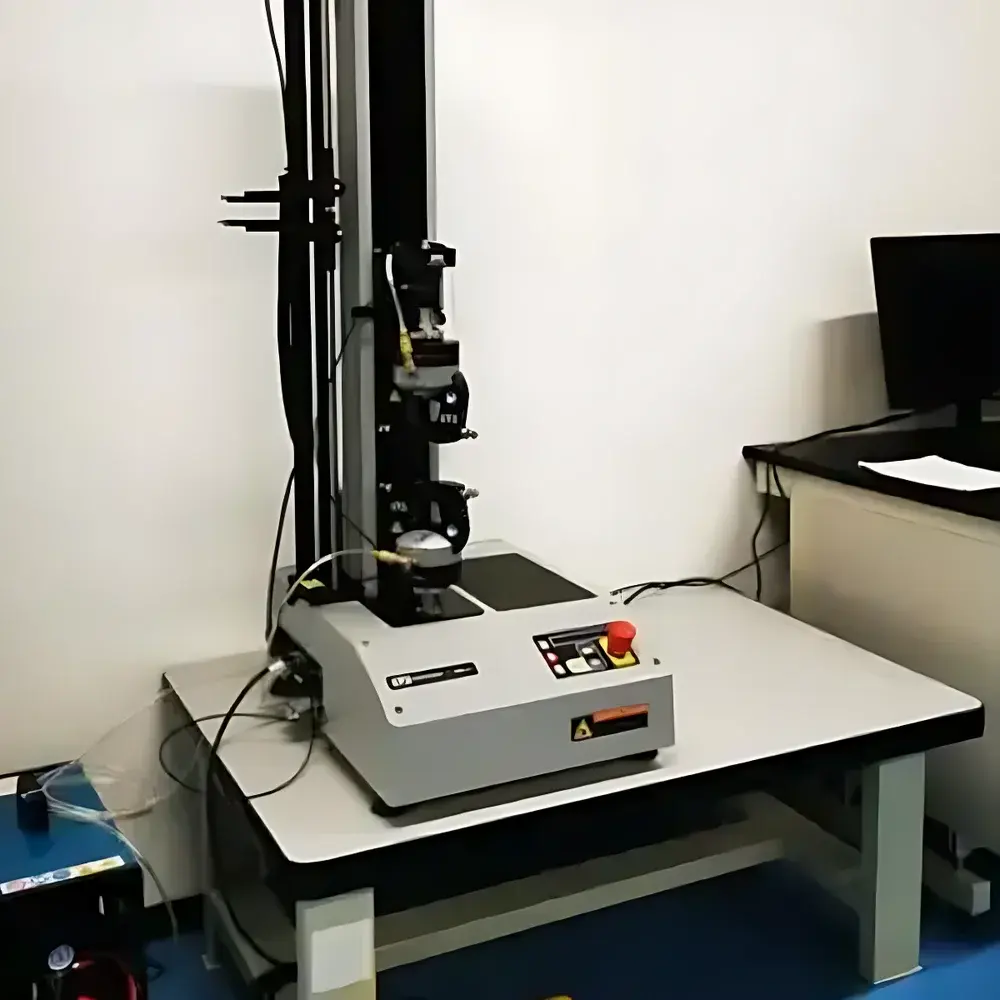
Jianhu DV-UTM Series High-Precision Universal Testing Machine
| Brand | Jianhu |
|---|---|
| Origin | Shanghai, China |
| Instrument Type | Electromechanical Universal Testing Machine |
| Load Capacity Range | 0.02 N to 300 kN |
| Load Accuracy | ±0.5% (per ISO 7500-1 Class 0.5, ASTM E4, JIS B7721, BS 1610, DIN 51221, EN 10002-2 Grade 05) |
| Crosshead Speed Range | 0.0005 mm/min to 1500 mm/min |
| Speed Accuracy | Better than ±0.1% |
| Data Acquisition Rate | Up to 10,000 samples/sec (Force–Displacement–Strain) |
| Frame Stiffness | 180 kN/mm with Automatic Deflection Compensation |
| Alignment Compliance | ASTM E1012 Class 10 |
| Optical Extensometer | ≥500 mm field of view, ±0.5% measurement accuracy, video-synchronized strain tracking |
Overview
The Jianhu DV-UTM Series High-Precision Universal Testing Machine is an electromechanical testing platform engineered for static mechanical characterization of materials under tension, compression, bending, and shear loading conditions—across ambient, elevated, or sub-ambient temperature environments. Based on servo-controlled linear actuation and high-fidelity multi-channel data acquisition, the system implements standardized quasi-static mechanical testing per ISO 6892-1 (tensile), ISO 178 (flexural), ISO 604 (compressive), and ASTM D638/D790/D695 protocols. Its modular architecture integrates dual-range load cells, optical extensometry, and real-time closed-loop control—enabling traceable, repeatable, and auditable measurement of fundamental mechanical properties including yield strength, ultimate tensile strength, Young’s modulus, Poisson’s ratio, r-value, elongation at break, and stress relaxation behavior.
Key Features
- Dual high-accuracy load cells (1 kN and 50 kN) certified to ISO 7500-1 Class 0.5 and ASTM E4, delivering ±0.3% accuracy in mid-to-high load ranges and ±0.5% down to 1 N—ensuring metrological integrity across six decades of force measurement.
- High-stiffness frame (180 kN/mm) with integrated automatic deflection compensation algorithm, minimizing parasitic deformation effects during high-load testing and maintaining alignment fidelity per ASTM E1012 Class 10 requirements.
- Optical extensometer with ≥500 mm field of view, ±0.5% strain resolution, and synchronized high-speed video capture—supporting non-contact measurement of local strain, Poisson’s ratio, and r-value without grip interference.
- Ultra-broad crosshead speed range (0.0005–1500 mm/min) with ±0.1% speed accuracy, enabling both creep/relaxation tests and high-rate quasi-static evaluations within a single platform.
- Real-time data acquisition at up to 10,000 samples per second across force, displacement, and extensometer channels—preserving full waveform fidelity for post-test derivative analysis (e.g., strain rate sensitivity, hysteresis loops).
- Modular fixture interface compatible with pneumatic, hydraulic, wedge-grip, pin-and-hole, and custom tooling—supporting standardized geometries (ASTM E8, ISO 6892) as well as application-specific specimen configurations.
Sample Compatibility & Compliance
The DV-UTM accommodates specimens ranging from micro-scale polymer films (≥10 µm thickness) to structural metallic coupons (up to 300 mm gauge length), including ductile metals, thermoplastics, elastomers, composites, ceramics, hydrogels, textiles, and biomedical polymers. It supports environmental chamber integration (−70°C to +300°C) for temperature-dependent mechanical profiling. All measurement outputs comply with GLP/GMP documentation requirements, including audit-trail-enabled test logs, electronic signatures, and 21 CFR Part 11–compliant software configuration. Calibration certificates are traceable to NIM (National Institute of Metrology, China) and internationally recognized national metrology institutes.
Software & Data Management
Jianhu TestSuite™ v5.2 provides ISO/IEC 17025-aligned test sequencing, real-time parameter monitoring, and automated report generation per ASTM/ISO templates. The interface supports multiple control modes—including constant crosshead speed, constant strain rate, constant stress rate, and load-controlled ramp-hold sequences—with seamless switching during active tests. Raw binary data (force/displacement/strain/time) is exported in ASCII-compatible .csv and standardized .tdms formats for third-party analysis (MATLAB, Python, Minitab). All user actions, calibration events, and instrument state changes are logged with timestamped audit trails. Software validation packages—including IQ/OQ documentation—are available upon request for regulated industries (pharmaceuticals, medical devices, aerospace).
Applications
The DV-UTM serves as a core instrumentation platform in R&D laboratories, QC/QA departments, and accredited testing facilities. Typical use cases include: tensile evaluation of PCB substrates per IPC-TM-650 2.4.1; cyclic extension testing of hydrogels for tissue engineering scaffolds; determination of elastic modulus and Poisson’s ratio in PET thin films per ISO 527-2; multi-point tensile characterization of carbon-fiber-reinforced polymers (CFRPs); and strain-rate-dependent yield mapping of aluminum alloys per ASTM E2234. It is routinely deployed in academic institutions (e.g., Tsinghua University, Harbin Institute of Technology), national research centers (CAS Institutes), and global certification bodies (SGS, Bureau Veritas).
FAQ
What standards does the DV-UTM comply with for load cell calibration?
It meets ISO 7500-1 Class 0.5, ASTM E4, JIS B7721, BS 1610, DIN 51221, and EN 10002-2 Grade 05 requirements.
Can the system perform strain-controlled testing?
Yes—via closed-loop feedback from the optical extensometer, supporting constant strain rate, strain ramp-hold, and strain-controlled fatigue protocols.
Is the software compliant with FDA 21 CFR Part 11?
TestSuite™ v5.2 supports electronic signatures, audit trails, and role-based access control—fully configurable for Part 11 compliance in validated environments.
What is the maximum specimen height accommodated without environmental chamber?
Standard configuration supports specimens up to 1,200 mm in height; extended frames are available for taller configurations.
Does Jianhu provide installation qualification (IQ) and operational qualification (OQ) documentation?
Yes—validated IQ/OQ protocols, including sensor linearity verification, speed accuracy checks, and alignment certification, are supplied with each system.



