
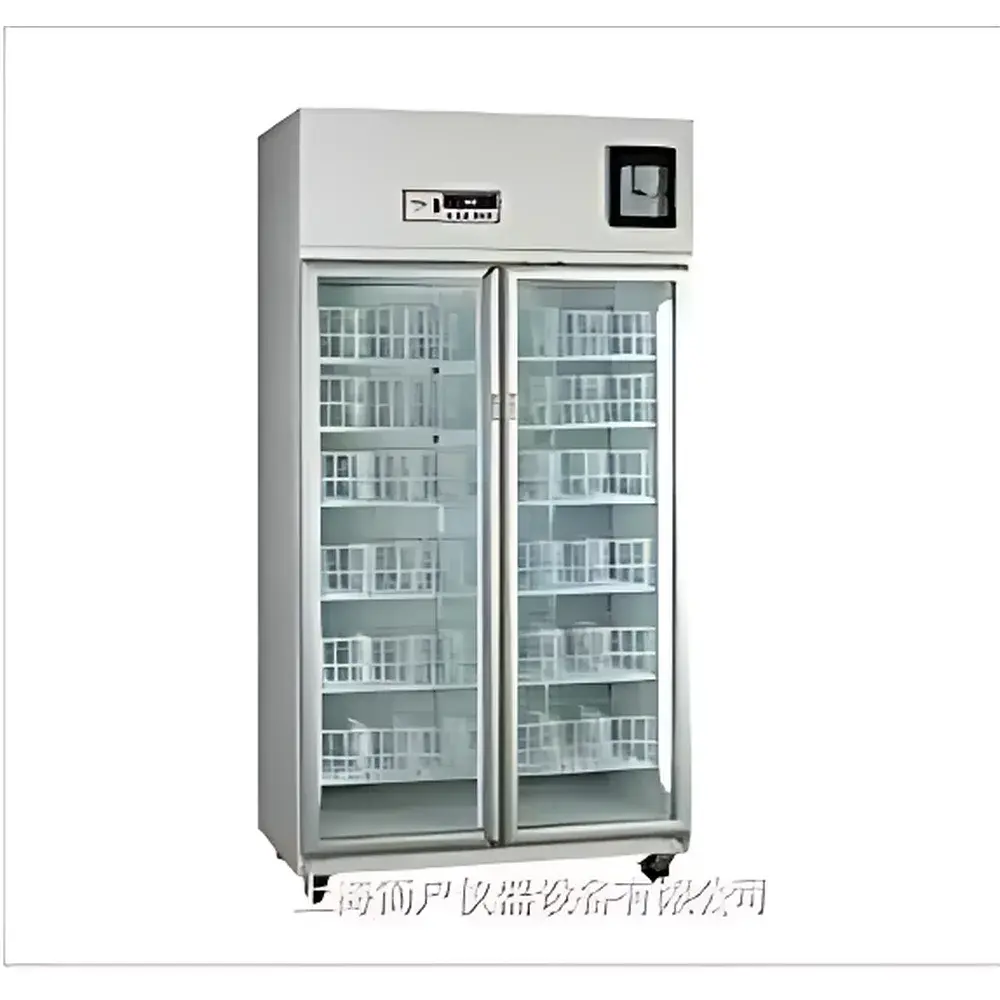
Jianhu JCD Series Low Temperature Test Chamber
| Brand | Jianhu |
|---|---|
| Model | JCD |
| Temperature Range Options | 0°C to 8°C |
| Control System | Microprocessor-based digital temperature controller |
| Alarm Functions | Dual-temperature limit alarm (high/low) and sensor fault detection |
| Alarm Outputs | Audible buzzer + visual LED flash |
| Compressor | Danfoss (imported) |
| Condenser Fan | EBM (imported) |
| Insulation | High-density polyurethane foam |
| Refrigerant | CFC-free / HCFC-free |
| Test Port | Φ40 mm |
| Ambient Operating Range | 10°C to 32°C |
| Interior Design | Corrosion-resistant stepped stainless steel chamber |
| Door Security | Mechanical lock |
| Compliance | Designed per IEC 60068-2 environmental testing standards framework |
| Power Supply | Standard single-phase AC input (specify voltage/frequency per regional configuration) |
Overview
The Jianhu JCD Series Low Temperature Test Chamber is an engineered environmental simulation system designed for controlled thermal exposure of materials, components, and assemblies under defined low-temperature conditions. Utilizing a dual-stage or cascade refrigeration architecture—depending on selected temperature range—it achieves stable, repeatable thermal profiles across multiple operational bands, including sub-zero operation down to –95°C and extended high-temperature capability up to +150°C. The chamber operates on a microprocessor-based closed-loop control system with real-time PID regulation, enabling precise setpoint maintenance within ±0.5°C typical stability under load. Its core application domain includes accelerated aging, cold storage validation, thermal shock pre-conditioning, and compliance-driven environmental stress screening in accordance with IEC 60068-2-1 (cold test), IEC 60068-2-2 (dry heat), and related product-specific qualification protocols.
Key Features
- Multi-range temperature capability: Six configurable operating bands—from general refrigerated storage (0°C to 8°C) through deep-cryogenic performance (–95°C to 150°C)—supporting diverse test requirements without hardware modification.
- Dual-fault detection system: Independent monitoring of chamber temperature deviation and Pt100 sensor integrity ensures operational reliability and early failure identification.
- Redundant alarm outputs: Simultaneous audible (buzzer) and visual (LED flash) alerts triggered by user-defined upper/lower temperature thresholds or sensor open-circuit conditions.
- High-efficiency refrigeration package: Integrated Danfoss hermetic compressors and EBM axial condenser fans deliver rapid cooldown rates and sustained thermal uniformity, verified per IEC 60068-3-5 methodology.
- Structural thermal integrity: 100–150 mm thick rigid polyurethane insulation (≥35 kg/m³ density, closed-cell structure) minimizes heat ingress and supports energy-efficient long-duration testing.
- Operator-safe access design: Mechanically locked door prevents unauthorized entry during active test cycles; Φ40 mm sealed test port enables external instrumentation feedthrough while preserving chamber integrity.
- Ambient adaptability: Rated for continuous operation in ambient environments from 10°C to 32°C, eliminating need for climate-controlled machine rooms in most laboratory or QC facility settings.
Sample Compatibility & Compliance
The JCD chamber accommodates standard industrial sample carriers—including stackable stainless steel baskets, ISO-compliant trays, and custom fixtures—via its corrosion-resistant stepped interior liner. Chamber volume and internal dimensions are optimized for ISO/IEC 17025-accredited laboratories conducting GLP-aligned environmental qualification. While not certified to UL/CSA or CE as a standalone medical device, the unit complies with electromagnetic compatibility (EMC) and safety fundamentals aligned with IEC 61000-6-3 and IEC 61000-6-4. Its refrigerant selection adheres to Montreal Protocol phase-out schedules, utilizing zero-ozone-depletion-potential (ODP = 0) and low-global-warming-potential (GWP < 10) alternatives.
Software & Data Management
The embedded controller logs temperature data at user-selectable intervals (1 s to 60 min) to internal non-volatile memory (≥30 days at 1-min resolution). Optional RS485 Modbus RTU or Ethernet TCP/IP interface enables integration into centralized SCADA or LIMS platforms. Data export supports CSV format for post-test analysis in MATLAB, Excel, or statistical process control (SPC) software. Audit trail functionality meets basic FDA 21 CFR Part 11 expectations for electronic records when paired with external timestamped logging systems; full electronic signature support requires third-party validation-ready middleware.
Applications
- Electronics: Cold-start validation of automotive ECUs, battery module thermal cycling, PCB solder joint reliability assessment.
- Pharmaceuticals: Stability testing of lyophilized formulations per ICH Q1A(R3); cold chain packaging qualification.
- Automotive: Material embrittlement evaluation of polymer gaskets, elastomer seal compression set at low T, brake fluid low-temperature flow testing.
- Academic Research: Cryobiology sample pre-conditioning, superconducting material characterization support, polymer crystallinity studies via controlled cooling ramps.
- Quality Assurance: Incoming inspection of temperature-sensitive raw materials; shelf-life verification under accelerated cold storage conditions.
FAQ
What temperature uniformity can be expected across the working volume?
Typical spatial uniformity is ±1.5°C at steady state within the central 1/3 volume, measured per IEC 60068-3-5 using nine calibrated Pt100 sensors.
Is remote monitoring supported out-of-the-box?
Standard configuration includes local display and relay alarms only; RS485 or Ethernet connectivity requires optional communication module installation.
Can the chamber operate continuously at –80°C or lower?
Yes—the –95°C to +150°C model utilizes a cascade refrigeration system rated for indefinite continuous operation at –80°C, provided ambient conditions remain within specified limits and maintenance intervals are observed.
Does the unit include calibration documentation?
Factory calibration certificates traceable to NIM (China National Institute of Metrology) are provided; ISO/IEC 17025-accredited third-party calibration is available upon request.
What maintenance schedule is recommended?
Compressor oil and filter replacement every 24 months; condenser coil cleaning quarterly; annual verification of sensor accuracy and control loop response time.
Related Products



