
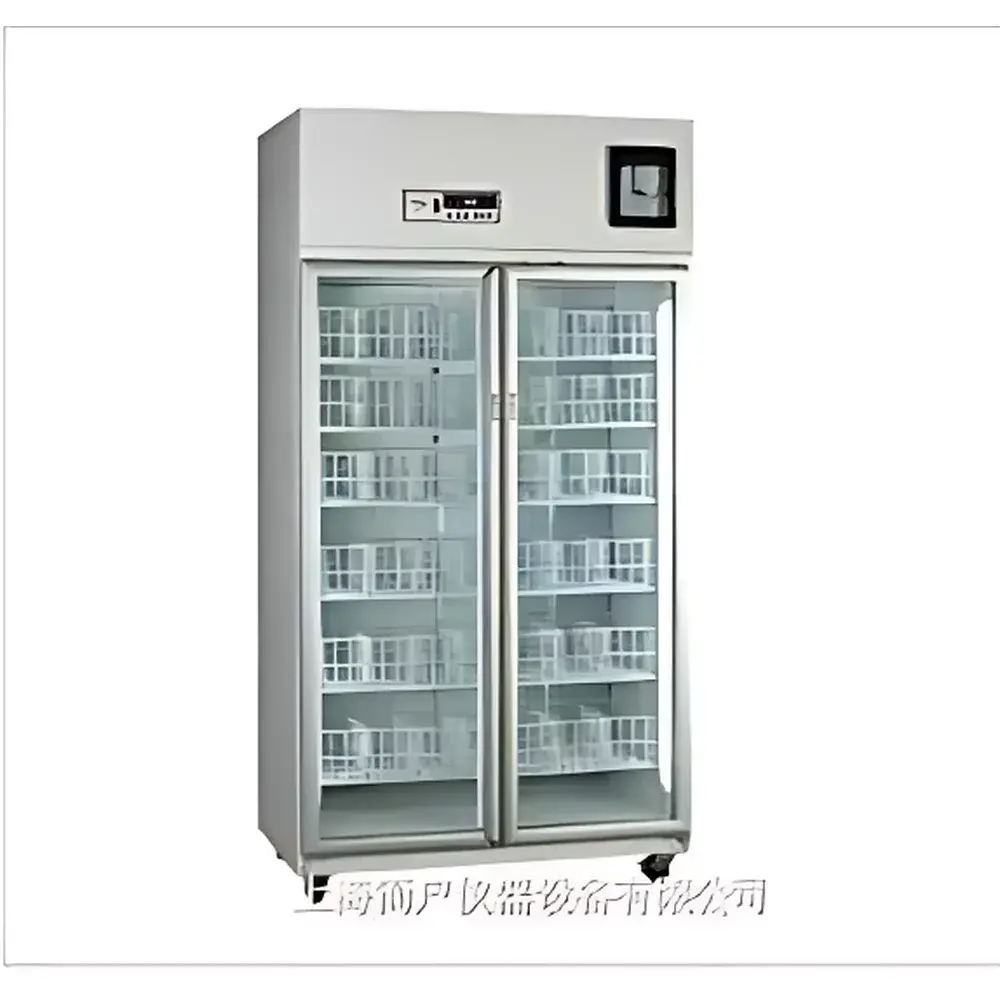
Jianhu JH-100B Low Temperature Environmental Test Chamber
| Brand | Jianhu |
|---|---|
| Model | JH-100B |
| Temperature Range Options | 0°C to 8°C |
| Refrigeration System | Danfoss compressor + EBM condenser fan |
| Insulation | High-density polyurethane foam |
| Refrigerant | CFC-free / HFC-free |
| Test Port | Φ40 mm |
| Ambient Operating Range | 10°C to 32°C |
| Safety Features | Dual-temperature alarm, sensor fault detection, audible buzzer + visual flashing alert, mechanical door lock |
| Interior Design | Corrosion-resistant stepped stainless steel chamber with basket-compatible structure |
| Compliance Context | Designed for GLP-compliant stability testing and ICH Q1–Q5 environmental stress qualification |
Overview
The Jianhu JH-100B Low Temperature Environmental Test Chamber is an engineered thermal simulation platform designed for controlled, repeatable exposure of materials, components, and packaged products to defined low-temperature and wide-range thermal profiles. Built upon a dual-stage or cascade refrigeration architecture (depending on selected temperature configuration), the chamber employs thermodynamic principles consistent with ISO 16750-4, IEC 60068-2-1 (cold test), and ASTM D3424 (low-temperature performance evaluation). Its operational envelope spans from cryogenic conditions (–95°C) up to elevated ambient temperatures (150°C), enabling sequential or static thermal stress application in compliance with accelerated aging protocols, cold chain validation, and long-term stability studies required by pharmaceutical, electronics, and automotive sectors.
Key Features
- Precision microprocessor-based temperature controller with real-time digital display and ±0.3°C typical stability across all operating ranges.
- Dual independent alarm system: configurable high/low temperature thresholds and real-time sensor integrity monitoring—triggering both audible (piezoelectric buzzer) and visual (LED strobe) alerts upon deviation or hardware fault.
- Industrial-grade refrigeration core integrating Danfoss scroll compressors and EBM axial-flow condenser fans, optimized for rapid pull-down and sustained thermal load management.
- High-efficiency insulation using ≥120 mm thick closed-cell polyurethane foam (thermal conductivity ≤0.022 W/m·K), minimizing parasitic heat ingress and ensuring energy-efficient operation under continuous duty cycles.
- Corrosion-resistant stepped stainless steel interior (AISI 304), engineered to accommodate standardized sample baskets, trays, and fixture mounts without thermal bridging or condensation accumulation.
- Mechanically interlocked safety door with key-operated latch—preventing unauthorized access during critical test phases and supporting SOP-driven lab workflows.
- Dedicated Φ40 mm pass-through port with silicone gasket seal, facilitating integration with external instrumentation (e.g., data loggers, humidity sensors, or power feeds) while maintaining chamber integrity.
- Wide ambient adaptability: rated for stable operation within 10°C–32°C room temperature and 20%–80% non-condensing RH—eliminating need for dedicated HVAC conditioning in most laboratory or QC environments.
Sample Compatibility & Compliance
The JH-100B accommodates diverse sample geometries—including sealed vials, blister packs, PCB assemblies, polymer specimens, and battery modules—within its uniform airflow chamber. Internal air distribution follows ASHRAE Guideline 12 principles to ensure ±1.5°C spatial uniformity (per IEC 60068-3-5) at steady state. The unit supports regulatory-aligned test execution per ICH Q1A(R2) (stability protocol), USP (storage conditions), and ISO 14644-1 (cleanroom-compatible operation when equipped with optional HEPA filtration). All firmware logs—including setpoint history, alarm events, and sensor calibration timestamps—are time-stamped and exportable in CSV format, meeting basic ALCOA+ data integrity expectations for non-GxP pilot studies. Full 21 CFR Part 11 compliance requires optional audit trail module and electronic signature integration.
Software & Data Management
The embedded controller provides local parameter configuration, profile programming (up to 99 segments), and real-time trend visualization via 4.3-inch TFT LCD. Optional RS485/Modbus RTU or Ethernet interface enables integration into centralized LabVantage, TrackWise, or custom SCADA systems. Data logging interval is adjustable from 1 second to 60 minutes; stored records persist for ≥30 days onboard. Exported datasets include absolute timestamp, chamber setpoint, actual chamber temperature, compressor status, and alarm flags—structured to support statistical process control (SPC) analysis in Minitab or JMP. Firmware updates are performed via USB drive with version-controlled checksum verification.
Applications
- Pharmaceutical stability testing under ICH Zone IVb (hot/humid) and sub-zero storage condition mapping.
- Electronics component qualification per AEC-Q200 for low-temperature solder joint reliability and capacitor derating.
- Automotive material validation per GMW15007 (cold soak) and Ford CETP 00.00-L-467 (freeze-thaw cycling).
- Polymer crystallinity assessment via controlled cooling ramp experiments (e.g., DSC correlation studies).
- Battery cell performance evaluation at –40°C to +60°C for EV and aerospace applications.
- Medical device packaging integrity testing under extreme thermal transit simulations.
FAQ
What temperature ranges does the JH-100B support?
The chamber offers six selectable operating envelopes: 0°C to 8°C, –15°C to 25°C, –20°C to 40°C, –30°C to 60°C, –20°C to 86°C, and –95°C to 150°C—each calibrated and verified per internal QA procedure.
Is the refrigerant compliant with global environmental regulations?
Yes. The system uses zero-ozone-depletion-potential (ODP = 0) and low-global-warming-potential (GWP < 10) refrigerants, fully aligned with EU F-Gas Regulation (EU) No 517/2014 and EPA SNAP Program requirements.
Can the chamber be validated for GxP use?
As supplied, it meets IQ/OQ prerequisites. Full PQ and 21 CFR Part 11 readiness require documented installation in a qualified environment, third-party sensor calibration (NIST-traceable), and optional software add-ons for electronic signatures and audit trail.
What maintenance intervals are recommended?
Compressor oil inspection every 2,000 hours; condenser coil cleaning quarterly; door gasket integrity check monthly; full system performance verification annually per ISO/IEC 17025-accredited service provider.
Related Products



