
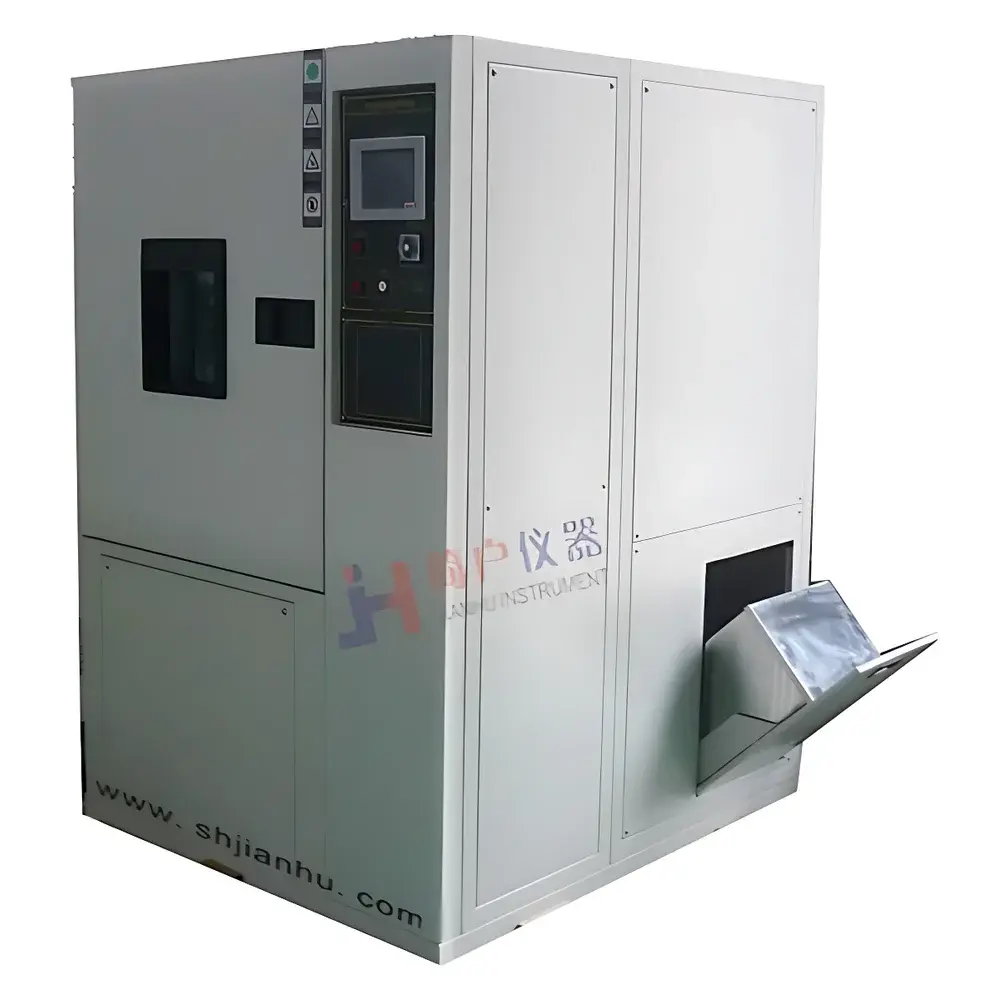
Jianhu JTH Series Temperature and Humidity Controlled Environmental Test Chamber
| Brand | Jianhu |
|---|---|
| Origin | Shanghai, China |
| Manufacturer Type | Authorized Distributor |
| Country of Origin | China |
| Model | JTH-50P to JTH-1000P (Programmable Touchscreen) / JTH-50S to JTH-1000S (Standard Microprocessor Control) |
| Temperature Range | -70 °C to +150 °C (selectable variants A–E) |
| Humidity Range | 20–98% RH |
| Temp. Stability | ±0.5 °C (P), ±1 °C (S) |
| Humidity Stability | ±1.5% RH (P), ±2.5% RH (S) |
| Temp. Control Resolution | 0.01 °C (P), 1 °C (S) |
| Humidity Control Resolution | ±0.1% RH (P), ±1% RH (S) |
| Ramp Rate | 0.7–1.2 °C/min (non-linear, unloaded) |
| Internal Dimensions (D×W×H, cm) | 32×35×45 to 100×100×100 |
| External Dimensions (D×W×H, cm) | 70×80×140 to 145×145×195 |
| Compliance | GB/T 2423, GJB 150, IEC 60068, ISO 16750, ASTM D4332, UL 746C |
Overview
The Jianhu JTH Series Temperature and Humidity Controlled Environmental Test Chamber is an engineered solution for accelerated environmental stress testing of materials, components, and finished products under precisely regulated thermal and hygrometric conditions. Designed for laboratories and quality assurance departments requiring cost-effective yet technically robust environmental simulation, the JTH chamber employs a dual-stage cascade refrigeration system—comprising imported hermetic compressors and eco-friendly refrigerants—to achieve stable low-temperature operation down to –70 °C. Its humidity control architecture integrates PID-driven SSR (solid-state relay) modulation with automatic water-level compensation and dry-run protection, ensuring long-term operational safety and repeatability across 20–98% RH. The chamber’s structural integrity is reinforced by double-layer high-tensile silicone rubber door seals, corrosion-resistant electrostatically sprayed exterior housing, and vibration-damped PU casters with locking mechanisms—features aligned with industrial-grade durability expectations.
Key Features
- Triple-layer vacuum-coated observation window with integrated Philips energy-efficient fluorescent lighting—eliminates condensation without mechanical wipers and supports real-time visual monitoring under all test conditions.
- Physically segregated humidification piping from electrical control circuits and PCB assemblies—minimizes risk of moisture-induced short-circuiting and enhances system MTBF (mean time between failures).
- Imported LCD touchscreen controller (P-series) or microprocessor-based digital display (S-series), both supporting programmable ramp-soak profiles, data logging, and alarm history with timestamped event records.
- Front-accessible water reservoir with level sensor feedback and audible/visual low-water alert—enabling maintenance without chamber disassembly.
- Optimized airflow design with adjustable rear-mounted centrifugal blower ensures uniform temperature/humidity distribution (±1.5 °C/±3% RH spatial uniformity per IEC 60068-3-5).
- Ergonomic flat-profile door handle with zero-backlash actuation mechanism—reduces operator fatigue during frequent access cycles in production-line QA environments.
Sample Compatibility & Compliance
The JTH chamber accommodates diverse sample geometries—from printed circuit boards and polymer films to automotive ECUs and medical device housings—within internal volumes ranging from 53 L (JTH-50) to 1000 L (JTH-1000). Its sealed chamber cavity meets ingress protection requirements equivalent to IPX2 for incidental moisture exposure during operation. All models comply with national and international environmental test standards including GB/T 2423.1–2423.4 (cold, dry heat, damp heat), GJB 150.9A (humidity), IEC 60068-2-30 (cyclic damp heat), ISO 16750-4 (road vehicles), ASTM D4332 (conditioning of plastics), and UL 746C (polymeric materials evaluation). Optional calibration certificates traceable to NIM (National Institute of Metrology, China) are available upon request for GLP-compliant validation protocols.
Software & Data Management
The programmable P-series controller supports up to 100 user-defined test cycles, each with 99 segments (ramp, soak, step), and stores ≥10,000 data points internally. USB export enables CSV-formatted temperature/humidity/time logs compatible with Excel, MATLAB, or LIMS platforms. Audit trail functionality—including operator ID tagging, parameter change timestamps, and firmware version logging—meets basic FDA 21 CFR Part 11 readiness requirements when deployed with networked authentication. Remote monitoring via optional RS485 Modbus RTU interface allows integration into centralized facility SCADA systems for predictive maintenance scheduling and cross-chamber correlation analysis.
Applications
- Electronics reliability assessment: solder joint fatigue, conformal coating performance, capacitor leakage under thermal cycling and high-humidity exposure.
- Automotive component qualification: dashboard material fogging, connector corrosion resistance, battery pack thermal management validation.
- Pharmaceutical packaging stability: blister seal integrity, desiccant efficacy, and moisture vapor transmission rate (MVTR) screening per USP .
- Polymer aging studies: tensile strength retention, color shift (ΔE), and dimensional stability per ISO 527 and ASTM D638.
- Quality control in manufacturing: final inspection of consumer appliances, LED lighting modules, and HVAC components prior to shipment.
FAQ
What is the difference between P-type and S-type controllers?
The P-type uses a full-color capacitive touchscreen with multi-segment programming, real-time graphing, and USB data export; the S-type features a 4-digit LED display with fixed-setpoint operation and basic alarm functions.
Can the chamber perform rapid temperature transitions?
Yes—its cascade refrigeration system delivers average ramp rates of 0.7–1.2 °C/min (unloaded, non-linear), optimized for applications such as thermal shock pre-conditioning per MIL-STD-810G Method 502.6.
Is third-party calibration support available?
Certified calibration services—including as-found/as-left reports traceable to national metrology institutes—are offered through Jianhu’s authorized service partners in APAC and EMEA regions.
Does the unit meet electromagnetic compatibility (EMC) requirements?
All JTH models comply with EN 61000-6-2 (immunity) and EN 61000-6-4 (emission) standards for industrial environments, verified during factory acceptance testing.
What maintenance intervals are recommended?
Compressor oil inspection every 24 months; condenser coil cleaning quarterly; humidity sensor recalibration annually or after 2000 operational hours—documented in the included maintenance logbook.



