
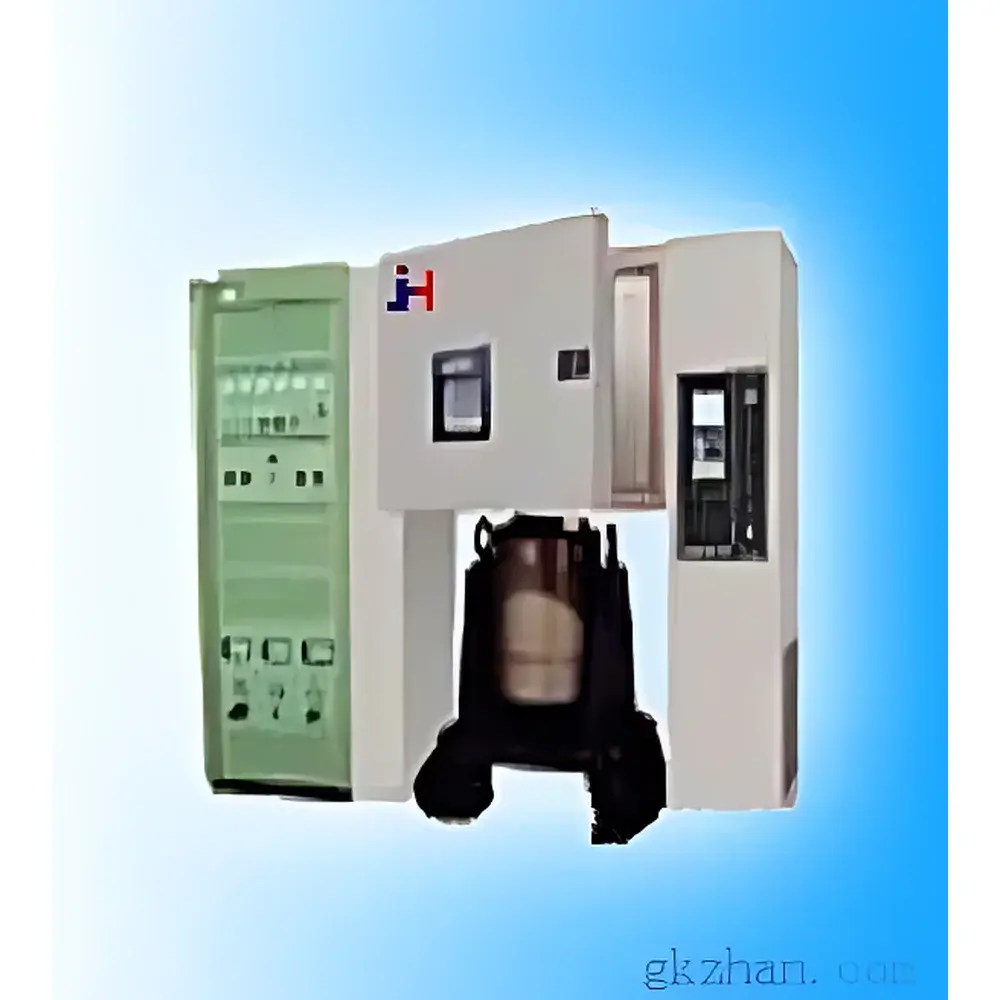
Jianhu VTH Series Tri-Environmental Test Chamber (Temperature, Humidity, Vibration)
| Brand | Jianhu |
|---|---|
| Origin | Shanghai, China |
| Manufacturer Type | Authorized Distributor |
| Country of Origin | China |
| Model Series | VTH-A / VTH-B / VTH-C |
| Quotation | Upon Request |
| Internal Dimensions (W×H×D) | 500×600×870 mm / 600×800×870 mm / 1000×800×870 mm |
| Temperature Range | −70.0 °C to +150.0 °C (optional up to +180.0 °C) |
| Humidity Range | 10.0 %RH (achievable) / 20.0–98.0 %RH (standard control range) |
| Vibration Frequency Range | 3–2000 Hz (extended to 4000 Hz) |
| Max. Vibration Amplitude | 0–20 mm (optional up to 40 mm) |
| Max. Dynamic Thrust | 100–1200 kgf (optional up to 2000 kgf) |
| Control System | THS-2001 Microcontroller (10,000-segment programmable) |
| Vibration Control Modes | Random, Sine, Linear Sweep, Logarithmic Sweep, Octave Sweep |
| Refrigeration | HFC-based eco-friendly refrigerant with French Servo Valve modulation |
| Low-Humidity Technology | LHC regenerative desiccant system + low-RH sensor |
| Rapid Cooling Option | LN2V liquid nitrogen injection |
| Data Interface | DATA PHYSICS DP-540 PC interface |
| Data Logging | Removable disk-based thermal/humidity/vibration time-history recording |
| Energy Efficiency | 30% power reduction and 20% water savings vs. conventional systems |
Overview
The Jianhu VTH Series Tri-Environmental Test Chamber is an integrated reliability validation platform engineered for simultaneous or independent application of temperature, humidity, and mechanical vibration stressors. It operates on the principle of multi-stress accelerated environmental simulation—enabling concurrent exposure to thermally induced expansion/contraction, hygroscopic swelling/desiccation, and dynamic mechanical loading—thereby replicating real-world operational and transport conditions encountered by aerospace components, defense electronics, automotive ECUs, and high-reliability consumer electronics. Unlike sequential single-stress testing, this tri-combined methodology accelerates failure mode identification (e.g., solder joint fatigue, conformal coating delamination, connector fretting corrosion) in accordance with MIL-STD-810H Method 520.3 (Combined Environments), IEC 60068-2-68 (Combined Temperature/Humidity/Vibration), and RTCA DO-160 Section 25 (Environmental Conditions and Test Procedures for Airborne Equipment). The chamber’s modular architecture supports both qualification-level testing per contractual specifications and design verification under GLP-compliant workflows.
Key Features
- Triple-stress synchronization: Independent yet fully coordinated control of thermal, hygric, and vibrational profiles within a single test volume—eliminating inter-system latency and enabling true physics-based coupling.
- Advanced climate subsystem: Dual-stage HFC refrigeration with French Servo Valve precision refrigerant metering; integrated LN2V liquid nitrogen auxiliary cooling for rapid thermal transitions (<5°C/min from +150°C to −40°C).
- Ultra-low humidity capability: LHC (Low-Humidity Control) system featuring regenerative desiccant wheels and dedicated 10.0 %RH-capable sensors—validated per ISO 12238 Annex B for sub-20 %RH stability.
- Vibration integration: Direct-coupled electrodynamic shaker with DP-540 digital controller; supports random PSD, sine dwell, resonant dwell, swept-sine, and octave-based profiles per ASTM D999, ISO 13373-1, and IEC 60068-2-64.
- Intelligent thermal load compensation: Real-time servo adjustment of refrigerant flow based on internal heat dissipation—ensuring stable chamber conditions during powered device-under-test (DUT) operation.
- Human-centric HMI: Full-color LCD touchscreen with bilingual (English/Chinese) GUI, HELP-driven context-sensitive operation menus, and intuitive drag-and-drop profile sequencing.
- Robust data integrity: Onboard SRAM program storage (10,000 segments) plus removable disk-based logging; timestamped, CRC-verified raw data export compatible with MATLAB, Python Pandas, and JMP for statistical life modeling.
Sample Compatibility & Compliance
The VTH chamber accommodates samples ranging from PCB assemblies and handheld devices to avionics chassis and automotive control modules—up to 1000 mm × 800 mm × 870 mm internal volume (VTH-C model). Fixturing interfaces comply with ISO 5344 and ASTM E1856 standard vibration mounting configurations. All models meet CE marking requirements under the EU Machinery Directive 2006/42/EC and Electromagnetic Compatibility Directive 2014/30/EU. Climate control accuracy adheres to IEC 60068-3-5 (±0.5 °C temperature uniformity, ±2.0 %RH humidity uniformity over working volume). Vibration performance conforms to ISO 10816-1 for calibration traceability and meets Class 1 vibration severity per MIL-STD-810H Table 520.3-VI. Optional IQ/OQ documentation packages support FDA 21 CFR Part 11-compliant validation for regulated medical device testing.
Software & Data Management
The THS-2001 embedded controller provides deterministic real-time execution of multi-segment test protocols—including conditional branching (e.g., “if temperature exceeds +125°C, initiate 5g random vibration for 30 min”). Data acquisition occurs at configurable sampling rates up to 10 kHz per channel (temperature, humidity, acceleration X/Y/Z). Export formats include CSV, TDMS, and HDF5—enabling direct ingestion into Weibull++ for reliability prediction or ReliaSoft BlockSim for system-level FMEA correlation. Audit trails record all operator actions, parameter changes, and alarm events with user ID and timestamp—fully compliant with GLP/GMP electronic record requirements. Remote monitoring via Ethernet TCP/IP enables secure web-based access using TLS 1.2 encryption and role-based authentication.
Applications
- Aerospace: Environmental stress screening (ESS) of flight-critical sensors per SAE ARP4754A and DO-160G Section 25.
- Defense: HALT/HASS of ruggedized communication terminals and guided munition guidance units per MIL-HDBK-344.
- Automotive: Validation of ADAS ECUs under combined thermal cycling, condensation, and road-spectrum vibration per ISO 16750-4 and GMW3172.
- Consumer Electronics: Accelerated life testing of wearables and foldable displays under humidity-induced flex fatigue and thermal-mechanical hysteresis.
- Medical Devices: Biocompatibility material aging studies per ISO 10993-12, including polymer hydrolysis kinetics under elevated RH and cyclic strain.
FAQ
What standards does the VTH chamber support for combined environment testing?
It complies with MIL-STD-810H Method 520.3, IEC 60068-2-68, RTCA DO-160 Section 25, and ISO 16750-4 for synchronized temperature/humidity/vibration profiles.
Can the chamber maintain 10% RH continuously across its full temperature range?
The LHC system achieves 10% RH at temperatures ≥15°C; below 15°C, the practical lower limit is 20% RH due to dew-point constraints—validated per ISO 12238.
Is vibration control traceable to national metrology institutes?
Yes—shaker force and displacement transducers are calibrated annually against NIST-traceable reference standards; full calibration certificates available upon request.
How is data integrity ensured during long-duration tests (>30 days)?
Disk-based logging includes automatic file rotation, cyclic redundancy checksums, and power-fail-safe write buffering—preventing data corruption during unexpected outages.
Does the system support automated pass/fail evaluation against acceptance criteria?
The THS-2001 firmware allows user-defined limit checks per channel (e.g., “vibration RMS must remain within ±5% of setpoint”); deviations trigger configurable alarms and log entries.



