
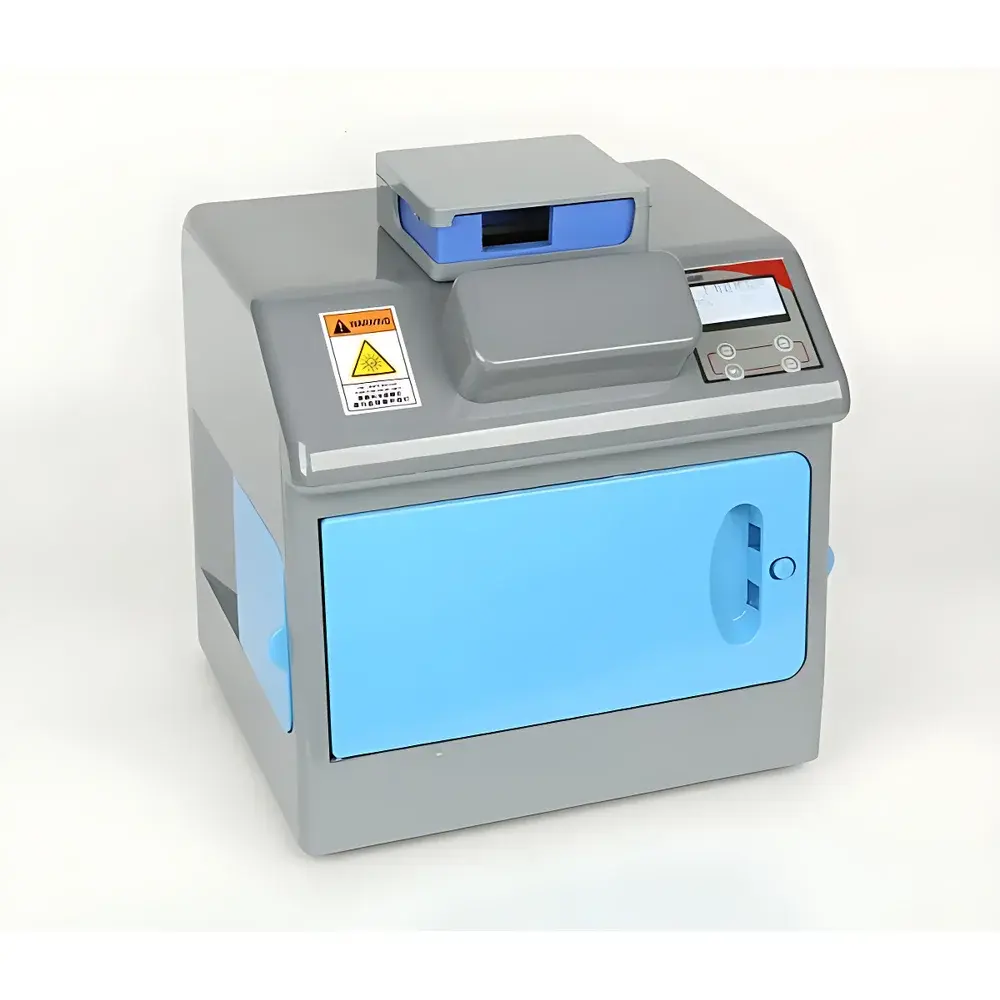
Jiapeng ZF-7ND Darkroom-Style Triple-Function UV Transilluminator and Gel Cutter
| Brand | Jiapeng |
|---|---|
| Origin | Shanghai, China |
| Model | ZF-7ND |
| Instrument Type | Darkroom-style |
| Wavelength Types | Dual-band UV (254 nm & 365 nm) + Visible Light |
| UV Emission | 254 nm (reflective), 365 nm (reflective) |
| UV Lamp Count | 2 × 8 W |
| UV Filter Size | 200 × 50 mm |
| UV Transillumination Area | 200 × 50 mm |
| Visible Light Lamp | 1 × 4 W |
| Power Input | AC 220 V, 50/60 Hz |
| Internal Dimensions | 280 × 245 × 220 mm |
| External Dimensions | 280 × 330 × 330 mm |
| Weight | 2.65 kg |
| UV Intensity | ≥20 µW/cm² at 20 cm (per JJF 1936–2021) |
| Compliance | JJF 1936–2021 (National Verification Regulation for UV Analyzers) |
Overview
The Jiapeng ZF-7ND is a darkroom-style triple-function UV transilluminator engineered for routine nucleic acid and protein visualization, gel documentation, and precise excision of DNA bands during molecular biology workflows. It operates on the principle of ultraviolet-induced fluorescence—where ethidium bromide (EtBr), SYBR® Safe, or other nucleic acid stains absorb UV photons at 254 nm or 365 nm and re-emit visible light, enabling rapid detection of DNA/RNA fragments in agarose or polyacrylamide gels. Unlike open-bench UV boxes, the ZF-7ND’s fully enclosed ABS polymer housing eliminates ambient light interference and provides operator protection via integrated UV-blocking viewing window (≥99% attenuation of 254/365 nm radiation). Its dual-wavelength capability supports both high-sensitivity short-wave (254 nm) detection—ideal for low-concentration samples—and long-wave (365 nm) excitation, which minimizes photodamage to DNA and improves compatibility with UV-sensitive dyes such as GelRed™. The unit also incorporates a dedicated visible-light mode (4 W white LED) for Coomassie- or silver-stained protein gels, making it a versatile platform across electrophoretic applications.
Key Features
- Triple-mode illumination: Independent switching between 254 nm UV, 365 nm UV, and visible white light—controlled via intuitive LCD interface with backlighting optimized for low-light lab environments.
- Adjustable UV lamp orientation: Dual 8 W UV lamps mounted on pivoting arms allow directional illumination across the entire 200 × 50 mm transillumination area, ensuring uniform excitation even for off-center samples.
- Integrated safety architecture: High-transparency polycarbonate observation window with certified UV filtration (≥99% blocking at 254/365 nm), compliant with IEC 62471 photobiological safety standards for UV equipment.
- Modular imaging readiness: Built-in camera mount and USB port support plug-and-play integration with consumer-grade digital cameras (e.g., Canon EOS M series, Nikon D3x00 line) for standardized gel documentation; no proprietary software required.
- Robust mechanical design: One-piece injection-molded ABS chassis (UL94 HB flame-retardant grade) ensures structural integrity, chemical resistance to common lab solvents, and long-term dimensional stability under repeated thermal cycling.
- Traceable performance: Calibrated UV output meets JJF 1936–2021 national metrological verification requirements; intensity ≥20 µW/cm² at 20 cm distance from surface—validated per ISO/IEC 17025-accredited protocols.
Sample Compatibility & Compliance
The ZF-7ND accommodates standard electrophoresis formats including mini-gels (up to 10 × 10 cm), wide-format gels (up to 20 × 5 cm), and multi-well plates used in PCR product screening. Its 200 × 50 mm UV transmission zone is optimized for horizontal slab gels cast in standard casting trays. The system complies with Chinese national metrological regulation JJF 1936–2021 and aligns with internationally recognized safety benchmarks—including IEC 61010-1 (electrical safety) and IEC 62471 (UV hazard classification). While not FDA 510(k)-cleared or CE-marked for clinical diagnostics, it satisfies GLP-aligned documentation requirements for academic, industrial QC, and R&D laboratories performing non-regulated nucleic acid analysis. All UV components are RoHS-compliant and free of mercury-containing lamps.
Software & Data Management
The ZF-7ND operates as a hardware-only imaging station: no embedded operating system or proprietary firmware is installed. Image capture relies entirely on externally connected digital cameras using native manufacturer drivers (e.g., Canon EOS Utility, Nikon Camera Control Pro). Raw image files (JPEG/TIFF) are stored directly on the host computer or SD card, enabling full traceability and compatibility with third-party analysis tools—including ImageJ/Fiji, TotalLab Quant, or GeneTools. For laboratories requiring audit trails, the device supports time-stamped manual logging of exposure conditions (wavelength, duration, lamp position) in accordance with ISO/IEC 17025 clause 7.7. No data encryption, electronic signatures, or 21 CFR Part 11 compliance features are provided—consistent with its classification as a general-purpose benchtop analyzer rather than a regulated diagnostic instrument.
Applications
- Visualization and documentation of DNA/RNA bands in agarose and polyacrylamide gels stained with EtBr, SYBR® Gold, GelGreen®, or similar fluorophores.
- UV-guided excision of target DNA fragments prior to gel extraction and downstream cloning or sequencing library preparation.
- Fluorescent detection of proteins labeled with UV-excitable tags (e.g., dansyl chloride derivatives) or stained with UV-compatible dyes.
- Routine quality control of PCR amplification products, restriction digests, and plasmid preparations in teaching labs and core facilities.
- Forensic sample screening (e.g., latent biological stain detection on fabrics or swabs) where portable, non-destructive fluorescence inspection is required.
- Archaeological pigment analysis and document authentication using intrinsic fluorescence signatures of aged inks and binders.
FAQ
Is the ZF-7ND suitable for use with SYBR® Safe stain?
Yes—the 365 nm long-wave UV mode is specifically recommended for SYBR® Safe due to reduced photobleaching and lower DNA damage compared to 254 nm excitation.
Can this unit be used for quantitative densitometry?
No—it lacks calibrated CCD sensors, internal reference standards, or linear response validation required for optical density quantification; it is intended for qualitative visualization only.
Does the device include a built-in camera?
No—a compact digital camera (e.g., Canon PowerShot G7 X Mark III) must be purchased separately and mounted using the included adjustable bracket.
What is the expected service life of the UV lamps?
Rated for ≥5,000 hours under normal intermittent use; output degradation follows typical exponential decay curves consistent with low-pressure mercury vapor lamp specifications.
Is the ZF-7ND compatible with European mains voltage (230 V, 50 Hz)?
Yes—the power supply accepts 220–240 V AC, 50/60 Hz input without modification; no external transformer is required.




