
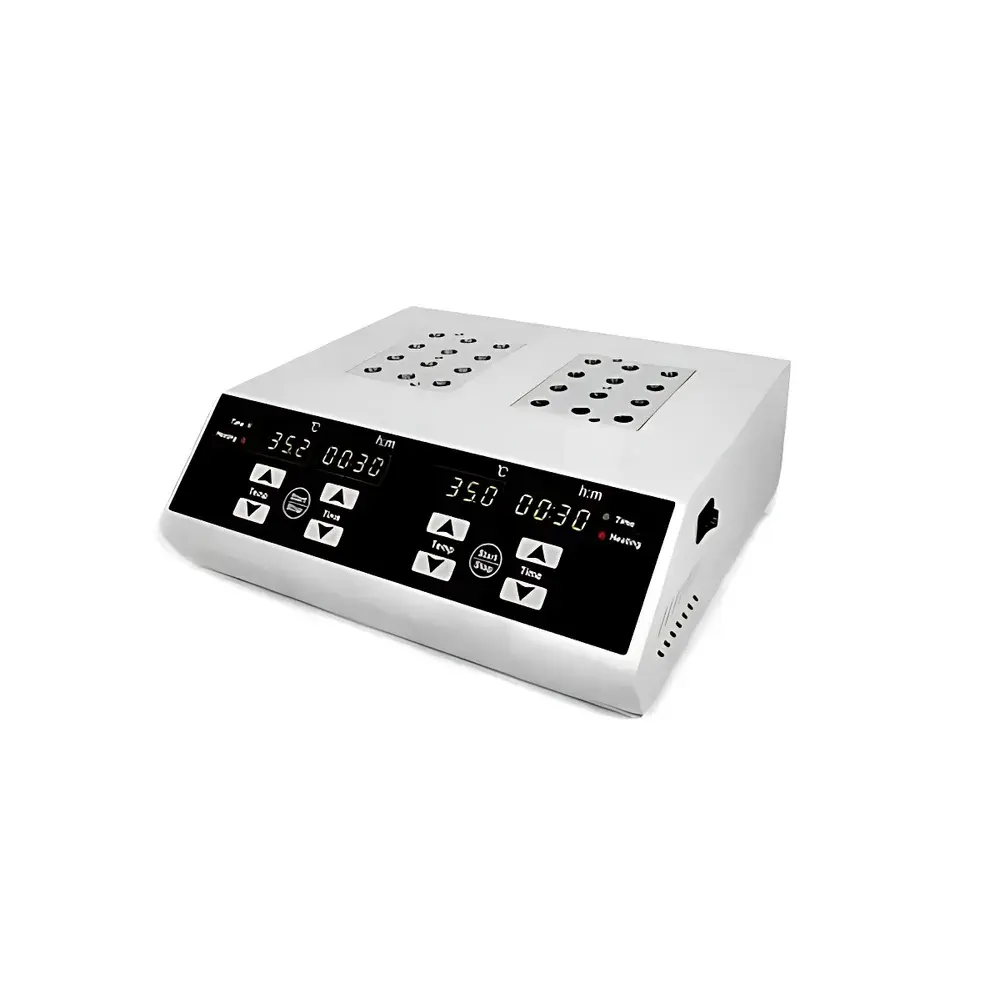
JIAYUAN DKT200-2A Dual-Zone Dry Block Heater
| Brand | JIAYUAN |
|---|---|
| Model | DKT200-2A |
| Temperature Range | Ambient +5°C to 150°C |
| Temperature Accuracy | ≤ ±0.5°C (40–100°C), ≤ ±1.0°C (100–150°C) |
| Temperature Uniformity | ≤ ±0.5°C across block surface |
| Max Block ΔT at 40°C differential | 0.3°C |
| Heating Time | ≤30 min (20°C → 150°C) |
| Display Resolution | 0.1°C |
| Timer Range | 1 min – 99 h 59 min |
| Max Power | 400 W |
| Dimensions (W×D×H) | 260 × 290 × 95 mm |
| Compatible Modules | DT01–DT19 (including 0.2 mL × 96, 1.5/2.0 mL × 24, 13–28 mm tube formats, 96-well PCR/ELISA plates, and custom blocks) |
Overview
The JIAYUAN DKT200-2A Dual-Zone Dry Block Heater is a microprocessor-controlled, conduction-based thermal incubation system engineered for precise, reproducible, and contamination-free temperature regulation of samples in sealed tubes and microplates. Unlike water baths—prone to evaporation, microbial growth, and cross-contamination—the DKT200-2A employs solid aluminum heating blocks with optimized thermal mass and high-efficiency resistive heating elements to deliver rapid, uniform heat transfer via direct metal-to-vessel contact. Its dual independent heating zones allow simultaneous operation at two distinct setpoints (e.g., 37°C for enzyme reactions and 95°C for denaturation), eliminating the need for multiple single-zone units and improving lab workflow efficiency. Designed for routine use in QC laboratories, clinical diagnostics, molecular biology workflows, and stability testing protocols, the instrument meets functional requirements aligned with ISO/IEC 17025 competency criteria for thermal equipment validation and supports GLP-compliant documentation when integrated with external data logging systems.
Key Features
- Dual-zone architecture with fully independent temperature control and real-time monitoring for each block—enabling concurrent assays requiring different thermal profiles.
- High-resolution LED display (0.1°C resolution) with intuitive keypad navigation and visual status indicators for setpoint, actual temperature, timer countdown, and operational mode.
- Rapid thermal response: achieves 150°C from ambient in ≤30 minutes, with minimal overshoot and stable equilibrium maintained within ±0.5°C (40–100°C) or ±1.0°C (100–150°C) per zone.
- Integrated safety systems include overtemperature cut-off (hardware-limited to 155°C), automatic fault detection with audible alarm, and self-calibrating temperature offset compensation to maintain long-term accuracy.
- Compact footprint (260 × 290 × 95 mm) and low-noise, fanless convection design minimize bench space usage and eliminate airflow interference during sensitive procedures such as PCR setup or ELISA plate handling.
- Modular interchangeability across 19 standardized and customizable block configurations—including 0.2 mL × 96-well PCR plates, 1.5/2.0 mL microcentrifuge tubes, 13–28 mm culture tubes, and flat-bottom 96-well ELISA plates—ensuring compatibility with common labware without adapters.
Sample Compatibility & Compliance
The DKT200-2A accommodates a broad spectrum of sample containers—from low-volume PCR strips and capped microtubes to standard 96-well assay plates—without risk of condensation, leakage, or immersion-related contamination. All aluminum blocks are anodized for chemical resistance and ease of decontamination using ethanol, hydrogen peroxide vapor, or autoclave-compatible sterilization methods (per manufacturer guidelines). While not certified to UL/CE or IEC 61010-1 out-of-the-box, the unit complies with general electrical safety principles applicable to Class I laboratory equipment. Its thermal performance characteristics align with ASTM E2251-22 (Standard Practice for Calibration of Thermal Devices Used in Laboratory Applications) and support validation protocols required under FDA 21 CFR Part 11 when paired with compliant data acquisition software and audit-trail-enabled controllers.
Software & Data Management
The DKT200-2A operates as a standalone instrument with no embedded connectivity; however, its analog output interface (0–5 V or 4–20 mA optional upon request) enables integration with third-party data loggers, SCADA systems, or LIMS platforms for automated temperature recording and traceability. Users may configure timed ramp-hold cycles up to 99 hours 59 minutes per zone, with non-volatile memory retaining settings after power interruption. For regulated environments, external validation tools (e.g., calibrated PT100 probes, thermographic imaging) are recommended to verify spatial uniformity and temporal stability per ISO/IEC 17025 Section 6.4.2. Firmware updates are performed manually via USB port (not included); revision history and calibration certificates are available upon request from authorized distributors.
Applications
- Molecular biology: Enzyme digestion, ligase incubation, plasmid transformation heat shock (42°C), and restriction enzyme activation.
- Clinical diagnostics: Serum coagulation assays (37°C), antigen retrieval for immunohistochemistry, and rapid antibody labeling protocols.
- Pharmaceutical QA/QC: Dissolution sample heating, extract stability studies, and excipient melting point screening.
- Food & environmental testing: Pathogen enrichment pre-incubation, mycotoxin extraction, and enzymatic cleanup steps prior to HPLC or GC analysis.
- Research labs: Cell lysate preparation, protein denaturation controls, and controlled-rate thawing of cryopreserved reagents.
FAQ
Can the DKT200-2A be used for PCR thermal cycling?
No—it lacks programmed ramping profiles and real-time thermal gradient control required for true PCR cycling. It functions as a static incubator or heat block only.
Is the unit compatible with ISO 13485-certified quality systems?
Yes, provided users implement documented IQ/OQ/PQ protocols, maintain calibration records, and apply appropriate change control for firmware or module replacements.
What is the expected service life of the heating elements?
Under normal operating conditions (≤150°C, ≤8 hrs/day), the resistive heating modules are rated for ≥10,000 hours of cumulative operation before significant drift occurs.
Are replacement blocks traceable to NIST standards?
Blocks themselves are not NIST-traceable; however, calibration verification using NIST-traceable reference thermometers (e.g., Fluke 1523/1524) is supported and recommended annually.
Does the device support remote monitoring via Ethernet or Wi-Fi?
Not natively—but analog output signals can be routed to industrial PLCs or IoT gateways for cloud-based telemetry when configured by qualified systems integrators.



