
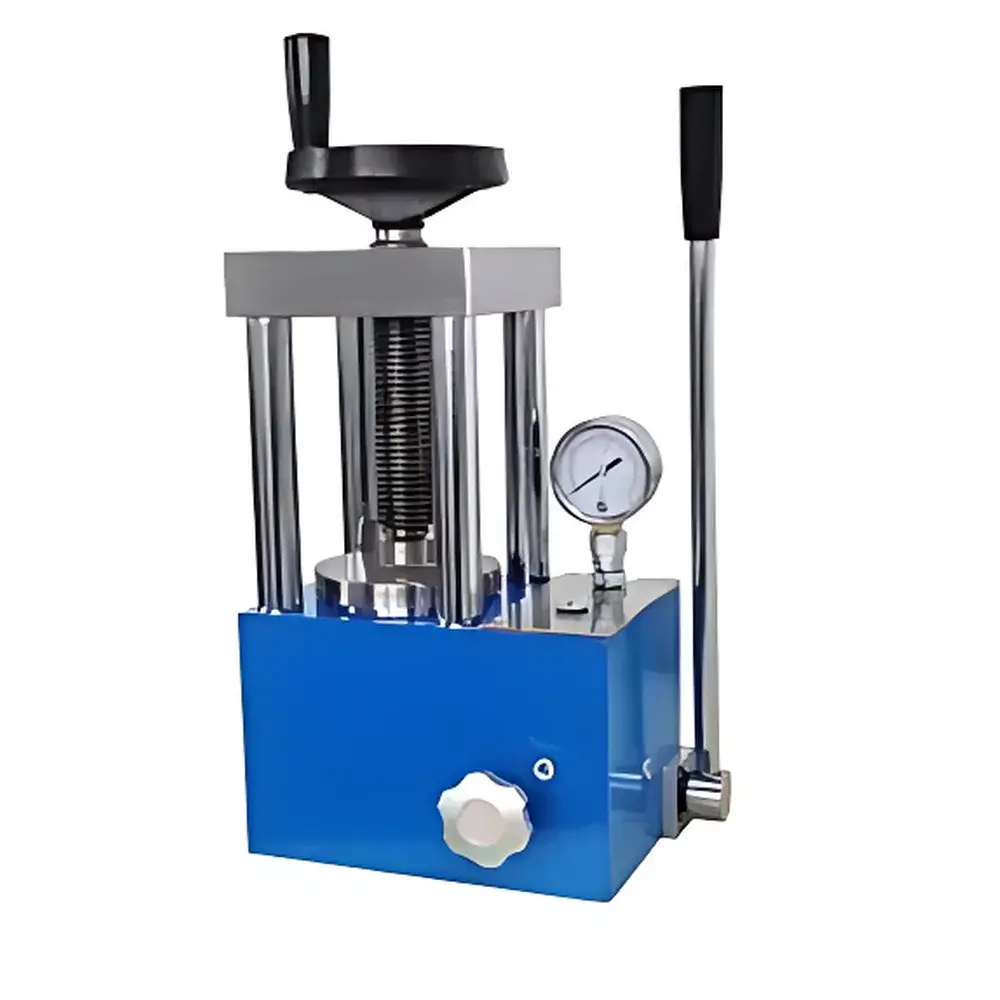
Jiayuan FW-4A Integrated Manual Hydraulic Powder Press
| Brand | Jiayuan |
|---|---|
| Origin | Beijing, China |
| Manufacturer Type | Authorized Distributor |
| Country of Origin | China |
| Model | FW-4A |
| Price | USD 1,100 (FOB Beijing) |
| Max Pressure | 0–24 Ton (0–38 MPa) |
| Pressure Stability | ≤1 MPa/10 min |
| Oil Cylinder Diameter | Φ70 mm (Chrome-Plated) |
| Max Piston Stroke | 20 mm |
| Worktable Diameter | 80 mm |
| Working Space | 120 × 120 × 130 mm |
| Frame | Monolithic Cast Base with 4 Guiding Columns |
| Weight | 25 kg |
| Dimensions (W×D×H) | 240 × 170 × 390 mm |
| Material | Anodized Aluminum Handwheel & Handle |
| Sealing | Integrated Chrome-Plated Cylinder with Zero-Leak Static Seal Architecture |
Overview
The Jiayuan FW-4A Integrated Manual Hydraulic Powder Press is an engineered solution for reproducible, high-fidelity sample compaction in analytical and materials science laboratories. Designed around a monolithic hydraulic architecture—integrating the base plate, oil reservoir, and cylinder into a single rigid casting—the FW-4A eliminates conventional dynamic sealing interfaces that are primary failure points in traditional toggle or bolted-frame presses. Its operating principle relies on manual hydraulic force multiplication via a precision-machined piston within a chrome-plated Φ70 mm cylinder, delivering calibrated pressures from 0 to 24 metric tons (0–38 MPa) with inherent mechanical stability. Unlike legacy designs prone to hydraulic fluid leakage, pressure decay during dwell, or seal degradation after storage, the FW-4A’s static-seal cylinder and corrosion-resistant aluminum handwheel ensure consistent force application over extended idle periods and repeated operational cycles—critical for preparing pellets for X-ray fluorescence (XRF), Fourier-transform infrared (FTIR), and pellet-based elemental analysis workflows.
Key Features
- Monolithic structural design: Unified base, oil reservoir, and cylinder eliminate interfacial gaskets and threaded joints—reducing leak paths and long-term drift.
- Chrome-plated hydraulic cylinder (Φ70 mm) with hardened internal bore ensures dimensional stability, low friction coefficient, and resistance to micro-pitting under cyclic loading.
- Dual-scale analog pressure gauge (MPa and ton units) enables rapid cross-referenced verification without unit conversion errors during method transfer.
- Anodized aluminum handwheel and handle provide ergonomic torque transmission while resisting oxidation in humid or solvent-exposed lab environments.
- Four-column guided ram motion ensures parallelism tolerance < ±0.02 mm across full stroke (20 mm), minimizing shear stress on fragile powder compacts.
- Pressure retention performance: ≤1 MPa decay over 10 minutes at maximum rated load—validated per ISO 6892-1 Annex E methodology for static load holding.
Sample Compatibility & Compliance
The FW-4A accommodates standard die sets (e.g., 13 mm, 25 mm, and 32 mm diameter punches) and supports both flat-faced and stepped dies for KBr, polyethylene, and borosilicate glass matrix pellet preparation. Its 80 mm worktable and 120 × 120 × 130 mm clear working envelope allow integration with automated die loaders and glovebox-compatible accessories. The press meets mechanical safety requirements outlined in EN 692:2005 (mechanical presses) and conforms to general laboratory equipment provisions under ISO/IEC 17025:2017 Clause 6.4 (equipment suitability). While not certified for GMP manufacturing, its pressure stability, traceable calibration capability (via external load cell validation), and documented maintenance intervals support GLP-aligned documentation practices in QC labs performing ASTM E1792 (XRF pellet preparation) or USP (solid dosage form testing).
Software & Data Management
The FW-4A operates as a standalone mechanical-hydraulic instrument with no embedded electronics or digital control interface. All pressure application and dwell timing are manually executed and recorded externally—enabling full auditability in regulated environments where deterministic, non-programmable operation is preferred. Users may integrate third-party load cells (e.g., Omega LCM Series) with USB/RS-232 data loggers to capture real-time force vs. time profiles for SOP compliance. Calibration certificates—including as-found/as-left data, uncertainty budgets (k=2), and traceability to NIST-traceable deadweight testers—can be generated upon request to satisfy FDA 21 CFR Part 11 metadata requirements when paired with validated electronic record systems.
Applications
- Preparation of homogeneous, binder-free pellets for quantitative XRF analysis of geological, metallurgical, and environmental samples.
- Compaction of KBr or polyethylene matrices for FTIR transmission spectroscopy—ensuring optical clarity and minimal scattering artifacts.
- Manufacturing of reference material tablets under controlled pressure protocols for method validation studies.
- Development of ceramic green bodies and battery electrode composites requiring precise green density control prior to sintering.
- Calibration verification of automated hydraulic presses using FW-4A as a stable, low-drift reference standard.
FAQ
Does the FW-4A require periodic hydraulic oil replacement?
Yes—hydraulic oil (ISO VG 32 mineral oil) should be replaced every 12 months or after 500 operational cycles, whichever occurs first, to maintain viscosity stability and prevent oxidation-induced seal swelling.
Can the FW-4A be used with custom die tooling?
Yes—its 80 mm worktable and open column geometry accommodate user-supplied dies up to 32 mm in diameter, provided vertical clearance and punch alignment tolerances are maintained.
Is pressure calibration traceable to national standards?
Calibration is performed using NIST-traceable deadweight testers (±0.05% FS uncertainty); certificates include measurement uncertainty, environmental conditions, and technician accreditation details.
What maintenance is required to sustain ≤1 MPa/10 min pressure stability?
Monthly inspection of cylinder surface finish, quarterly torque verification of column mounting bolts (12 N·m), and annual replacement of O-rings in the manual pump assembly are recommended.
How does the FW-4A compare to FW-5 in terms of structural rigidity?
The FW-4A’s four-column configuration provides 2.3× higher lateral stiffness than the FW-5’s two-column frame, reducing deflection-induced density gradients in large-diameter pellets (>20 mm).




