
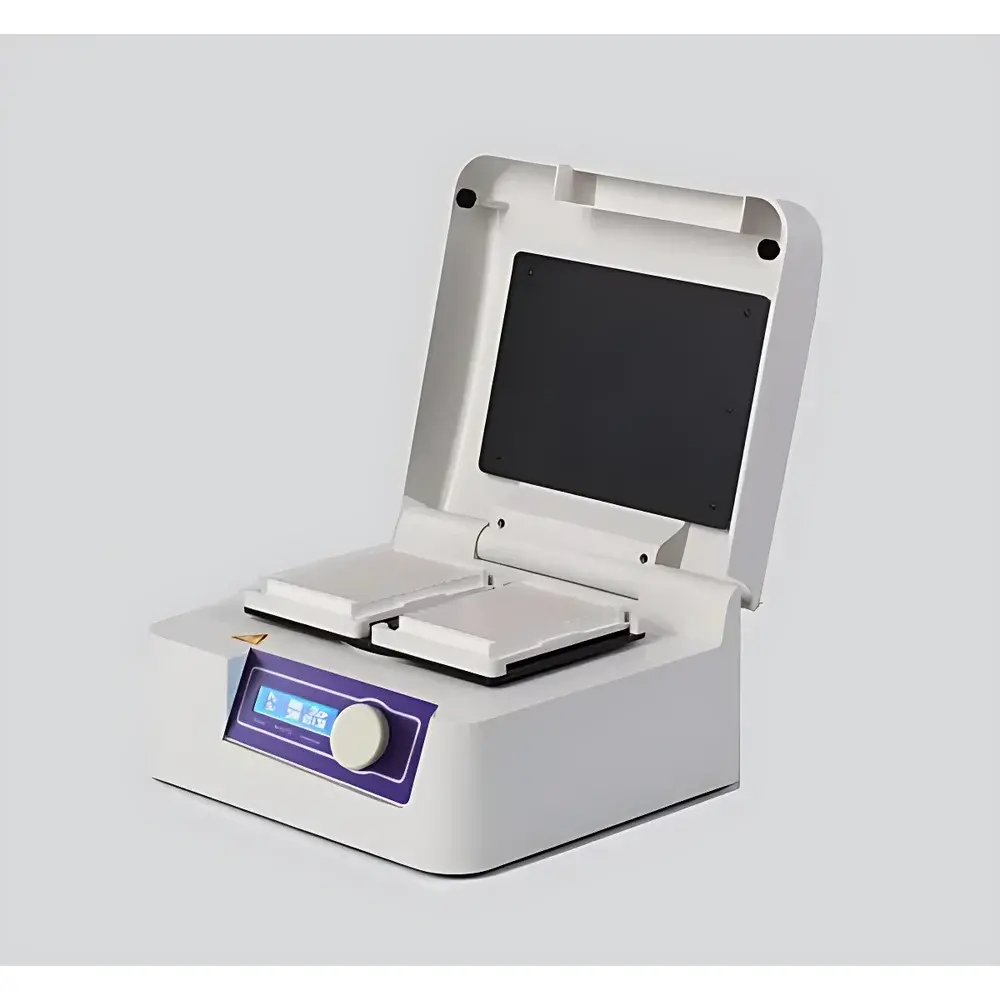
JIAYUAN MK100-2A Microplate Incubator
| Brand | JIAYUAN |
|---|---|
| Model | MK100-2A |
| Temperature Range | Ambient +5°C to 80°C |
| Temperature Accuracy | ≤ ±0.5°C |
| Heating Time | ≤20 min (from ambient to 80°C) |
| Timer Range | 1 min to 99 h 59 min |
| Display Resolution | 0.1°C |
| Temperature Uniformity Across Plate | ≤ ±0.5°C |
| Capacity | 2 standard microplates (e.g., 96-well, 384-well, deep-well, or cell culture plates) |
| Power Consumption | 120 W |
| Dimensions (W×D×H) | 280 × 270 × 140 mm |
| Net Weight | 4.0 kg |
Overview
The JIAYUAN MK100-2A Microplate Incubator is a compact, PID-controlled thermal incubation system engineered for precise and reproducible temperature maintenance across standard microplate formats. Designed specifically for life science laboratories performing enzyme-linked immunosorbent assays (ELISA), cell-based assays, immunoassays, and molecular binding studies, the device employs dual-zone resistive heating elements combined with real-time microprocessor feedback to deliver stable thermal environments without mechanical agitation or forced convection. Unlike water baths or orbital shakers, this unit maintains uniform surface temperature directly on the plate bottom—critical for minimizing edge effects in high-density assay formats such as 96-well and 384-well plates. Its solid-state architecture eliminates moving parts, reducing maintenance requirements and ensuring long-term operational stability under routine QC/QA and research conditions.
Key Features
- PID-controlled digital temperature regulation with ≤ ±0.5°C accuracy and ≤ ±0.5°C uniformity across full plate surface
- LCD interface displaying real-time temperature and programmable timer (1 minute to 99 hours 59 minutes)
- Dual-layer heating system optimized for rapid thermal equilibration—reaches 80°C from ambient in ≤20 minutes
- Automatic power recovery function: resumes pre-interruption settings after mains power restoration
- One-knob rotary interface for intuitive parameter entry—no menu navigation required
- Low-power consumption design (120 W) compatible with standard laboratory electrical infrastructure
- Compact footprint (280 × 270 × 140 mm) and lightweight chassis (4.0 kg) suitable for benchtop integration in biosafety cabinets or laminar flow hoods
Sample Compatibility & Compliance
The MK100-2A accommodates two standard-format microplates simultaneously—including ANSI/SLAS-compliant 96-well, 384-well, deep-well, and cell culture plates (e.g., 24-, 48-, and 96-well configurations). Its flat, thermally conductive aluminum heating block ensures minimal thermal gradient between wells, supporting applications requiring high inter-well consistency per ASTM E2922–22 (Standard Practice for Validation of Thermal Performance of Microplate-Based Assay Systems). While not certified for clinical diagnostic use under IVD regulations, the device meets general laboratory equipment safety standards per IEC 61010-1 and is routinely deployed in GLP-compliant environments where instrument qualification (IQ/OQ) documentation is maintained internally. It does not incorporate humidity control or CO2 regulation; therefore, it is intended for short-to-medium duration incubations where ambient atmospheric conditions are acceptable.
Software & Data Management
The MK100-2A operates as a standalone hardware platform with no embedded software stack, network interface, or data logging capability. All operational parameters are set and monitored locally via the front-panel LCD and rotary encoder. This design prioritizes reliability, electromagnetic compatibility, and audit readiness in regulated settings where uncontrolled firmware updates or remote access could compromise validation status. For laboratories requiring electronic recordkeeping, external USB-connected temperature loggers (e.g., compliant with FDA 21 CFR Part 11 when paired with validated software) may be used in parallel to capture time-stamped thermal profiles. The absence of internal memory or wireless connectivity ensures zero risk of unintended data modification—a key consideration during GMP or ISO 17025 audits.
Applications
- ELISA incubation steps: antigen-antibody binding, secondary antibody incubation, and substrate development phases
- Cell-based assay preconditioning: serum starvation, drug pretreatment, and receptor activation at defined temperatures
- Molecular interaction studies: hybridization kinetics in DNA/RNA probe assays, protein-protein binding equilibrium experiments
- Enzyme activity profiling: kinetic assays requiring strict thermal control over extended durations
- Quality control testing: stability assessment of reagent kits, calibrators, and controls under accelerated thermal conditions
- Teaching laboratories: hands-on instruction in assay protocol design, thermal parameter optimization, and experimental reproducibility principles
FAQ
Does the MK100-2A support humidity control or CO2 regulation?
No. This is a dry-heating incubator designed exclusively for temperature maintenance. Humidity-sensitive applications require supplemental environmental chambers.
Can the unit accommodate non-standard plate formats, such as PCR plates or custom microfluidic devices?
Only ANSI/SLAS-standard microplates with rigid, flat-bottom geometries are supported. Plates with irregular footprints or elevated rims may not achieve full thermal contact.
Is calibration traceable to national standards?
The device includes a factory calibration certificate. Users may perform periodic verification using NIST-traceable RTD probes placed directly on the heating surface per ISO/IEC 17025 guidelines.
What safety certifications does the MK100-2A carry?
It complies with IEC 61010-1 for electrical safety in laboratory equipment. No CE marking or UL listing is provided; regional conformity assessment must be conducted by the end-user institution.
How is temperature uniformity verified across the plate surface?
Uniformity is measured using a 9-point grid (center + eight perimeter positions) with calibrated thermistors per ASTM E2922–22 Annex A1, confirming ≤ ±0.5°C deviation under steady-state conditions.



