
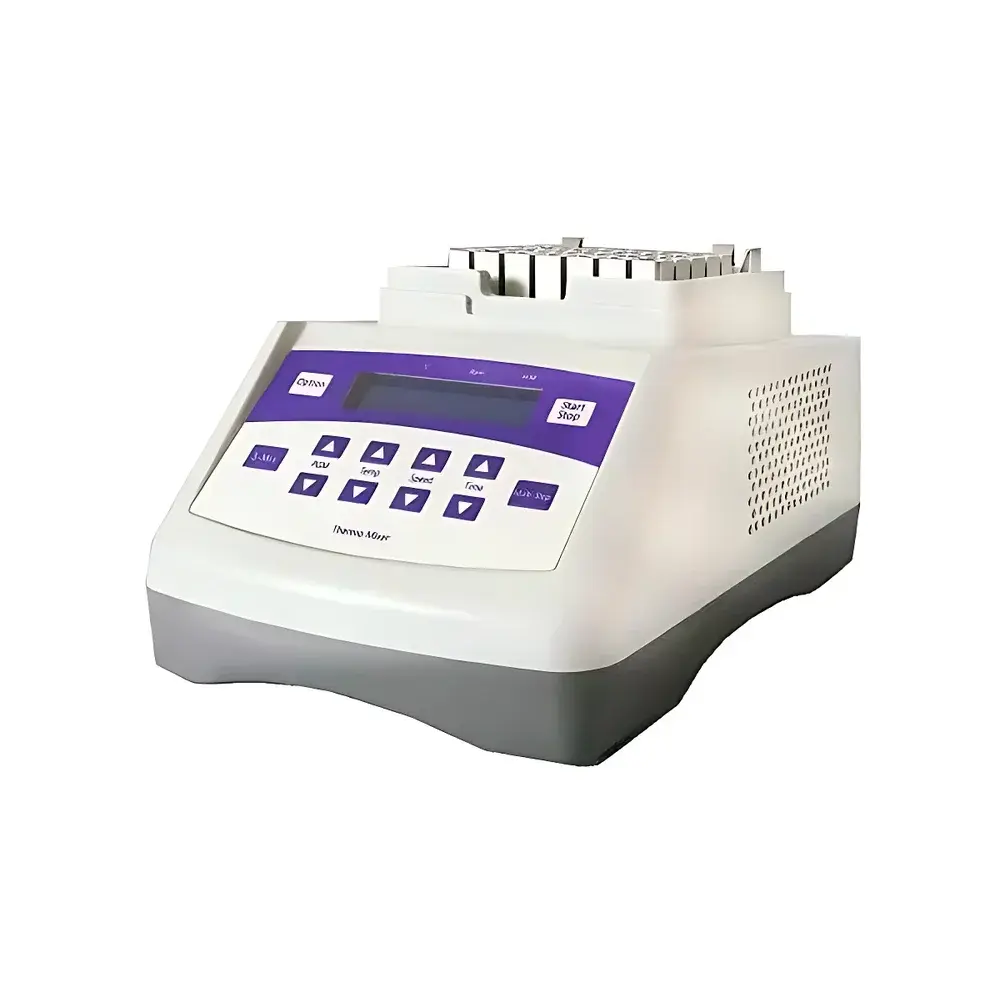
JIAYUAN MSC-100 Refrigerated Vortex Mixer with Temperature Control
| Key | Brand: JIAYUAN |
|---|---|
| Model | MSC-100 |
| Origin | Beijing, China |
| Type | Refrigerated Temperature-Controlled Orbital Shaker |
| Timing Range | 0–99 h 59 min |
| Oscillation Speed | 200–1500 rpm |
| Orbit Diameter | 3 mm |
| Temperature Range | 0–100 °C |
| Heating Accuracy | ≤ ±0.3 °C |
| Temperature Uniformity | ≤ ±0.3 °C |
| Display Resolution | 0.1 °C |
| Heating Time (25→100 °C) | ≤12 min |
| Cooling Time (100→25 °C) | ≤10 min |
| Cooling Time (RT→RT−20 °C) | ≤15 min |
| Power Consumption | 150 W |
| Dimensions (W×D×H) | 260 × 195 × 150 mm |
| Net Weight | 7.0 kg |
| Plate Quantity | 1 interchangeable aluminum block |
Overview
The JIAYUAN MSC-100 Refrigerated Vortex Mixer with Temperature Control is a compact, microprocessor-driven orbital shaker engineered for precise thermal management and consistent mechanical agitation in life science laboratories. Unlike conventional incubators or standalone vortexers, the MSC-100 integrates Peltier-based thermoelectric cooling, resistive heating, and brushless DC motor-driven orbital motion into a single platform—enabling simultaneous temperature regulation and homogeneous mixing across diverse sample formats. Its operation relies on closed-loop feedback control of both thermal and rotational parameters, ensuring reproducible conditions for time-sensitive biochemical reactions including enzyme kinetics, cell lysis, nucleic acid hybridization, and reagent equilibration. Designed for benchtop use in molecular biology, clinical diagnostics, and pharmaceutical R&D labs, the instrument complies with fundamental safety and electromagnetic compatibility requirements per IEC 61010-1 and meets ambient operating specifications under ISO/IEC 17025-compliant environments.
Key Features
- Integrated thermoelectric (Peltier) cooling and resistive heating system enabling rapid thermal transitions between 0 °C and 100 °C, with ≤±0.3 °C accuracy and uniformity across the aluminum heating block
- Brushless DC motor delivering stable orbital oscillation at 200–1500 rpm with ≤±2 rpm speed fluctuation and <45 dB(A) acoustic emission at maximum load
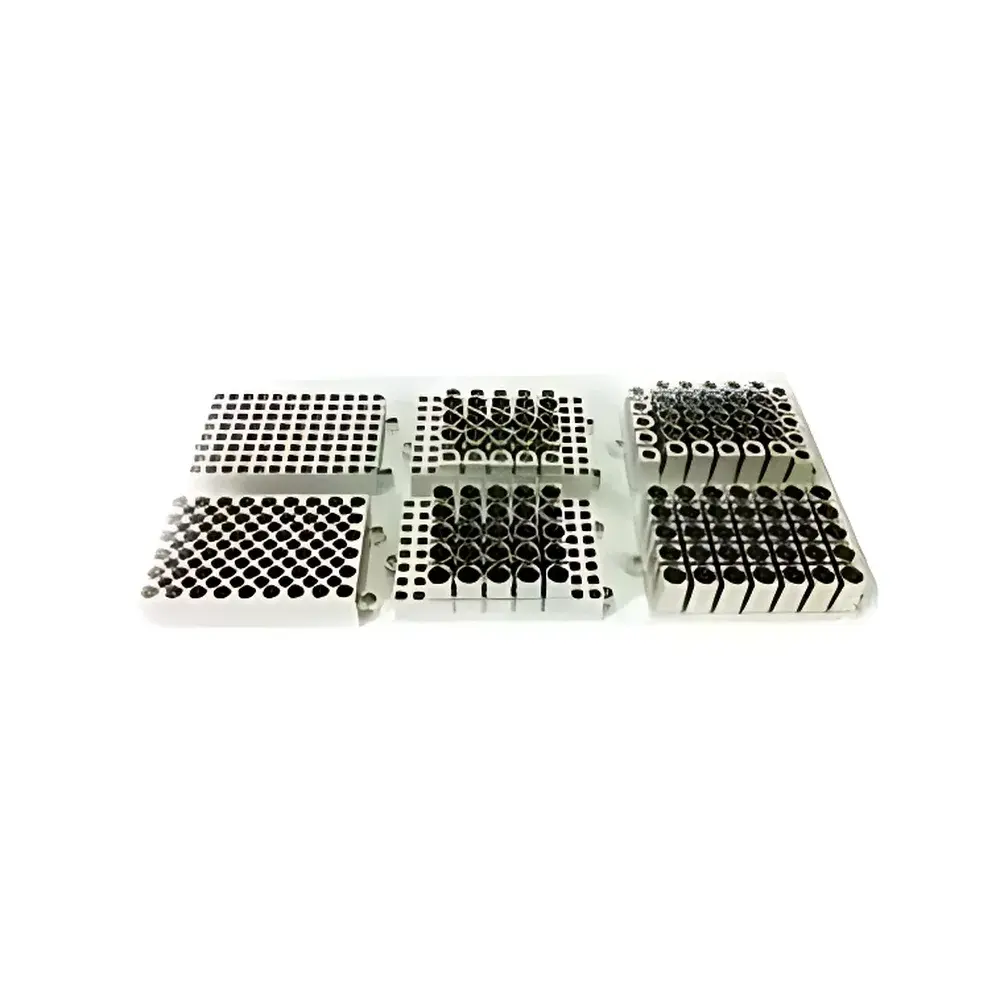
- Single interchangeable aluminum block platform supporting standardized tube and plate configurations—including 96-well PCR plates, 0.2–50 mL centrifuge tubes, and custom-configured multi-format blocks (A–J)
- High-resolution LCD interface displaying real-time temperature, speed, and remaining time; supports parameter lockout and user-defined calibration offsets for individual block types
- Dual-mode timing architecture: continuous run mode and programmable countdown timer (0–99 h 59 min) with audible end-of-program alert
- Configurable operational modes: independent activation/deactivation of temperature control, shaking, and timing functions to support sequential or parallel protocol steps
- Power-loss recovery functionality with configurable auto-restart behavior, preserving experimental continuity during brief outages
- Pre-heating and automatic 4 °C hold modes optimized for cold-sensitive applications such as protein stabilization and RNA handling
Sample Compatibility & Compliance
The MSC-100 accommodates a broad range of primary labware via its modular aluminum block system, including standard 0.2 mL PCR tubes (96-position), 1.5/2.0 mL microcentrifuge tubes (35-position), 5–50 mL conical tubes (up to 6×50 mL at reduced speed), and flat-bottom 96-well ELISA plates. All blocks are CNC-machined from high-conductivity anodized aluminum to minimize axial and radial thermal gradients. The instrument does not require external refrigerant or water circulation, eliminating maintenance overhead associated with compressor-based systems. While not certified for GLP/GMP production environments, its temperature and speed traceability—supported by internal logging and user-accessible calibration routines—aligns with routine QC/QA workflows in research and preclinical settings. It satisfies general laboratory equipment requirements outlined in CLSI EP23-A and ASTM E2500-13 for verification of thermal and mechanical performance.
Software & Data Management
The MSC-100 operates via embedded firmware without external PC dependency. All operational parameters—including setpoints, runtime, and calibration corrections—are stored in non-volatile memory. Though it lacks USB or Ethernet connectivity, the device supports manual audit trail generation through timestamped LCD screen captures and operator-recorded log entries. For laboratories implementing 21 CFR Part 11 compliance frameworks, the instrument may be integrated into broader electronic lab notebook (ELN) or LIMS ecosystems via external environmental monitoring gateways that record ambient chamber data and operator-initiated events. Firmware updates are performed locally using factory-provided service tools; version history and checksum validation are maintained in the boot ROM.
Applications
- Thermally controlled enzymatic digestions (e.g., restriction enzyme reactions, ligations, phosphorylations)
- Uniform resuspension of lyophilized reagents and bacterial pellets prior to downstream analysis
- Equilibration of reaction mixtures at defined temperatures before qPCR, RT-PCR, or digital PCR setup
- Controlled denaturation and annealing steps in nucleic acid probe preparation
- Cell culture sample homogenization during passaging or cryopreservation workflows
- Stabilization and mixing of antibody-antigen complexes in immunoassay development
- Routine quality checks of buffer formulations requiring temperature-dependent viscosity assessment
FAQ
Does the MSC-100 support external data logging or computer control?
No. The instrument operates autonomously with no serial, USB, or network interface. Data recording must be performed manually or via third-party environmental monitors.
Can multiple temperature zones be controlled simultaneously?
No. The MSC-100 features a single-zone thermal control system. Only one block is mounted at a time, and temperature uniformity is validated across its entire surface.
What is the maximum safe operating speed when using 50 mL tubes?
For mechanical stability and tube integrity, the recommended maximum speed is 600 rpm when using blocks designated for ≥5 mL capacity (G–J).
Is the unit suitable for long-term unattended operation?
Yes—provided ambient room temperature remains within 15–30 °C and relative humidity stays below 80% non-condensing. Continuous operation beyond 24 hours is supported under these conditions.
How often should temperature calibration be performed?
We recommend quarterly verification using a NIST-traceable thermometer; more frequent calibration may be required in high-throughput or regulated environments where thermal drift impacts assay validity.



