
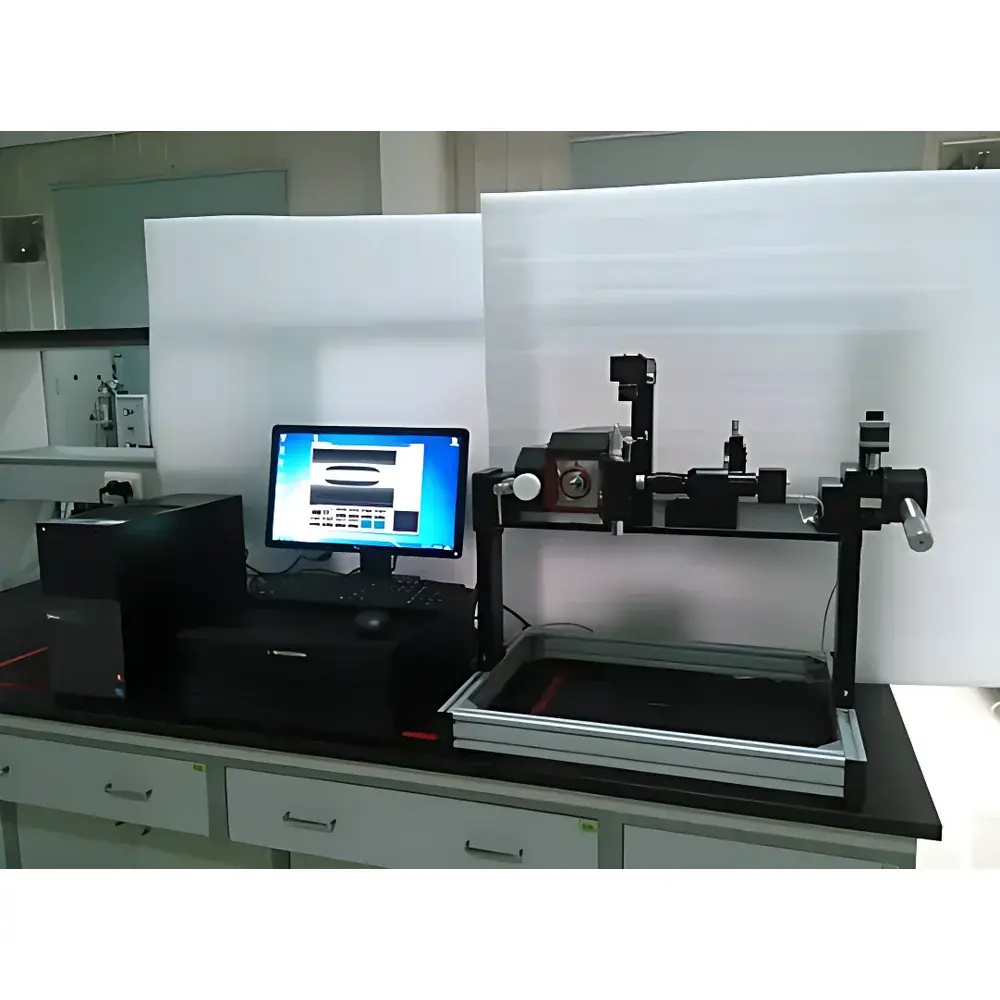
JingJie JJ2000TP High-Temperature & High-Pressure Rotating Drop Interfacial Tensiometer
| Origin | Beijing, China |
|---|---|
| Manufacturer Type | Authorized Distributor |
| Regional Origin | Domestic (PRC) |
| Model | JJ2000TP |
| Price Range | USD 70,000 – 140,000 |
| Surface/Interfacial Tension Range | 1×10⁻⁵ – 100 mN/m |
| Temperature Control Range | Ambient to 150 °C |
| Temperature Accuracy | ±0.1 °C |
| Maximum Pressure Rating | 0.78 MPa |
| Rotational Speed Range | 1,000 – 10,000 rpm (Control Accuracy: ±0.1%) |
| Optical Resolution | 768 × 576 pixels |
| Frame Rate | 30 fps |
| Video Output | RCA composite |
| Data Interface | RS-232 |
| Power Supply | 220 V / 50 Hz or 110 V / 60 Hz |
Overview
The JingJie JJ2000TP High-Temperature & High-Pressure Rotating Drop Interfacial Tensiometer is an engineered solution for precise measurement of ultra-low interfacial tension (IFT) and dynamic contact angle under thermally and mechanically controlled conditions. Based on the rotating drop method—a well-established technique rooted in capillary hydrodynamics and Laplace pressure equilibrium—the instrument determines interfacial tension by analyzing the shape deformation of a denser liquid droplet suspended within a less-dense continuous phase under centrifugal force. At equilibrium, the droplet assumes a prolate spheroid geometry whose aspect ratio correlates directly with the interfacial tension between the two immiscible phases. This principle enables reliable quantification across seven decades of IFT (1×10⁻⁵ to 100 mN/m), making the JJ2000TP particularly suited for enhanced oil recovery (EOR) formulation screening, microemulsion characterization, and high-pressure reservoir fluid studies where conventional pendant or sessile drop methods fail due to gravitational dominance or thermal instability.
Key Features
- Integrated high-precision temperature-controlled chamber with PID-regulated heating, maintaining stability within ±0.1 °C from ambient up to 150 °C—critical for simulating downhole thermal conditions in EOR workflows.
- Robust high-speed rotation system delivering 1,000–10,000 rpm with 0.1% speed control accuracy, ensuring reproducible centrifugal fields for consistent droplet deformation analysis.
- Dual-function capability: simultaneous acquisition of interfacial tension and dynamic contact angle on solid substrates immersed in two-phase systems—enabling direct assessment of wettability alteration during surfactant flooding or nanoparticle-enhanced recovery.
- Digital video imaging subsystem with 768 × 576 resolution and 30 fps capture rate, coupled with real-time image processing algorithms optimized for sub-pixel edge detection of rotating droplets.
- Modular quartz sample cell design (2 mm and 4 mm inner diameters) fabricated from high-purity fused silica to withstand pressures up to 0.78 MPa and thermal cycling without optical distortion or chemical leaching.
- Windows-based control software with intuitive GUI, supporting automated experiment sequencing, timestamped data logging, and export of raw BMP images and calibrated numerical results (IFT, contact angle, rotational speed, temperature).
Sample Compatibility & Compliance
The JJ2000TP accommodates a broad range of fluid systems including aqueous surfactant solutions, hydrocarbon mixtures (crude oils, distillates), polymer solutions, ionic liquids, and CO₂-expanded solvents. Its pressure-rated cell allows safe operation with volatile or supercritical components under sealed conditions. While not certified to ISO/IEC 17025 or ASTM D971/D1331 per se, the instrument’s measurement methodology aligns with established protocols for rotating drop tensiometry referenced in ASTM D7567 (Standard Guide for Interfacial Tension Determination Using the Rotating Drop Method) and ISO 6295 (Petroleum products — Determination of interfacial tension of mineral oil–water). Data integrity is supported through RS-232 traceable output and time-stamped experimental metadata—facilitating GLP-compliant documentation when integrated into validated laboratory workflows.
Software & Data Management
The proprietary Windows application provides full bidirectional communication with the embedded microcontroller for synchronized parameter setting (temperature, rotation speed, exposure time) and real-time monitoring. All acquired images are saved as uncompressed BMP files with embedded EXIF-style metadata (timestamp, setpoint values, calibration ID). Numerical outputs—including interfacial tension (mN/m), contact angle (°), droplet dimensions (mm), and system diagnostics—are exported to CSV or Excel-compatible formats. Audit trail functionality records operator login, method version, and modification history—supporting alignment with FDA 21 CFR Part 11 requirements when deployed in regulated QC environments under appropriate procedural controls.
Applications
- Screening and optimization of surfactant, co-surfactant, and alkali formulations for alkaline-surfactant-polymer (ASP) flooding and low-salinity waterflooding.
- Quantifying IFT reduction efficiency of novel nanostructured additives (e.g., silica nanoparticles, polymer-grafted surfactants) under reservoir-relevant P/T conditions.
- Characterizing wettability reversal mechanisms in carbonate and sandstone cores via dynamic contact angle evolution during spontaneous imbibition experiments.
- Studying phase behavior and stability limits of microemulsions and middle-phase emulsions used in chemical EOR pilot design.
- Quality control of industrial surfactants, lubricants, coatings, and agrochemical adjuvants where ultra-low interfacial activity dictates performance.
FAQ
What is the minimum measurable interfacial tension using the JJ2000TP?
The instrument achieves reliable detection down to 1×10⁻⁵ mN/m under optimal conditions (e.g., high-density contrast, stable rotation, low vibration environment).
Can the system operate at elevated pressures beyond 0.78 MPa?
No—the standard quartz cell is rated for a maximum working pressure of 0.78 MPa. Custom pressure vessels require third-party mechanical validation and are not supported out-of-the-box.
Is the software compatible with Windows 10/11 64-bit operating systems?
Yes, the current software release supports Windows 10 and 11 (64-bit) with .NET Framework 4.8 and standard USB-to-RS232 adapters.
Does the system meet FDA 21 CFR Part 11 requirements for electronic records?
The hardware and software provide foundational elements (audit trail, electronic signatures, data immutability options); full compliance requires site-specific validation and procedural governance per organizational SOPs.
What maintenance is required for long-term operational reliability?
Routine cleaning of optical path components, periodic recalibration of temperature sensor against NIST-traceable reference, and verification of rotational encoder linearity every 12 months are recommended.



