
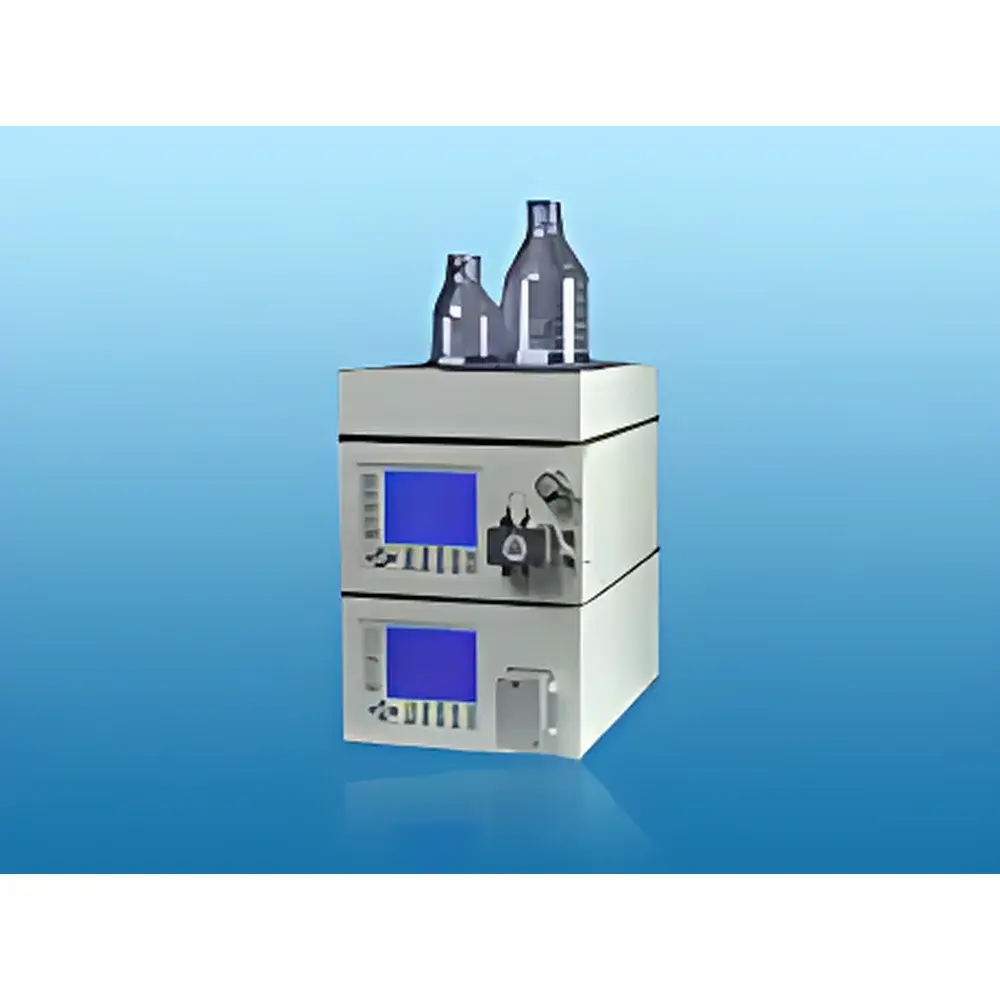
Jinpu LC-3000 Isocratic Liquid Chromatograph
| Brand | Jinpu |
|---|---|
| Origin | Shandong, China |
| Model | LC-3000 |
| Pump Type | Dual-plunger reciprocating high-pressure pump (P3000 series) |
| Max Pressure | 42 MPa (P3110), 30 MPa (P3120) |
| Flow Range | 0.002–9.998 mL/min (P3110), 0.01–49.99 mL/min (P3120) |
| Flow Accuracy | ±2% (2–5% range, MeOH/H₂O 80:20) |
| Flow RSD | <0.1% |
| UV/Vis Detector | UV3000 |
| Wavelength Range | 190–700 nm |
| Light Sources | Deuterium lamp (standard), Tungsten lamp (optional) |
| Wavelength Accuracy | ±2 nm |
| Wavelength Repeatability | 0.4 nm |
| Scan Modes | Step-scan with programmable start/end wavelengths and step size |
| Absorbance Range | 0–2 AU |
| Baseline Noise | 2×10⁻⁵ AU/h (254 nm, 1 mL/min, MeOH/H₂O 80:20) |
| Baseline Drift | 15×10⁻⁵ AU/h (254 nm, 1 mL/min, MeOH/H₂O 80:20) |
| Time Constants | 0.1/0.2/0.5/1/2/5/10 s |
| Auto-zero | Full-scale |
| Display | 320×240 dot-matrix LCD with adjustable blue backlight |
| Power Supply | 220 V ±10%, 50 Hz |
| Pump Power | 400 W |
| Detector Power | 60 W |
| Dimensions (D×H×W) | 398×149×267 mm |
| Weight | 14 kg |
| GLP Functions | Lamp operating time, lamp cycle count, lamp replacement log, serial number tracking |
Overview
The Jinpu LC-3000 Isocratic Liquid Chromatograph is a robust, benchtop HPLC system engineered for routine analytical separations in quality control laboratories, academic research settings, and small-scale method development workflows. Built around the P3000-series dual-plunger reciprocating high-pressure pumps and the UV3000 UV/Vis spectrophotometric detector, the LC-3000 implements classical isocratic elution—delivering constant mobile phase composition throughout the chromatographic run. Its design adheres to fundamental principles of liquid chromatography: analyte partitioning between a stationary phase (typically C18 or other bonded silica) and a homogeneous mobile phase under precisely controlled flow and pressure conditions. The system supports both analytical and semi-preparative applications through interchangeable pump heads (10 mL or 50 mL, stainless steel or PEEK) and flow cell options (analytical, semi-preparative, or preparative), enabling flexibility without hardware reconfiguration. All operational parameters—including flow rate, pressure limits, wavelength selection, scan configuration, and time constant—are accessible via front-panel controls or RS232 serial interface, ensuring compatibility with legacy lab automation environments.
Key Features
- Dual-plunger reciprocating pump architecture with slow-start/stop functionality and user-adjustable maximum/minimum pressure limits for enhanced column protection and solvent compressibility compensation.
- 320×240 dot-matrix LCD display with adjustable blue backlight for clear parameter visualization under varied ambient lighting conditions.
- UV3000 detector featuring deuterium lamp (190–370 nm) and optional tungsten lamp (350–700 nm) for broad spectral coverage; programmable step-scan mode allows precise wavelength selection for multi-analyte detection or spectral confirmation.
- High flow stability: RSD <0.1% under constant conditions (MeOH/H₂O 80:20, 1 mL/min), supporting reproducible retention time alignment across repeated injections.
- Integrated GLP-compliant data logging: automatic recording of lamp operating hours, lamp replacement events, lamp cycle counts, and instrument serial number—facilitating audit readiness per ISO/IEC 17025 and FDA 21 CFR Part 11 requirements when paired with compliant software.
- Modular pump head design: interchangeable 10 mL and 50 mL pump heads in stainless steel or PEEK materials to accommodate varying solvent compatibility needs (e.g., high-pH mobile phases with PEEK) and flow rate demands.
Sample Compatibility & Compliance
The LC-3000 accommodates standard 3.9–4.6 mm i.d. analytical columns and 10 mm i.d. semi-preparative columns, compatible with common reversed-phase, normal-phase, and ion-exchange stationary phases. Mobile phase compatibility includes aqueous buffers (pH 2–8), acetonitrile, methanol, tetrahydrofuran, and chlorinated solvents—subject to pump head material selection (PEEK recommended for high-pH or halogenated solvents). System components meet CE marking requirements for electromagnetic compatibility (EMC) and low-voltage directive compliance. While the base instrument does not include 21 CFR Part 11–compliant electronic signature or audit trail capabilities, its RS232 interface enables integration with validated third-party chromatography data systems (CDS) that provide full GxP-aligned data integrity features—including user access control, electronic signatures, and immutable audit trails—for regulated environments (e.g., pharmaceutical QC per USP , ICH Q2(R2), or ISO 17025-accredited testing).
Software & Data Management
The LC-3000 operates in two primary control modes: standalone (front-panel keypad input) and serial (RS232 communication). In standalone mode, all acquisition and display functions are self-contained—ideal for teaching labs or non-regulated method verification. For automated data capture and reporting, the system interfaces with external CDS platforms via ASCII-based command protocol. Raw analog absorbance signals (0–1 V output) and digital status registers (pressure, flow, lamp status) are continuously accessible. Instrument-generated GLP metadata—including total lamp hours, lamp swap history, and firmware version—is retained in non-volatile memory and retrievable via serial query. When integrated into a validated CDS environment, chromatograms, peak tables, and system suitability reports can be archived in vendor-neutral formats (e.g., .cdf or .dx) compliant with long-term digital preservation standards (ISO 14721:2012 OAIS).
Applications
- Pharmaceutical assay and impurity profiling per USP monographs requiring isocratic UV detection (e.g., paracetamol, caffeine, ibuprofen).
- Food additive quantification (e.g., benzoic acid, sorbic acid) in beverages and sauces using simple reversed-phase methods.
- Environmental analysis of phenolic compounds in water extracts following EPA Method 608 derivatization protocols.
- Polymer additive screening (e.g., antioxidants, UV stabilizers) in organic solvent extracts from polyolefin matrices.
- Academic teaching of HPLC fundamentals—including retention mechanism, selectivity optimization, and detector linearity assessment—due to intuitive operation and transparent parameter control.
FAQ
Is the LC-3000 compatible with gradient elution?
No—the LC-3000 is designed exclusively for isocratic operation. Gradient capability requires dual-pump synchronization and proportioning valves, which are not included in this model.
Can the UV3000 detector perform full-spectrum acquisition?
No—it supports step-scan mode only, where absorbance is measured at discrete, user-defined wavelengths—not continuous diode-array scanning.
What pump head material is recommended for phosphate buffer at pH 7.4?
PEEK pump heads (PH006 or PH008) are strongly recommended to prevent corrosion and metal ion leaching associated with stainless steel under neutral-to-alkaline conditions.
Does the system include column oven or autosampler?
No—these are optional accessories not supplied with the base LC-3000 configuration. Temperature control and sample injection must be implemented externally.
Is firmware upgrade support available?
Yes—Jinpu provides periodic firmware updates via secure download portal for registered instruments, addressing minor functional enhancements and diagnostic improvements.
Related Products





