
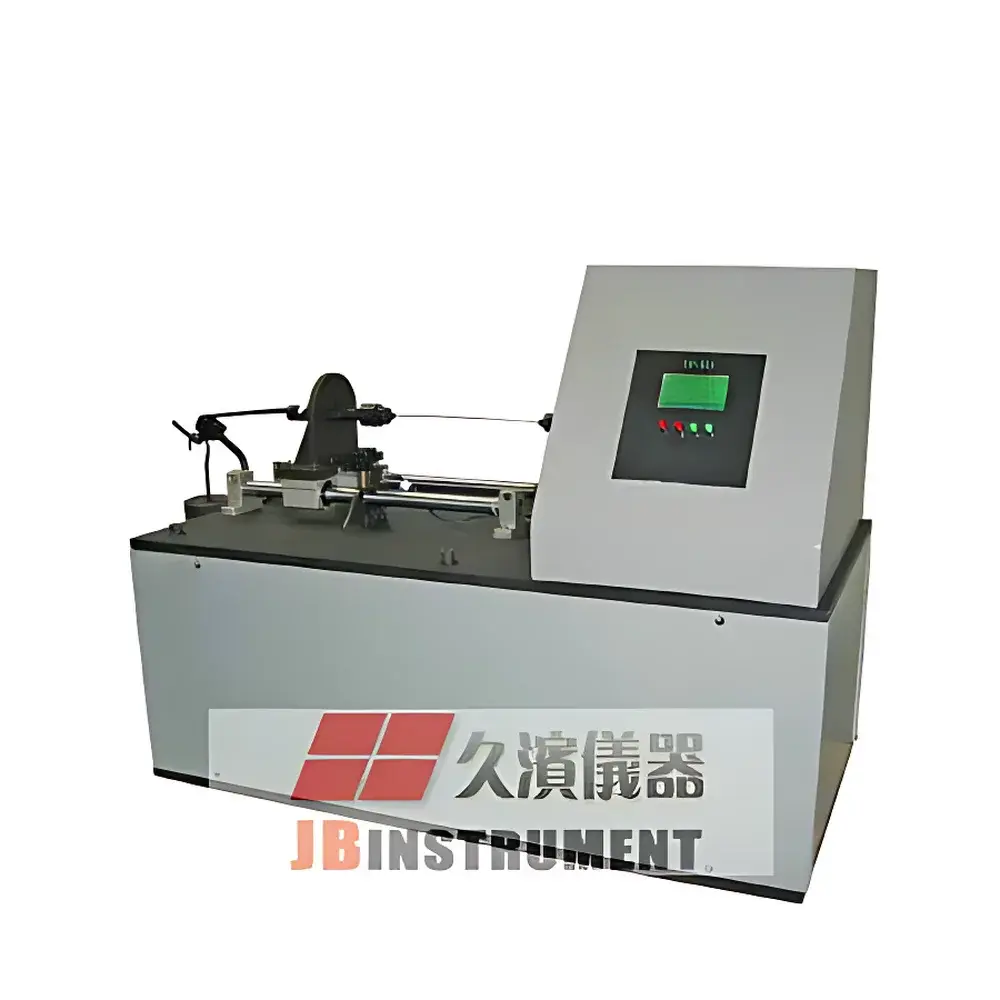
Jiubin Instruments JB-X10 Metal Wire Torsion Testing Machine
| Brand | Jiubin Instruments |
|---|---|
| Model | JB-X10 |
| Origin | Shanghai, China |
| Type | Benchtop Torsion Testing Machine for Metallic Wires |
| Specimen Diameter Range | 0.1–10.0 mm |
| Gauge Length | 500 mm |
| Torsion Speed Options | 30 / 60 / 90 / 120 rpm |
| Speed Accuracy | ±10% |
| Minimum Count Resolution | 0.1 turn |
| Coaxiality of Grips | < 0.4 mm |
| Parallelism of Sliding Rail | < 0.2 mm |
| Grip Hardness | 50–65 HRC |
| Dimensions (L×W×H) | 1360 × 430 × 600 mm |
| Weight | 200 kg |
| Power Supply | 220 V, 50 Hz |
| Operating Noise | < 50 dB(A) (idle), < 70 dB(A) (under load) |
| Compliance | GB/T 239–1999, ISO 7800:1984, ISO 9649:1990 |
Overview
The Jiubin Instruments JB-X10 Metal Wire Torsion Testing Machine is an electromechanically controlled benchtop system engineered for standardized mechanical evaluation of ductility, surface integrity, and internal homogeneity in metallic wire specimens. It operates on the principle of controlled angular displacement under constant or stepwise torque application, enabling precise quantification of torsional deformation behavior in accordance with internationally recognized metallurgical test protocols. The machine executes both unidirectional and bidirectional torsion cycles—defined as one full 360° rotation about the specimen’s longitudinal axis—with programmable cycle counts, real-time rotational counting, and automatic termination upon fracture or user-defined turn limits. Its rigid structural architecture, high-precision alignment tolerances (< 0.4 mm coaxiality; < 0.2 mm rail parallelism), and hardened grip systems (50–65 HRC) ensure repeatable clamping force distribution and minimal parasitic bending during testing—critical for eliminating measurement artifacts in fine-diameter wires (0.1–10.0 mm).
Key Features
- Four selectable torsion speeds (30, 60, 90, 120 rpm) with closed-loop regulation via Delixi variable-frequency drive system, maintaining speed stability within ±10% across load variations.
- High-resolution optical encoder-based turn counter with 0.1-turn minimum resolution and non-contact detection using dual photoelectric sensors—ensuring long-term calibration stability and immunity to mechanical wear.
- Modular grip assembly with three interchangeable jaw sets: flat jaws (0–3 mm), round jaw #1 (3–6 mm), and round jaw #2 (6–10 mm), each manufactured from heat-treated alloy steel meeting hardness specifications per GB/T 239–1999 Annex B.
- 500 mm fixed gauge length with precision-machined sliding carriage guided by hardened linear rails—designed to minimize axial deviation and maintain consistent torsional moment arm throughout testing.
- Integrated LCD interface with Chinese-character menu navigation, supporting parameter setup, real-time turn display, mode selection (unidirectional/bidirectional), and manual emergency stop activation.
- Compliance-ready mechanical construction: frame stiffness and dimensional tolerances conform to GB/T 2611 (General Requirements for Testing Machines); packaging meets JB/T 614 (Mechanical Product Packaging Standards).
Sample Compatibility & Compliance
The JB-X10 accommodates solid metallic wires—including copper, aluminum, stainless steel, titanium alloys, and precious metal conductors—with nominal diameters ranging from 0.1 mm to 10.0 mm. Its grip geometry and clamping force profile are optimized to prevent slippage or localized crushing during high-cycle torsion, particularly critical for brittle-phase-containing alloys or drawn micro-wires. The system fully supports statutory test execution per GB/T 239–1999 (Chinese National Standard), ISO 7800:1984 (Unidirectional Torsion of Metallic Wires), and ISO 9649:1990 (Bidirectional Torsion of Metallic Wires). While not inherently 21 CFR Part 11-compliant (as it lacks electronic audit trail functionality), raw test data—including turn count, speed setting, and failure event timestamp—can be manually recorded into GLP/GMP-aligned laboratory notebooks. Calibration certificates traceable to national metrology institutes may be issued upon request.
Software & Data Management
The JB-X10 operates as a standalone hardware platform without embedded PC-based software or network connectivity. All operational parameters are configured locally via the front-panel LCD interface. Turn count, speed selection, and test mode are displayed in real time; no digital data export (USB, Ethernet, RS-232) is provided. Users are required to document results manually or integrate external video recording for visual verification of fracture onset and surface defect propagation. For laboratories requiring automated reporting, third-party DAQ systems may be interfaced via TTL-level pulse output from the optical sensor (available upon technical consultation). Firmware updates are performed exclusively through factory service—no user-accessible programming interface exists.
Applications
- Quality control of drawn copper and aluminum magnet wires used in motor windings and transformer coils.
- Evaluation of cold-drawn stainless steel suture wires for medical device manufacturing, assessing fatigue resistance and microstructural consistency.
- Verification of torsional ductility in precious metal bonding wires (e.g., gold, palladium) prior to semiconductor packaging.
- Research-grade assessment of texture evolution and shear band formation in ultrafine-grained metallic wires subjected to severe plastic deformation.
- Failure analysis of fractured wire specimens—correlating torsional fracture morphology (helical vs. transverse) with underlying metallurgical anomalies such as centerline segregation or inclusion clusters.
FAQ
Does the JB-X10 support automated data logging or CSV export?
No. The JB-X10 does not include internal memory storage, USB ports, or software drivers. All test records must be manually documented.
Can the machine test stranded or insulated wires?
It is designed exclusively for solid, bare metallic wires. Stranded, coated, or polymer-insulated specimens are outside its validated scope due to inconsistent torque transmission and grip interference.
Is ASTM E140 or ISO 6892 applicable to this instrument?
No. ASTM E140 (hardness conversion) and ISO 6892 (tensile testing) define unrelated mechanical test methods. The JB-X10 implements torsion-specific standards only: GB/T 239, ISO 7800, and ISO 9649.
What maintenance intervals are recommended for the optical sensors?
Clean lens surfaces quarterly with lint-free swabs and isopropyl alcohol; verify signal integrity annually using a calibrated reference disc. No recalibration is field-serviceable.
Is CE or UKCA marking available?
The JB-X10 complies with GB/T 2611 safety requirements but is not certified to EU Machinery Directive 2006/42/EC or UKCA regulations. Export configurations require third-party conformity assessment.



