
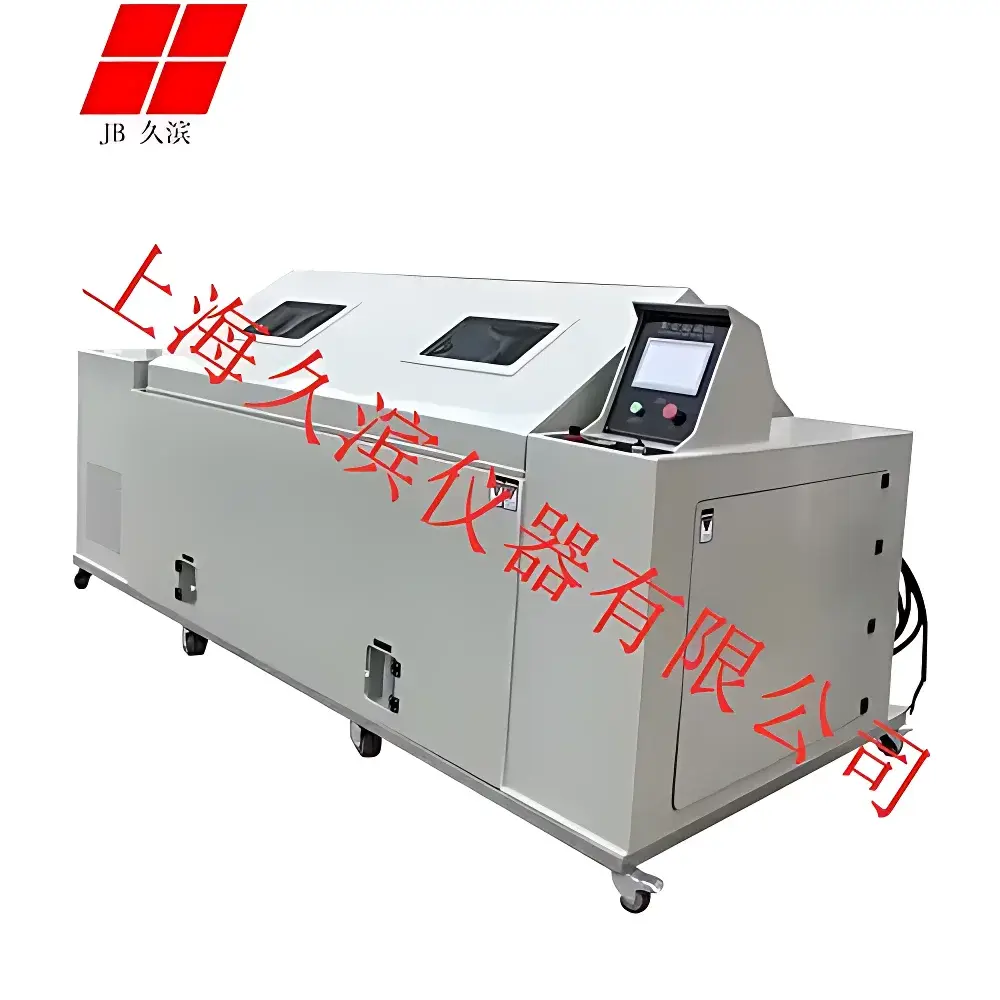
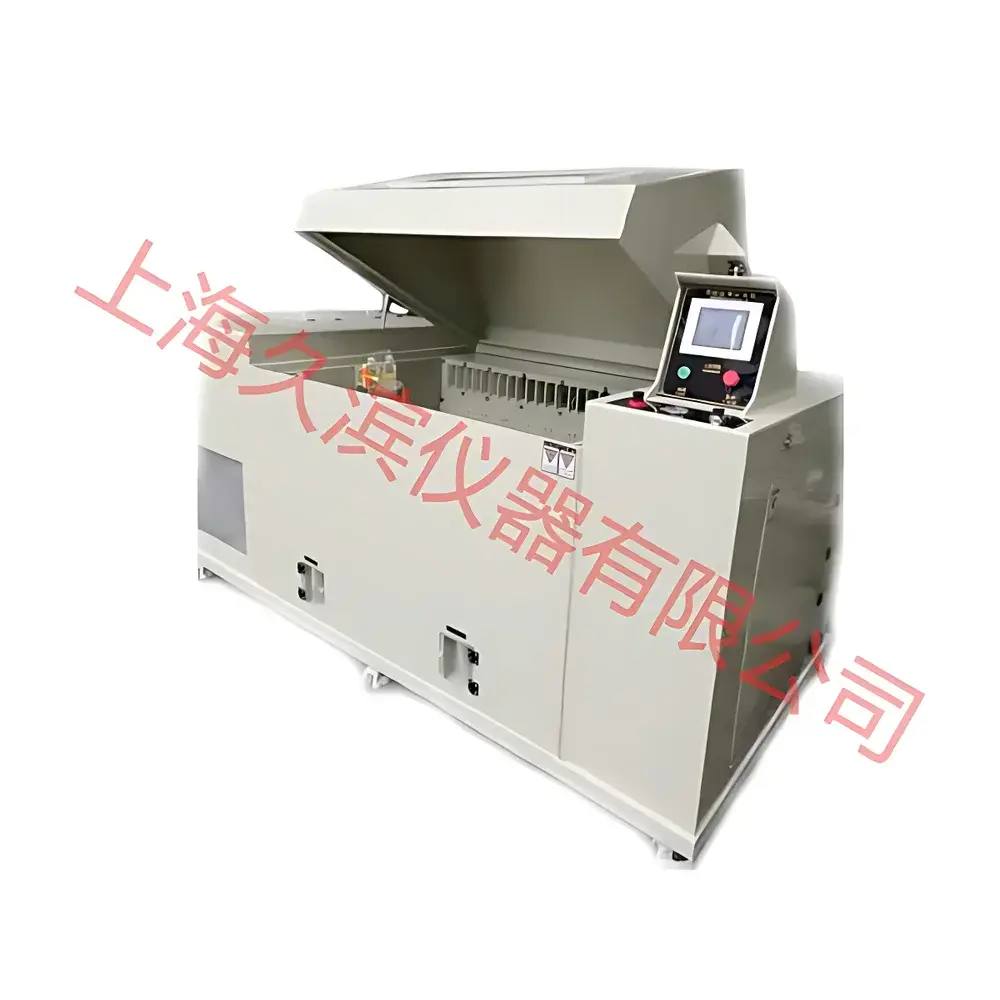
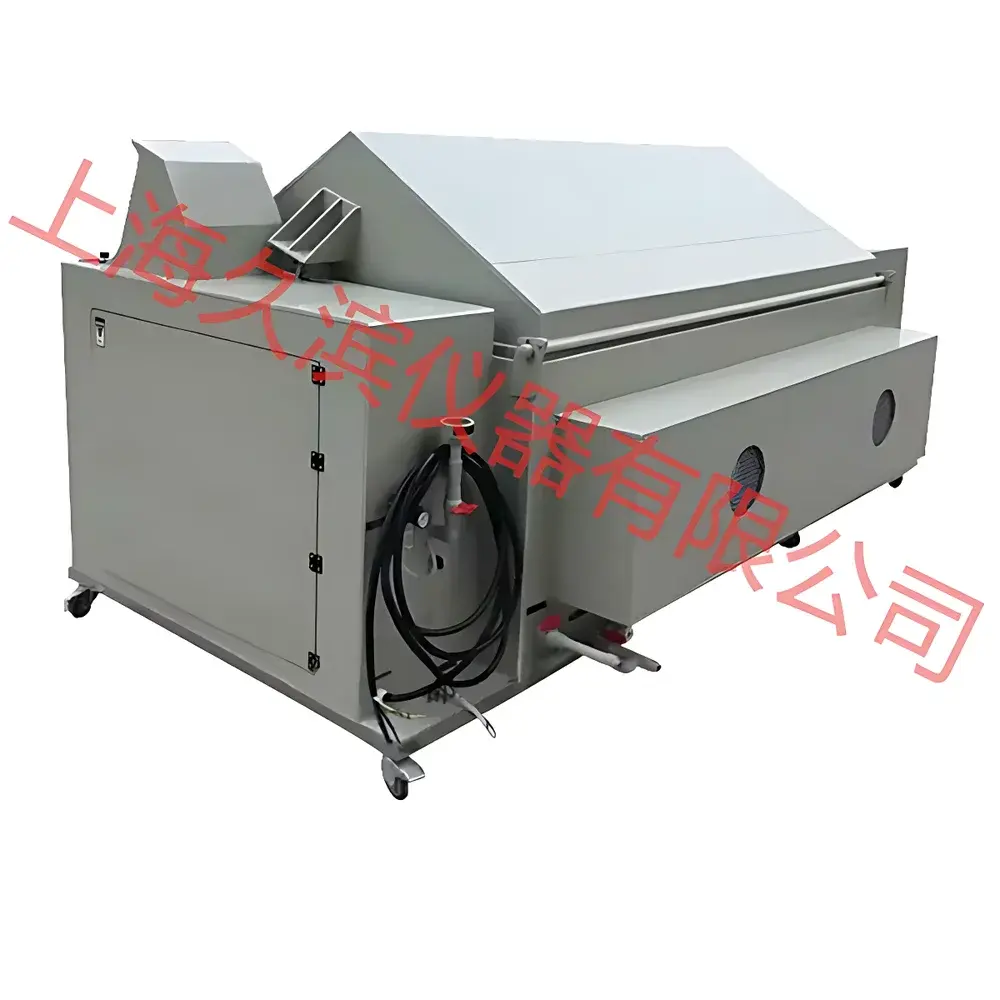
Jiubin JB-128D Composite Programmable Salt Spray Test Chamber
| Brand | Jiubin |
|---|---|
| Origin | Shanghai, China |
| Manufacturer Type | Manufacturer |
| Model | JB-128D |
| Spray Mode | Continuous or intermittent programmable air-driven spray |
| Salt Spray Deposition Rate | 1.0–2.0 mL / 80 cm²·h (adjustable, uniform distribution) |
| Temperature Range | −20°C to +70°C (chamber), +47°C to +70°C (saturated tower) |
| Humidity Range | 30–98% RH ±2% RH |
| Temperature Uniformity | ≤2°C |
| Temperature Stability | ≤±1.0°C |
| Humidity Accuracy | ±5% RH (<75% RH) |
| Chamber Dimensions (W×D×H) | 2000 × 1000 × 650 mm |
| External Dimensions (approx.) | 3400 × 1800 × 1400 mm |
Overview
The Jiubin JB-128D Composite Programmable Salt Spray Test Chamber is an advanced environmental simulation system engineered for rigorous corrosion resistance evaluation of metallic substrates, coated components, electronic assemblies, and industrial products. It operates on the principle of controlled electrochemical acceleration—inducing chloride ion–driven corrosion under precisely regulated thermal, humid, and saline aerosol conditions. Unlike basic salt fog chambers, the JB-128D integrates multi-stage programmability to replicate real-world exposure sequences including neutral salt spray (NSS), acetic acid salt spray (AASS), cyclic humidity-salt-hold phases, and ambient conditioning—all within a single test cycle. This capability aligns with the functional requirements of accelerated life testing in automotive, aerospace, defense, and electronics manufacturing, where material degradation mechanisms must be assessed across dynamic environmental stressors rather than static endpoints.
Key Features
- Composite environmental programming supporting up to six distinct test phases per cycle—including NSS, AASS, high-humidity soak (40°C / 99.9% RH), ambient conditioning (23°C / 50% RH), and temperature-controlled dry-off stages.
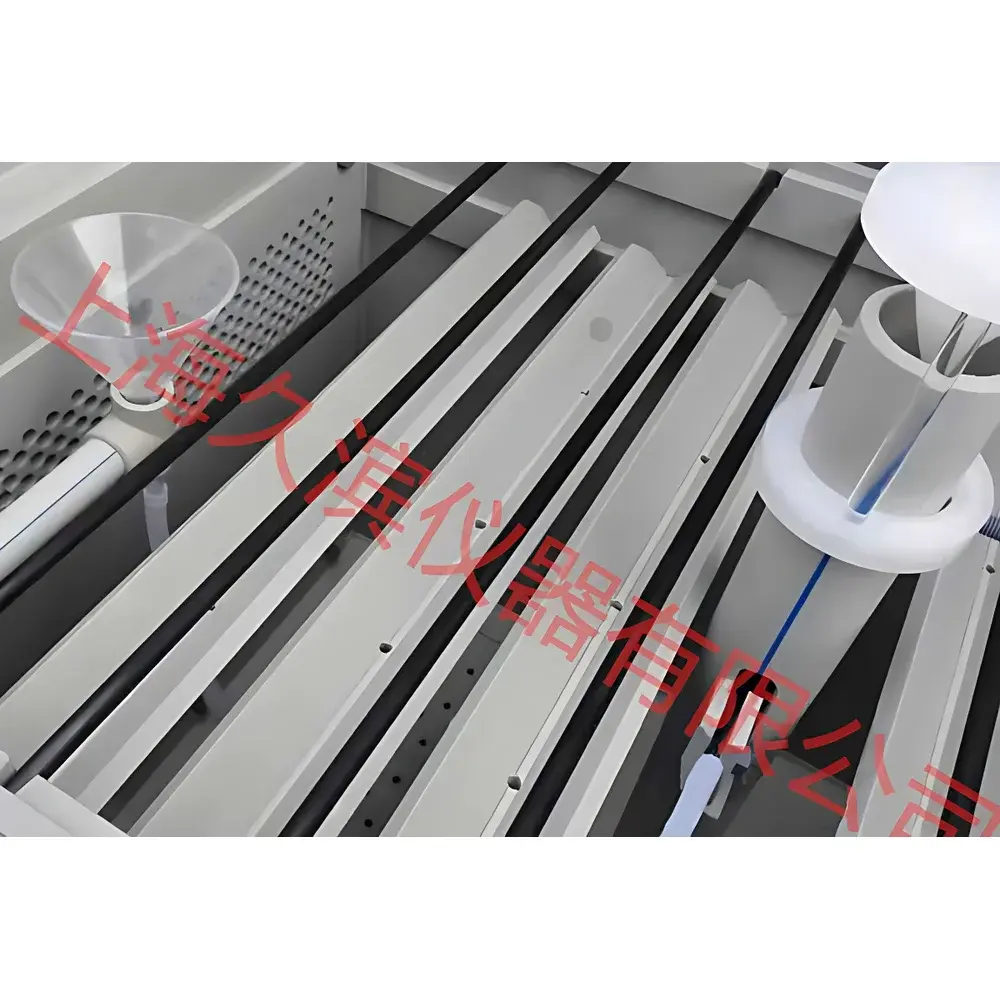
- Programmable air-driven spray system enabling precise selection between continuous and intermittent salt mist delivery, with adjustable deposition rate from 1.0 to 2.0 mL per 80 cm² per hour—verified via ASTM B117-compliant collection methodology.
- Dual-zone temperature control: independently regulated test chamber (−20°C to +70°C, ±1.0°C stability) and saturated tower (+47°C to +70°C), ensuring consistent fog generation across operational ranges.
- High-fidelity humidity control (30–98% RH, ±2% RH accuracy) with differential calibration across low- and high-RH regimes per IEC 60068-2-78 specifications.
- Robust stainless-steel chamber construction (SUS316L interior) with double-wall insulation, corrosion-resistant piping, and sealed pneumatic actuation for long-term reliability in aggressive saline environments.
- Integrated swing-nozzle rain simulation module with adjustable flow rate and programmable intermittent cycling—enabling combined salt spray + simulated rainfall protocols per GMW14872 and CETP 00.00-L-467.
Sample Compatibility & Compliance
The JB-128D accommodates test specimens up to 2000 mm (W) × 1000 mm (D) × 650 mm (H), accommodating full-size automotive trim panels, PCB assemblies, fasteners, and structural brackets. Its design conforms to multiple international test standards, including but not limited to: GB/T 2423.17 (NSS), ISO 9227 (AASS/ASS), ASTM B117, JIS Z2243, and DIN 50021. Cyclic test profiles meet OEM-specific requirements such as General Motors GMW14124 (multi-phase corrosion protocol), GMW14872 (combined humidity/salt/rain), and Ford CETP 00.00-L-467. All thermal and humidity sensors are NIST-traceable and support GLP/GMP audit readiness, with optional 21 CFR Part 11–compliant data logging available upon configuration.
Software & Data Management
Equipped with a 10.1-inch industrial touchscreen HMI running embedded Linux OS, the JB-128D provides intuitive cycle programming, real-time parameter visualization (temperature, RH, spray status, saturation tower temp), and automatic event logging. Test programs are stored in non-volatile memory with timestamped operation records, including start/stop times, phase transitions, alarm events, and sensor deviation alerts. Data export is supported via USB 2.0 and Ethernet (Modbus TCP), enabling integration into centralized LIMS or MES platforms. Optional PC-based software offers advanced report generation (PDF/CSV), statistical trend analysis (e.g., time-to-white-rust), and electronic signature functionality compliant with FDA 21 CFR Part 11 Annex 11 requirements.
Applications
- Corrosion performance validation of zinc-nickel, electrophoretic, powder-coated, and chromate conversion finishes per ASTM D610 and ISO 4628-3.
- Qualification of printed circuit board conformal coatings under IPC-CC-830B and MIL-I-46058C.
- Accelerated durability assessment of automotive under-hood components exposed to road de-icing salts (per SAE J2334).
- Comparative process validation for electroplating lines, anodizing baths, and passivation treatments.
- Pre-compliance screening for MIL-STD-810H Method 509.6 (salt fog) and RTCA DO-160 Section 16 (environmental endurance).
FAQ
What standards does the JB-128D support for cyclic corrosion testing?
It natively supports GMW14124, GMW14872, Ford CETP 00.00-L-467, and ISO 16701—configurable via built-in program templates.
Can the chamber operate at sub-zero temperatures while spraying salt solution?
No. Salt spray operation is restricted to ≥+15°C chamber temperature to prevent nozzle freezing and ensure stable aerosol formation.
Is the salt spray deposition rate independently verified during calibration?
Yes. Calibration includes ASTM B117-compliant collection using five standardized funnels distributed across the working volume, with volumetric measurement traceable to national metrology institutes.
Does the system include hardware-level safeguards against over-temperature or over-humidity?
Yes. Redundant dual-channel PID controllers, independent mechanical high-limit cutouts (±5°C and ±5% RH margins), and real-time fault logging ensure Class II safety compliance per IEC 61000-6-2.
Can third-party software interface with the chamber’s control system?
Yes. Modbus TCP and RS485 interfaces enable bidirectional communication with LabVIEW, Python-based test orchestration tools, or enterprise QA systems.



