
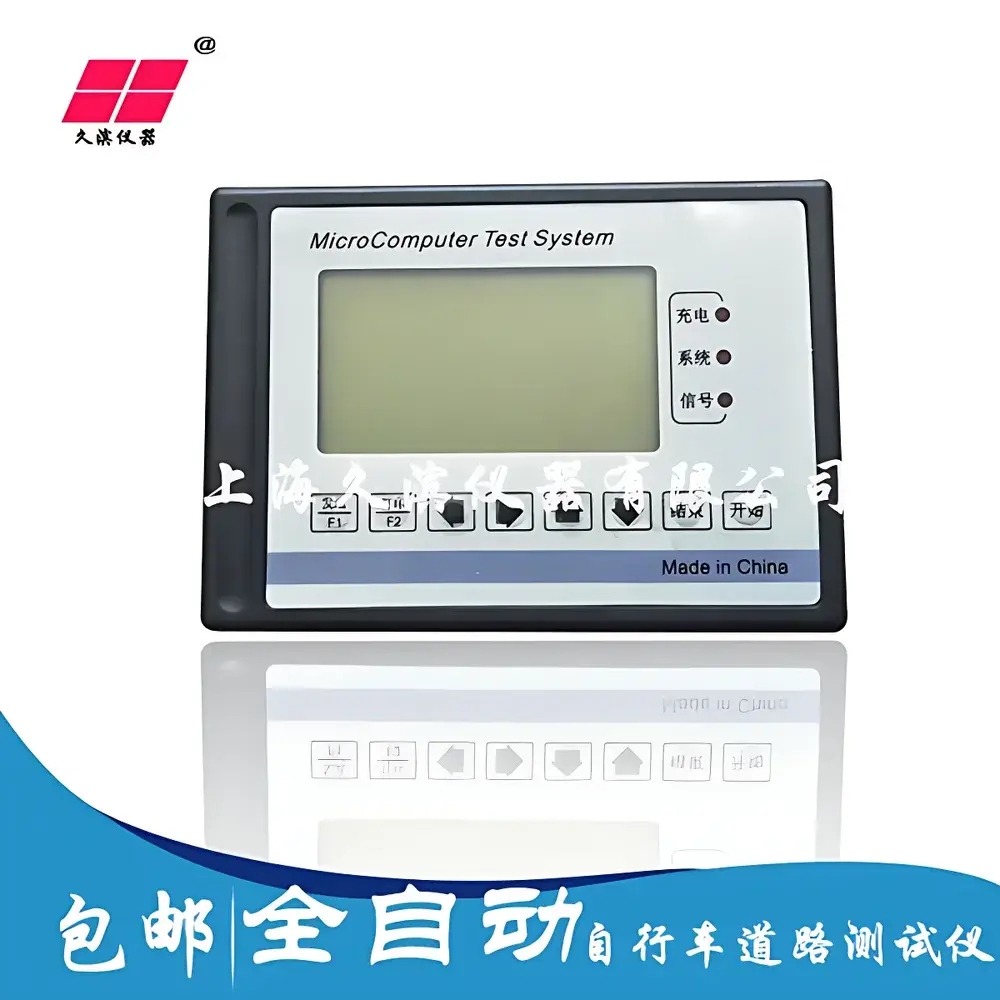
Jiubin JB-2300 Electric Bicycle Speed and Distance Measurement System
| Brand | Jiubin |
|---|---|
| Origin | Shanghai, China |
| Manufacturer Type | Authorized Distributor |
| Country of Origin | China |
| Model | JB-2300 |
| Pricing | Available Upon Request |
| Power Consumption | <10 W (Static: 5 W) |
| Internal Power Supply | DC 9.6 V (8 × 1.2 V / 700 mAh Ni-Cd batteries) |
| External Power Input | DC 12 V |
| Communication Interface | Standard 9-pin RS232 (TXD on Pin 3, RXD on Pin 2, GND on Pin 5) |
| Serial Configuration | 9600 baud, 8 data bits, 1 stop bit, no parity |
| Dimensions | 205 × 145 × 55 mm |
| Weight | 1.0 kg (including battery) |
| Operating Temperature | −15 °C to +45 °C |
| Relative Humidity | 30%–80% RH |
Overview
The Jiubin JB-2300 Electric Bicycle Speed and Distance Measurement System is a dedicated, portable instrumentation platform engineered for compliance-driven performance validation of electric bicycles in accordance with national regulatory standards. It operates on a microcontroller-based architecture with integrated high-resolution velocity and displacement sensing modules, enabling real-time acquisition and logging of critical dynamic parameters including instantaneous speed, speed-limiting threshold activation, audible alert trigger speed, dry/wet-condition braking distance, and pedal-assisted travel distance. Unlike general-purpose tachometers or GPS-based loggers, the JB-2300 employs calibrated optical or magnetic wheel-sensor coupling—optimized for low-speed, high-repeatability measurement across varied surface conditions—to ensure metrological traceability under GB17761-2018 test protocols. Its embedded firmware implements deterministic timing control and anti-jitter signal conditioning, minimizing latency and drift during transient events such as motor cut-off or brake engagement. Designed for both laboratory-grade indoor validation and field-deployable outdoor testing, the system delivers consistent measurement integrity across ambient temperature ranges from −15 °C to +45 °C and humidity levels up to 80% RH.
Key Features
- Compliance-certified measurement engine aligned with GB17761-2018, GB20073-2006, and related Type Approval test procedures
- Real-time dual-parameter display (speed + distance) via backlit monochrome LCD with native Chinese character interface for operator clarity
- Menu-driven test sequencing with preconfigured test modes: speed limit verification, audible warning speed check, dry/wet braking evaluation, and pedaling range quantification
- Low-power embedded design (<10 W max, 5 W standby) supporting extended operation via internal Ni-Cd battery pack (9.6 V / 5.6 Ah equivalent)
- Ruggedized portable form factor (205 × 145 × 55 mm; 1.0 kg) incorporating ergonomic grip and shock-absorbing casing for transport between test sites
- RS232 serial interface compliant with EIA/TIA-232-F specification (Pinout: Pin 2 = RXD, Pin 3 = TXD, Pin 5 = GND), configurable at 9600 baud, 8N1
Sample Compatibility & Compliance
The JB-2300 is validated for use with all Class I and Class II electric bicycles as defined under GB17761-2018, including those equipped with pedal-assist systems (PAS), throttle-controlled motors, and integrated speed-limiting firmware. Sensor mounting adaptability accommodates common wheel diameters (16″–29″) and hub configurations without mechanical modification. The system’s measurement uncertainty profile meets the repeatability requirements stipulated in Clause 6.3.2 (Speed Limit Verification) and Clause 6.4.3 (Braking Distance Test) of GB17761-2018. While not certified to ISO/IEC 17025, its operational methodology supports GLP-aligned documentation practices—including timestamped raw data export and manual test log correlation—for audit readiness in third-party certification laboratories.
Software & Data Management
Data output is delivered via ASCII-formatted serial stream, enabling seamless integration with host PCs running custom LabVIEW, Python (pySerial), or MATLAB scripts for automated report generation. Each transmitted frame includes UTC timestamp (derived from internal RTC), test mode identifier, measured speed (km/h, resolution 0.1 km/h), cumulative distance (m, resolution 0.01 m), and status flags (e.g., “LIMIT_ACTIVE”, “BRAKE_INITIATED”). No proprietary software is bundled; users retain full control over post-processing workflows. The absence of cloud connectivity or firmware-over-the-air updates ensures data sovereignty and aligns with industrial cybersecurity best practices for regulated testing environments.
Applications
- Pre-certification functional safety validation of speed-limiting algorithms in e-bike control units
- Comparative braking performance assessment across tire compounds and road surface conditions (asphalt, concrete, wet tile)
- Verification of PAS engagement thresholds and cadence-dependent assist profiles
- Third-party conformity assessment per CCC (China Compulsory Certification) Annex III requirements
- Quality assurance auditing in OEM and Tier-1 supplier production lines
- Academic research on human–machine interaction dynamics in micromobility platforms
FAQ
Does the JB-2300 support Bluetooth or USB connectivity?
No. It provides only a standard RS232 serial interface to ensure electrical isolation, noise immunity, and long-term compatibility with legacy lab infrastructure.
Can the device be used for testing motorcycles or scooters?
It is specifically calibrated and validated for electric bicycles per GB17761-2018. While some parameters (e.g., braking distance) overlap with GB20073-2006, cross-platform use requires independent metrological verification and is not covered under warranty.
Is calibration traceable to national standards?
The unit ships with a factory calibration certificate referencing internal reference standards. End-user recalibration must be performed using NIST-traceable speed simulators or rotary calibration rigs meeting JJF 1001–2011 metrological requirements.
What maintenance is required for sustained accuracy?
Annual sensor alignment verification and battery capacity testing are recommended. Ni-Cd cells should be fully discharged every 3 months to prevent memory effect; replacement kits are available directly from Jiubin authorized service centers.
Is firmware upgrade capability available?
Firmware updates are performed exclusively via RS232 using manufacturer-provided utility tools under controlled technical support supervision—no field-upgradable bootloader is exposed to end users.





