
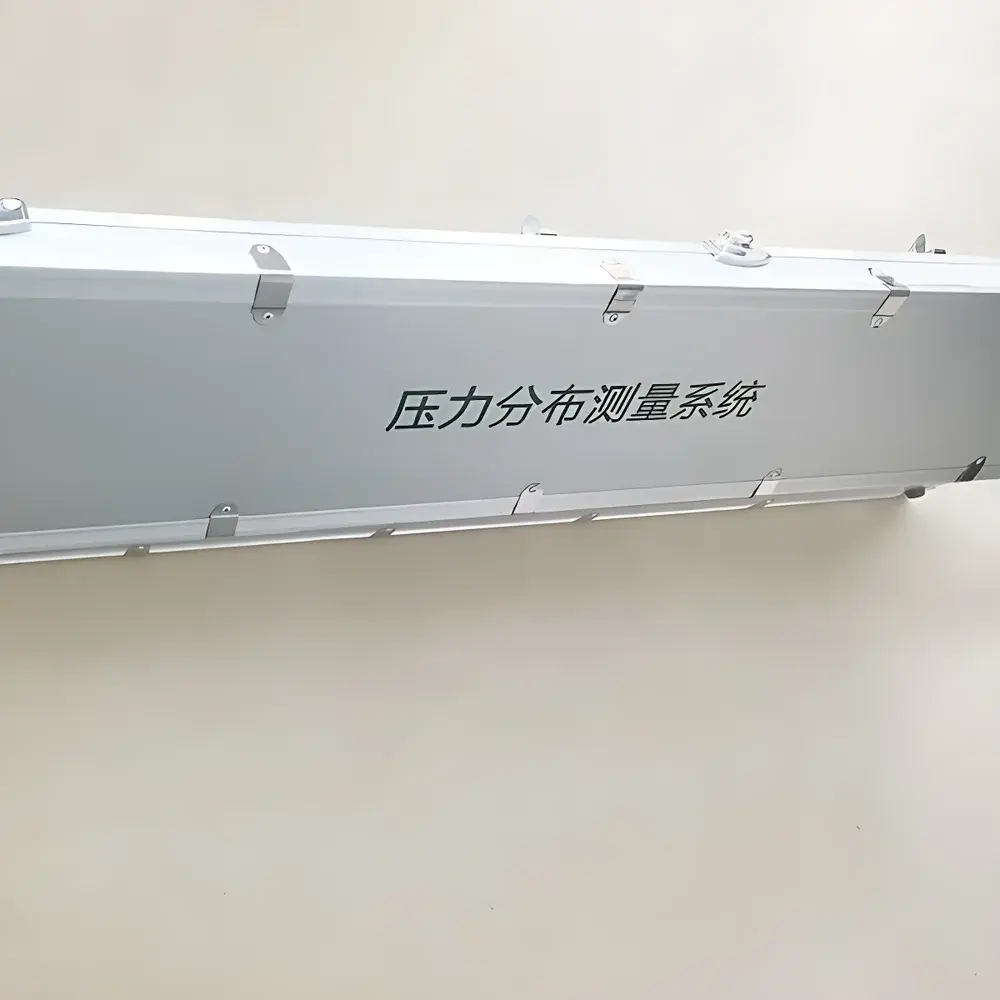
Jiubin JB-B Automotive Seat Pressure Distribution Measurement System
| Brand | Jiubin |
|---|---|
| Origin | Shanghai, China |
| Manufacturer Type | Authorized Distributor |
| Country of Origin | China |
| Model | JB-B |
| Pricing | Available Upon Request |
Overview
The Jiubin JB-B Automotive Seat Pressure Distribution Measurement System is a high-fidelity, sensor-based physical property testing instrument engineered for quantitative biomechanical assessment of human-seat interface pressures. It operates on the principle of capacitive or piezoresistive thin-film pressure sensing—where an array of micro-sensors embedded in a flexible, conformable mat transduces localized mechanical load into proportional electrical signals. This enables spatially resolved, time-synchronized measurement of contact pressure (kPa), contact area (cm²), center-of-pressure (COP) trajectory, and dynamic load evolution during static seating, ingress/egress maneuvers, and real-world vehicle operation. Designed for R&D laboratories, Tier-1 automotive suppliers, and ergonomics validation centers, the system supports ISO 11228-1 (manual handling), SAE J2730 (seat comfort evaluation), and UNECE R17 (seating strength and durability) compliance frameworks through traceable, repeatable data acquisition under both controlled and mobile environments.
Key Features
- Fully portable, battery-operated architecture with integrated USB 2.0 and optional PCI interface—enabling real-time data capture inside moving vehicles without external power dependency.
- High-spatial-resolution pressure mat with customizable active sensing area (standard configurations support up to 400 × 500 mm; modular tiling available).
- Sampling frequency: up to 100 Hz via USB interface; up to 127 Hz with PCI card—sufficient to resolve transient events such as seat entry, lateral shift, and posture adjustment.
- 8-bit pressure resolution (256 gray levels), calibrated across 0–100 kPa range—optimized for soft tissue loading typical of foam-backed automotive seats.
- Real-time dual-mode visualization: simultaneous 2D heat-map overlay and interactive 3D surface plot with adjustable iso-pressure contours and COP vector tracking.
- Durable, washable, and reusable sensor film—resistant to abrasion, flex fatigue, and repeated sterilization (alcohol wipe compatible); individual sensor zones replaceable without full mat replacement.
- Onboard timestamping, trigger synchronization (TTL-compatible), and hardware-level data buffering ensure integrity during intermittent connectivity or vibration-prone conditions.
Sample Compatibility & Compliance
The JB-B system accommodates anthropometric variability across adult populations (5th–95th percentile per ISO 7250-1) and integrates seamlessly with standard automotive seat frames, mock-up cabins, and ergonomic test benches. Sensor mats conform to curvature radii ≥50 mm and withstand compression cycles exceeding 100,000 repetitions without signal drift. All firmware and calibration certificates comply with GLP documentation requirements. Data export formats—including CSV, AVI (for synchronized video overlay), and proprietary .jbd binary files—support audit-ready archiving per FDA 21 CFR Part 11 when used in regulated human factors validation protocols.
Software & Data Management
The bundled JB-Analysis Suite provides ISO/IEC 17025-aligned post-processing tools: automatic contact area segmentation, COP velocity/acceleration derivation, temporal pressure histogramming, and region-of-interest (ROI) masking for lumbar, ischial, and thigh sub-zones. Export modules generate PDF reports with embedded metadata (operator ID, test date, seat configuration ID, environmental temperature/humidity). Raw data streams are timestamped with microsecond precision and support third-party integration via DLL API for MATLAB, Python (NumPy/Pandas), and LabVIEW environments. Audit trail logs record all user actions—including filter application, ROI modification, and calibration reset—ensuring full traceability.
Applications
- Evaluation of foam density gradients, viscoelastic recovery, and cover material shear resistance under dynamic loading.
- Validation of adjustable lumbar support algorithms against subjective comfort ratings (e.g., Borg CR-10 scale correlation).
- Quantification of ingress/egress biomechanical demand—measuring peak pressure spikes at sacral and femoral regions during seat transition.
- Long-duration driving studies: monitoring COP drift, pressure redistribution rate, and sustained load thresholds (>30 min) linked to fatigue onset.
- Comparative benchmarking of seat designs across OEM platforms using standardized test manikins (e.g., Hybrid III 50th percentile) or live subjects.
- Support for EU REACH and US CPSC regulatory submissions requiring objective comfort metrics in occupant restraint system certification.
FAQ
What is the recommended calibration interval for the JB-B sensor mat?
Annual factory recalibration is advised; field verification using NIST-traceable dead-weight standards is supported via the software’s calibration assistant module.
Can the system be used with electrically powered adjustable seats?
Yes—the sensor mat and DAQ unit are EMI-shielded and tested to ISO 11452-2 for immunity in 10–1000 MHz automotive electromagnetic environments.
Is COP trajectory data exported with coordinate system metadata?
Yes—each dataset includes origin definition (e.g., seat reference plane), axis orientation (X: longitudinal, Y: lateral, Z: vertical), and scaling factor in the header metadata.
Does the software support multi-mat synchronization for full-body pressure mapping?
Up to four mats can be daisy-chained and time-aligned via hardware trigger sync; software automatically merges spatial coordinates into a unified anatomical coordinate frame.
Are raw sensor values accessible for custom algorithm development?
Full-resolution 8-bit frame buffers are accessible via documented C++ API; no data compression or interpolation is applied prior to export.



