
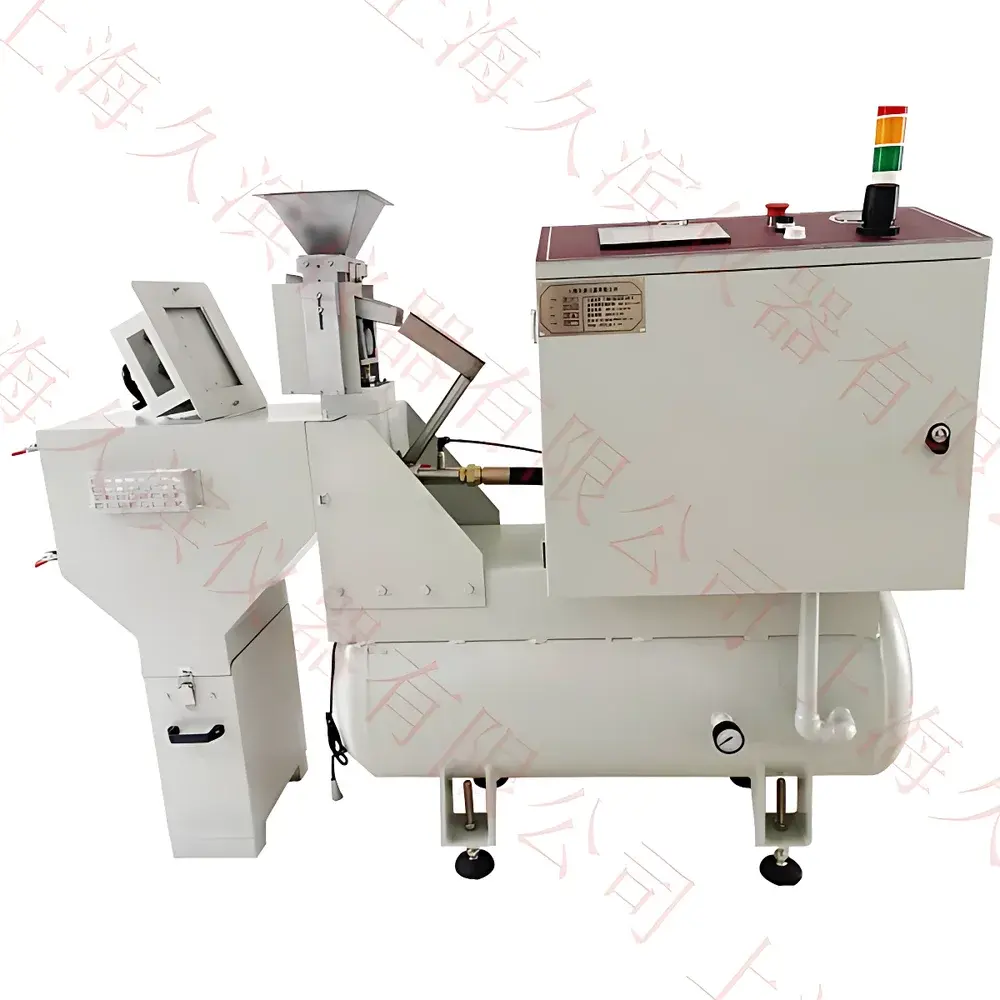
Jiubin JB-JM5 Gravel Impact Resistance Tester for Automotive Grilles
| Brand | Jiubin Instruments |
|---|---|
| Origin | Shanghai, China |
| Manufacturer Type | Authorized Distributor |
| Country of Origin | China |
| Model | JB-JM5 |
| Price Range | USD 7,000 – 14,000 |
| Pressure Range | 0–0.8 MPa (adjustable) |
| Test Temperature | Ambient (optional low-/high-temperature chamber available) |
| Air Hose Internal Diameter | 15 mm / 20 mm |
| Air Reservoir Volume | 136 L |
| Nozzle Tube Internal Diameter | 30 mm / 53 mm |
| Sample Mounting Angles | 45°, 54°, 90° (flat specimens) |
| Sound Pressure Level | ≤120 dB(A) |
| Operation Mode | Continuous-duty cycle |
| Impact Media | Calibrated gravel or crushed stone (ASTM D3292-compliant grading) |
| Feed Rate Control | Electromagnetic vibratory feeder |
| Airflow Pressure Control | Manual needle valve |
| Required Compressed Air Supply | User-provided |
Overview
The Jiubin JB-JM5 Gravel Impact Resistance Tester is an engineered simulation system designed to replicate real-world stone-chip damage encountered by automotive front-end components—particularly grilles, fascias, headlamp housings, and adjacent painted or coated plastic substrates. It operates on the principle of controlled pneumatic propulsion: calibrated gravel or crushed stone is metered via electromagnetic vibration into a high-velocity air stream, accelerated through interchangeable nozzles, and directed at standardized or production-representative test specimens under precisely defined impact angles and pressure conditions. This methodology aligns with industry-standard durability assessment protocols used by OEMs and Tier-1 suppliers to evaluate coating adhesion, substrate fracture resistance, interlayer cohesion in multi-coat systems, and the onset of chip-induced delamination or microcracking. The tester supports both R&D validation and production-line quality control, delivering repeatable, quantifiable damage profiles that correlate directly with field performance data.
Key Features
- Modular nozzle configuration with dual internal diameters (30 mm and 53 mm) to accommodate varying particle size distributions and impact energy densities.
- Precision-adjustable compressed air pressure regulation (0–0.8 MPa) enabling systematic study of kinetic energy influence on damage morphology.
- Three fixed-angle mounting positions (45°, 54°, and 90°) for flat-panel specimens, plus an optional 3D test chamber for complex automotive grille geometries—ensuring representative exposure across curvature and shadowed zones.
- 136-liter pressurized air reservoir ensures stable airflow during extended test cycles, minimizing pressure decay and maintaining impact velocity consistency.
- Electromagnetically driven vibratory feeder provides linear, stepless control over gravel feed rate—critical for generating statistically robust damage counts per unit area (e.g., chips/cm²).
- Integrated acoustic enclosure design limits operational noise to ≤120 dB(A), compliant with OSHA 29 CFR 1910.95 hearing protection requirements; ear protection is mandatory during operation.
- Robust stainless-steel and abrasion-resistant polymer construction ensures long-term reliability under repeated abrasive media exposure.
Sample Compatibility & Compliance
The JB-JM5 accommodates specimens up to 600 × 600 mm (flat) or irregular 3D assemblies within its optional environmental test chamber. It supports ISO 20567-1 (Paints and varnishes — Determination of stone-chip resistance — Part 1: Gravelometer method), SAE J400 (Measuring Abrasion Resistance of Materials by the Falling Sand Method), and ASTM D3292 (Standard Test Method for Resistance of Coatings to Chipping by Gravel). When integrated with traceable calibration gravel (e.g., ASTM E11-certified 3–6 mm basalt), the system meets GLP-aligned test documentation requirements. All mechanical adjustments—including angle fixtures and nozzle alignment—are lockable and documented for audit readiness.
Software & Data Management
While the base JB-JM5 operates via analog controls for pressure, feed rate, and timing, optional digital upgrade kits include programmable logic controller (PLC) interfaces with RS-485/Modbus RTU output. These enable integration into centralized lab data acquisition systems (e.g., LabVIEW, DeltaV) for automated logging of pressure setpoints, cumulative exposure time, and feeder actuation cycles. Audit trails comply with FDA 21 CFR Part 11 when paired with validated electronic record software. Raw impact data—including specimen photos pre/post-test and annotated chip maps—can be archived in PDF/A-1b format for regulatory submission.
Applications
- Evaluation of thermoplastic polyolefin (TPO), polypropylene (PP), and PC/ABS grille substrates for chip-initiated craze formation and crack propagation.
- Quantification of intercoat adhesion strength in multi-layer paint systems (e.g., e-coat + primer + basecoat + clearcoat) under oblique impact loading.
- Validation of anti-chip coatings (e.g., elastomeric urethanes) applied to under-hood components exposed to road debris.
- Comparative testing of glass-filled versus unfilled polymers in headlamp bezel applications.
- Supporting material selection decisions during DFMEA (Design Failure Mode and Effects Analysis) for front-end module assemblies.
FAQ
Is compressed air supply included with the JB-JM5?
No. Users must provide an external oil-free compressed air source delivering ≥2 m³/min at 0–0.8 MPa. A refrigerated dryer and coalescing filter are strongly recommended to prevent moisture or particulate contamination of the air circuit.
Can the tester be used for non-automotive applications?
Yes. It has been successfully deployed for evaluating stone-chip resistance of wind turbine blade leading-edge protectors, railway carriage cladding, and architectural metal façade coatings—provided specimen geometry and impact parameters fall within the system’s mechanical envelope.
What gravel specifications are recommended for calibration?
ASTM D3292-specified crushed basalt (3–6 mm nominal size, angularity index ≥85%, Los Angeles abrasion loss <30%) is the reference medium. Particle size distribution must be verified per ISO 9276-2 using sieve analysis before each qualification run.
Does the system support temperature-controlled testing?
The standard unit operates at ambient temperature. An optional climate-controlled test chamber (-40°C to +85°C) is available as a factory-installed accessory, enabling evaluation of thermal-impact synergies on coating brittleness.
How is repeatability ensured across laboratories?
Through strict adherence to nozzle wear monitoring (replacement interval: every 200 hours of cumulative operation), annual air pressure transducer calibration (NIST-traceable), and use of certified reference gravel lots—procedures documented in the included Operator Qualification Protocol (OQP).




