
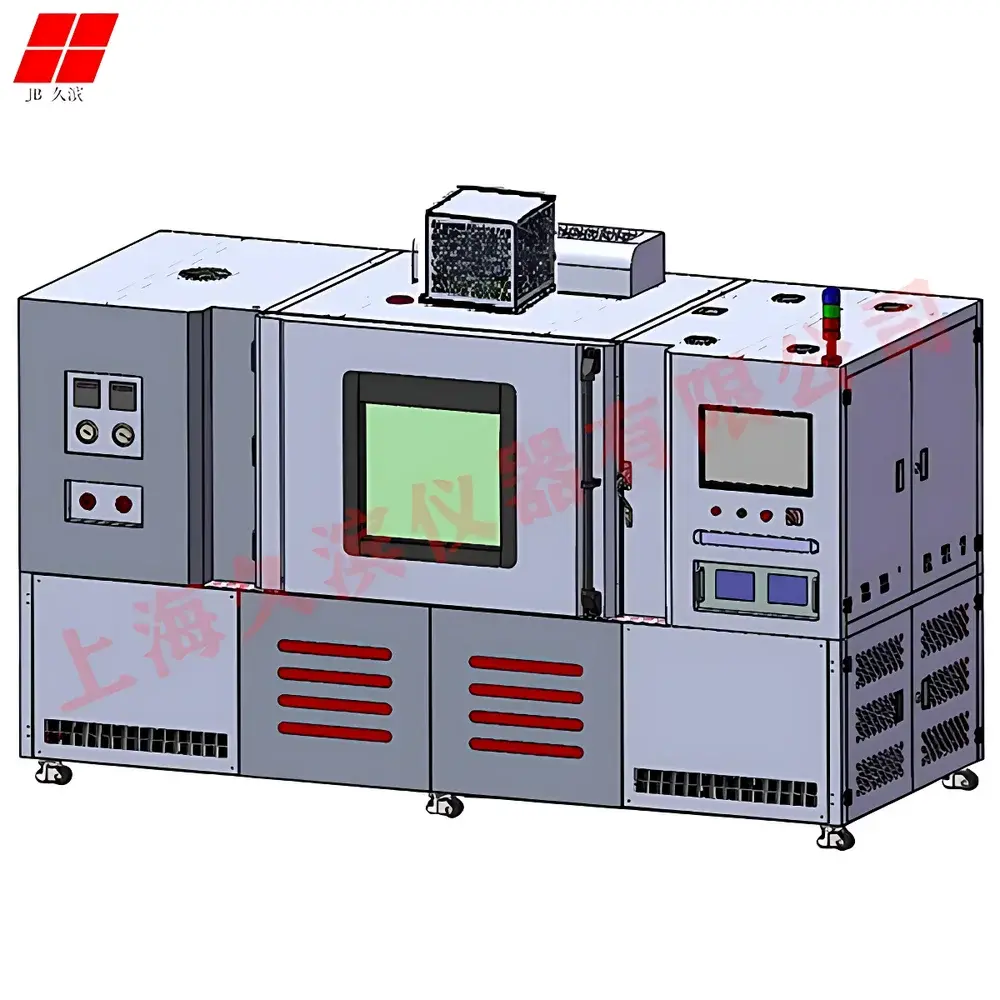
Jiubin JB-JM8 Automotive Hose Pressure Pulse Testing System
| Brand | Jiubin |
|---|---|
| Origin | Shanghai, China |
| Model | JB-JM8 |
| Test Medium | Hydraulic Oil or Ethylene Glycol Mixture |
| Max Test Pressure | 0–5 MPa (adjustable) |
| Pressure Control Accuracy | ±0.01 MPa (full scale dependent) |
| Pulse Frequency | 5–120 cycles/min (adjustable) |
| Pulse Waveform | Square or Trapezoidal (pulse width configurable per user specification) |
| Test Medium Temperature Range | Ambient to 160 °C |
| Environmental Temperature Control Range | −30 °C to 250 °C |
| Maximum Continuous Cycles | >1,000,000 |
| Control Method | PC-based Automated Control with Servo/Proportional Actuation |
| Compliance | Designed for ISO 6803, SAE J1402, GB/T 5563, and ASTM D380-conforming validation protocols |
Overview
The Jiubin JB-JM8 Automotive Hose Pressure Pulse Testing System is an engineered solution for evaluating the fatigue resistance and structural integrity of flexible fluid conveyance components under cyclic pressure loading. It operates on the principle of controlled hydraulic pulsation—applying repetitive, precisely regulated pressure waveforms to simulate real-world service conditions experienced by automotive rubber hoses, thermoplastic elastomer (TPE) assemblies, metal-braided hydraulic lines, and petroleum pipeline connectors. Unlike static burst testing, this system subjects specimens to dynamic stress states that accelerate degradation mechanisms such as interlayer delamination, reinforcement wire fatigue, and elastomer creep relaxation. The system supports both ambient and elevated temperature test environments, enabling accelerated life-cycle assessment in accordance with international durability standards.
Key Features
- Modular high-integrity pressure train: All pressure-bearing components—including manifolds, quick-connect couplings, and pulse actuators—are sourced from globally recognized industrial suppliers; zero welded joints ensure leak-tight integrity, ease of maintenance, and extended service life.
- High-fidelity pressure waveform generation: Configurable square or trapezoidal pulse profiles with independently adjustable rise time, dwell duration, and fall characteristics—enabling compliance with OEM-specific test specifications (e.g., Ford WSS-M99P1111-A, GMW14872).
- Integrated thermal management: Dual-zone temperature control accommodates simultaneous regulation of test fluid temperature (up to 160 °C) and chamber ambient temperature (−30 °C to 250 °C), supporting low-temperature flexibility and high-temperature aging studies.
- Real-time closed-loop control architecture: Servo-driven or proportional hydraulic actuation ensures repeatable pressure ramp rates, cycle-to-cycle consistency, and sub-0.01 MPa pressure stability across full-scale operation.
- Comprehensive failure monitoring: Onboard sensors continuously monitor pressure deviation, temperature drift, electrical anomalies, and unexpected pressure decay—triggering automatic shutdown and event logging upon threshold violation.
Sample Compatibility & Compliance
The JB-JM8 accommodates a broad range of hose and tube geometries, including but not limited to: EPDM, NBR, silicone, and fluorocarbon (FKM) rubber hoses; PTFE-lined thermoplastic assemblies; stainless steel braided hydraulic lines; and composite fuel delivery conduits. Fixturing supports straight sections, bent configurations, and end-fitting interfaces (e.g., O-ring grooves, crimped ferrules, flared ends). The system is configured to support test execution per ISO 6803 (rubber hoses—hydraulic—pressure impulse testing), SAE J1402 (automotive brake hose requirements), GB/T 5563 (Chinese national standard for hose pulse testing), and ASTM D380 (standard test methods for rubber hose). Data acquisition and audit trails are structured to meet GLP and GMP documentation expectations where applicable.
Software & Data Management
The embedded Windows-based control software provides intuitive graphical interface navigation, programmable test sequence definition (including multi-step pressure ramps, dwell intervals, and temperature ramps), and synchronized data capture at up to 100 Hz sampling rate. All pressure–time and temperature–time waveforms are stored in industry-standard CSV and binary formats, with timestamped metadata (operator ID, test ID, calibration status, environmental logs). USB export enables offline analysis in MATLAB, Python (Pandas), or Excel. Report generation includes customizable templates compliant with internal QA forms and external certification submissions. Audit trail functionality records all user actions, parameter changes, and system events—supporting 21 CFR Part 11 readiness when deployed in regulated environments.
Applications
- Validation of OEM hose specifications for engine cooling, power steering, brake, and turbocharger oil supply systems.
- Qualification of aftermarket replacement hoses against original equipment performance benchmarks.
- Material development support: Comparative fatigue evaluation of novel elastomer compounds, reinforcement architectures, and adhesive bonding systems.
- Root cause analysis of field failures through controlled replication of suspected service-induced stress histories.
- Pre-certification testing for regulatory submissions under UN ECE R110 (brake hose safety) and ISO 11425 (fuel system components).
FAQ
What standards does the JB-JM8 support out-of-the-box?
The system includes preloaded test templates for ISO 6803, SAE J1402, GB/T 5563, and ASTM D380. Custom waveform definitions can be imported to match proprietary OEM protocols.
Can the system perform combined thermal–mechanical cycling?
Yes—the dual thermal control system allows independent regulation of fluid and ambient temperatures, enabling coupled thermal–pulsation tests per GMW14872 Annex C or Ford CETP 00.00-L-467.
Is remote monitoring or network integration possible?
The control PC supports Ethernet connectivity and OPC UA server configuration for integration into plant-wide MES or SCADA infrastructure.
What maintenance intervals are recommended?
Pressure transducer recalibration every 12 months; hydraulic fluid replacement every 2,000 operating hours; seal inspection after every 50,000 cycles or annually—whichever occurs first.
Does the system provide pass/fail criteria evaluation?
Yes—user-defined acceptance thresholds (e.g., max allowable pressure drop per cycle, deformation limits via optional extensometry add-on) trigger automated pass/fail classification and report annotation.



