
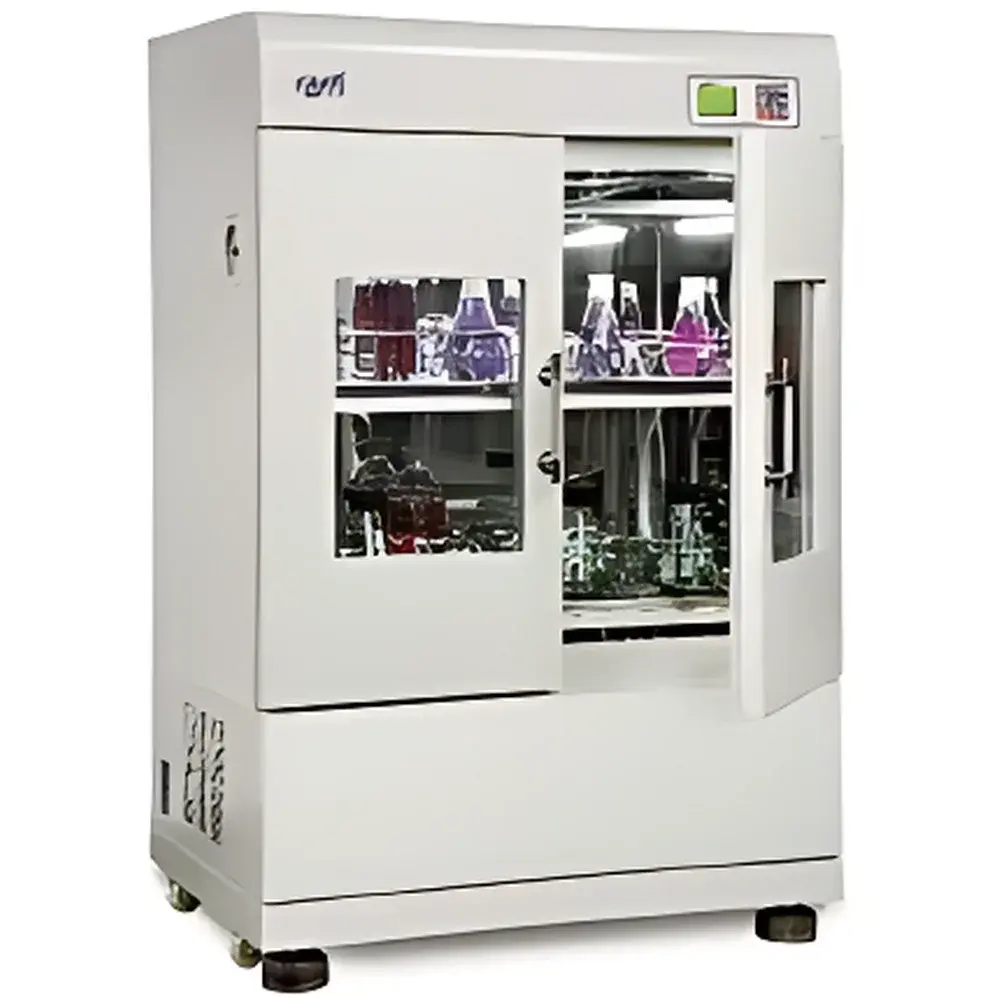
JP 1102 Large-Capacity Orbital Shaking Incubator
| Brand | JP |
|---|---|
| Origin | Spain |
| Model | 1102 |
| Instrument Type | Air-Jacketed Temperature-Controlled Orbital Shaker |
| Timer Range | 0–500 h |
| Oscillation Speed | 30–300 rpm |
| Orbit Diameter | 26 mm |
| Temperature Range | Ambient +5°C to 60°C |
| Number of Shaking Platforms | 2 |
| Construction | AISI 316 Stainless Steel Interior |
| Exterior | Epoxy-Coated Steel Cabinet |
| Drive System | Brushless Induction Motor |
| Safety Features | Door-Interlocked Power Cut-off, Overload Protection, Audible & Visual End-of-Program Alert, Fault Detection (Temp/Time Deviation) |
| Platform Flexibility | Adjustable Support Arms, Interchangeable Fixtures (Erlenmeyer Clamp, Microtiter Plate Holder, Spring-Based Universal Mount) |
Overview
The JP 1102 Large-Capacity Orbital Shaking Incubator is an air-jacketed, dual-platform incubated shaker engineered for reproducible cultivation of microbial, mammalian, and suspension-cell cultures under precisely controlled temperature and orbital agitation conditions. Designed and manufactured in Spain, this instrument employs a robust brushless induction motor to deliver smooth, low-vibration orbital motion (26 mm orbit diameter) across two independently configurable shaking platforms—enabling parallel experiments with heterogeneous vessel configurations. Its air-jacketed thermal architecture ensures uniform temperature distribution (±0.3°C stability at 37°C, typical) within the chamber, while the AISI 316 stainless steel interior resists corrosion from repeated sterilization cycles, organic solvents, and high-humidity environments common in long-term fermentation or bioprocess development workflows.
Key Features
- Dual independent orbital platforms (26 mm orbit) with height-adjustable support arms—optimized for simultaneous handling of large-volume vessels (up to 5 L flasks) and microtiter plates.
- Air-jacketed heating system with PID-controlled digital thermostat, maintaining setpoint accuracy from ambient +5°C to 60°C (±0.3°C typical at 37°C).
- Brushless induction motor drive delivering consistent speed control (30–300 rpm, ±1 rpm resolution) with minimal mechanical wear and zero carbon dust generation—critical for GLP-compliant labs.
- Full-spectrum safety architecture: door-activated power interlock, real-time motor current monitoring with automatic overload cutoff, audible/visual end-of-program alert, and fault-triggered alarm for temperature deviation or timer malfunction.
- Ergonomic dual-door design with reinforced tempered glass viewing window—enabling non-invasive process monitoring without thermal or vibrational disturbance.
- Modular fixture system including Erlenmeyer flask clamps (for 100 mL–5 L), microtiter plate holders (96-/384-well), and spring-loaded universal mounts for irregularly shaped or custom bioreactors.
- Front-panel programmable interface supporting up to 99 user-defined protocols, each with independent time, temperature, and speed parameters; timer range extends to 500 hours for extended batch cultivation.
Sample Compatibility & Compliance
The JP 1102 accommodates a broad spectrum of culture vessels—from standard conical flasks and baffled bioreactors to deep-well plates and custom silicone tubing manifolds—thanks to its reconfigurable platform geometry and multiple mounting options. Its AISI 316 stainless steel chamber meets ISO 13485 material requirements for medical device manufacturing environments and complies with EU Directive 2014/30/EU (EMC) and 2014/35/EU (LVD). While not certified for Class II biological safety, the unit is routinely deployed in ISO 5–7 cleanrooms when integrated with HEPA-filtered laminar airflow hoods. Its operational parameters align with ASTM E1710 (standard practice for validation of shaker performance) and support audit-ready documentation for FDA 21 CFR Part 11–governed workflows when paired with validated external data logging systems.
Software & Data Management
The JP 1102 operates via an embedded microcontroller-based interface with non-volatile memory for protocol storage and event logging (start/end timestamps, fault codes, setpoint history). Although it does not include built-in Ethernet or USB connectivity, its analog/digital I/O ports support integration with third-party SCADA systems (e.g., LabVIEW, Ignition) via 4–20 mA or RS-485 Modbus RTU. Optional external data loggers compliant with 21 CFR Part 11 can capture timestamped temperature, speed, and runtime data with electronic signatures and audit trails—facilitating full traceability in GMP pharmaceutical QC labs or academic grant-funded studies requiring FAIR data principles.
Applications
- High-yield recombinant protein expression in E. coli and yeast using multi-liter shake-flask screening.
- Suspension culture of CHO and HEK293 cells for monoclonal antibody production process optimization.
- Microbial growth kinetics studies under controlled aeration (via adjustable air exhaust port) and thermal gradients.
- Enzyme activity assays requiring precise agitation-coupled thermal incubation (e.g., cellulase hydrolysis, lipase kinetics).
- Biodegradation testing of polymers and environmental contaminants in OECD 301B-compliant aerobic shake-flask setups.
- Seed train expansion and media optimization in early-stage bioprocess development.
FAQ
Is the JP 1102 suitable for sterile applications requiring frequent autoclaving?
Yes—the AISI 316 stainless steel interior withstands repeated exposure to saturated steam at 121°C for 20 minutes; however, platform fixtures and gaskets require periodic inspection per manufacturer maintenance schedule.
Can both platforms operate at different speeds and temperatures simultaneously?
No—temperature is uniformly controlled across the entire chamber; however, each platform supports independent speed settings and distinct fixture configurations.
What is the maximum flask volume supported on a single platform?
With optional heavy-duty clamps and lowered platform position, the unit accommodates two 5 L Erlenmeyer flasks per platform (total four 5 L vessels), subject to center-of-mass balance constraints.
Does the unit comply with FDA 21 CFR Part 11 for electronic records?
The base instrument provides audit-ready event logs; full Part 11 compliance requires integration with validated external data acquisition software meeting signature, retention, and change-control requirements.
How is airflow managed during operation to prevent condensation?
An adjustable rear-mounted air exhaust damper allows fine-tuning of chamber ventilation—reducing humidity buildup during prolonged incubation at elevated temperatures (>45°C) and high RPM (>250 rpm).



