
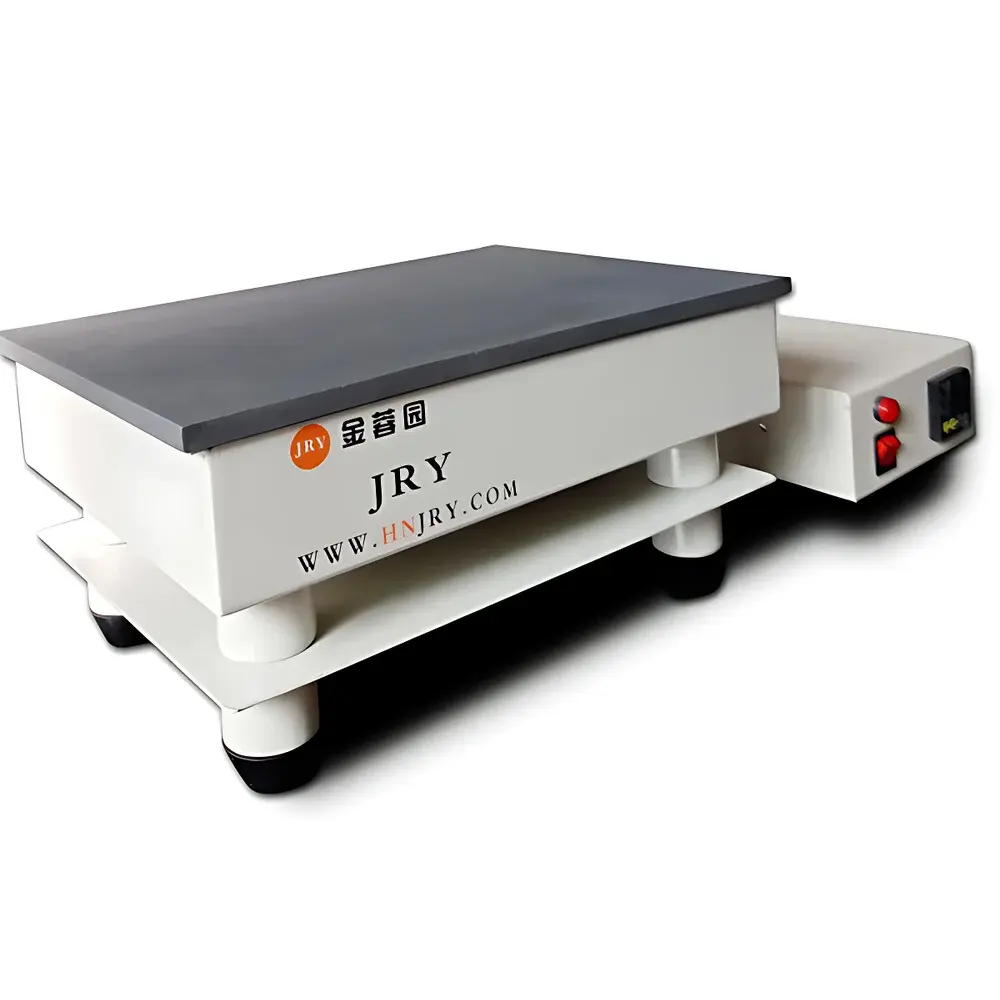
JRY-D350-D Split-Design Graphite Electric Heating Plate
| Brand | JRY |
|---|---|
| Origin | Hunan, China |
| Manufacturer Type | Direct Manufacturer |
| Country of Origin | China |
| Model | JRY-D350-D Split |
| Price | USD 1,280 (FOB) |
| Heating Power | 4 kW |
| Max Operating Temperature | 350 °C |
| Temperature Uniformity | ±0.1 °C |
| Top Plate Dimensions | 480 × 680 mm |
| Heating Zone Dimensions | 400 × 600 mm |
| Display | Digital LED |
Overview
The JRY-D350-D Split-Design Graphite Electric Heating Plate is an engineered thermal platform designed for precise, stable, and contamination-free sample preparation in analytical laboratories. Built upon a monolithic high-purity graphite heating surface — chemically inert, corrosion-resistant, and thermally homogeneous — the system operates on resistive heating principles with integrated PID temperature control. Unlike traditional ceramic or stainless-steel hotplates, graphite offers superior thermal mass and uniform heat distribution across large-area digestion zones, minimizing edge cooling and thermal gradients during extended heating cycles. Its split architecture physically isolates the heating module from the control electronics, reducing electromagnetic interference and enabling safe placement beneath fume hoods or within confined benchtop configurations. The unit is optimized for open-vessel acid digestion (e.g., HNO₃, HCl, HF), solvent evaporation, reflux, drying, and controlled thermal conditioning of environmental, agricultural, geological, and biological samples prior to elemental analysis (ICP-OES, ICP-MS, AAS).
Key Features
- Monolithic graphite top plate (400 × 600 mm active heating zone), fully machined without edge encapsulation or metallic cladding — eliminating crevices where reagents can accumulate and ensuring long-term chemical stability.
- Split design: heating base (height ≤ 100 mm) and detachable digital controller connected via ≥ 0.6 m shielded cable — enhancing ergonomic workflow and simplifying maintenance.
- Precision PID temperature regulation with ±0.1 °C uniformity across the entire heating surface at setpoints up to 350 °C; typical ramp time from ambient to 300 °C is ≤ 35 minutes.
- Robust mechanical construction: hollow steel support columns (≥ 45 mm diameter) thermally decouple the graphite plate from the base frame, limiting downward heat transfer — surface temperature beneath the unit remains ≤ 50 °C even at peak operation.
- Digital LED display with intuitive keypad interface; controller dimensions: ≤ 200 × 180 × 80 mm — compact enough for wall mounting or integration into modular lab furniture systems.
- Rated continuous duty cycle: validated for uninterrupted operation > 40 hours at full 4 kW load, supporting overnight digestion protocols without thermal derating or safety shutdown.
Sample Compatibility & Compliance
The JRY-D350-D accommodates standard digestion vessels including PTFE (Teflon™), quartz, borosilicate glass, and quartz-crucible assemblies up to 1 L capacity. Its inert graphite surface resists attack by concentrated mineral acids (including hydrofluoric acid under controlled conditions), making it suitable for EPA Methods 3050B, 3051A, and 3052, as well as ISO 11466 and GB/T 22105 (Chinese national standard for soil heavy metal digestion). While not certified to UL/CSA or CE for standalone safety compliance, the unit meets general electrical safety requirements per GB 4793.1–2019 (equivalent to IEC 61010-1) and supports GLP-aligned documentation when paired with external calibration logs and audit-trail-capable data recorders.
Software & Data Management
The JRY-D350-D operates as a standalone analog-controlled instrument with no embedded firmware or network connectivity. Temperature setpoint and real-time readout are managed exclusively via the front-panel digital interface. For traceable data capture, users may integrate optional third-party USB or RS-232 data loggers compatible with LabVIEW™, MATLAB®, or custom Python-based acquisition scripts. When deployed in regulated environments (e.g., ISO/IEC 17025-accredited labs), the device supports manual calibration verification per ASTM E220 and routine performance checks using NIST-traceable RTD probes — all records maintained in paper or electronic lab notebooks compliant with 21 CFR Part 11 if validated accordingly.
Applications
- Open-beaker acid digestion of soils, sediments, sludge, and plant tissues for total metal determination.
- Controlled evaporation of digestates prior to ICP analysis to achieve optimal matrix concentration.
- Pre-concentration of aqueous environmental samples (e.g., wastewater, rainwater) via gentle boiling.
- Thermal stabilization of calibration standards and reference materials at fixed temperatures (e.g., 95 °C for enzyme inactivation).
- Low-profile heating support for multi-position reaction blocks in method development workflows.
- Holding and warming of reagent bottles, buffers, or agarose gels in molecular biology prep areas.
FAQ
Is the graphite surface resistant to hydrofluoric acid (HF)?
Yes — high-purity graphite exhibits excellent resistance to HF at concentrations ≤ 40% and temperatures ≤ 200 °C; however, prolonged exposure above 250 °C requires validation with application-specific testing.
Can this unit be used inside a fume hood?
Yes — its low profile (≤ 100 mm), absence of moving parts or ventilation requirements, and split design make it ideal for under-hood installation; ensure minimum clearance of 150 mm around all sides for airflow.
Does it support programmable ramp-soak profiles?
No — the JRY-D350-D provides only single-setpoint temperature control; for multi-stage thermal protocols, external programmable controllers or data loggers must be used.
What is the recommended calibration frequency?
Per ISO/IEC 17025 guidelines, verify temperature accuracy before each critical batch using a calibrated NIST-traceable probe; perform full calibration annually or after any physical impact to the graphite surface.
Is the heating plate compatible with magnetic stirrers?
No — the graphite surface is non-magnetic and not designed for integration with stir plates; stirring must be performed separately using overhead or immersion stirrers placed atop the vessel.
Related Products



