
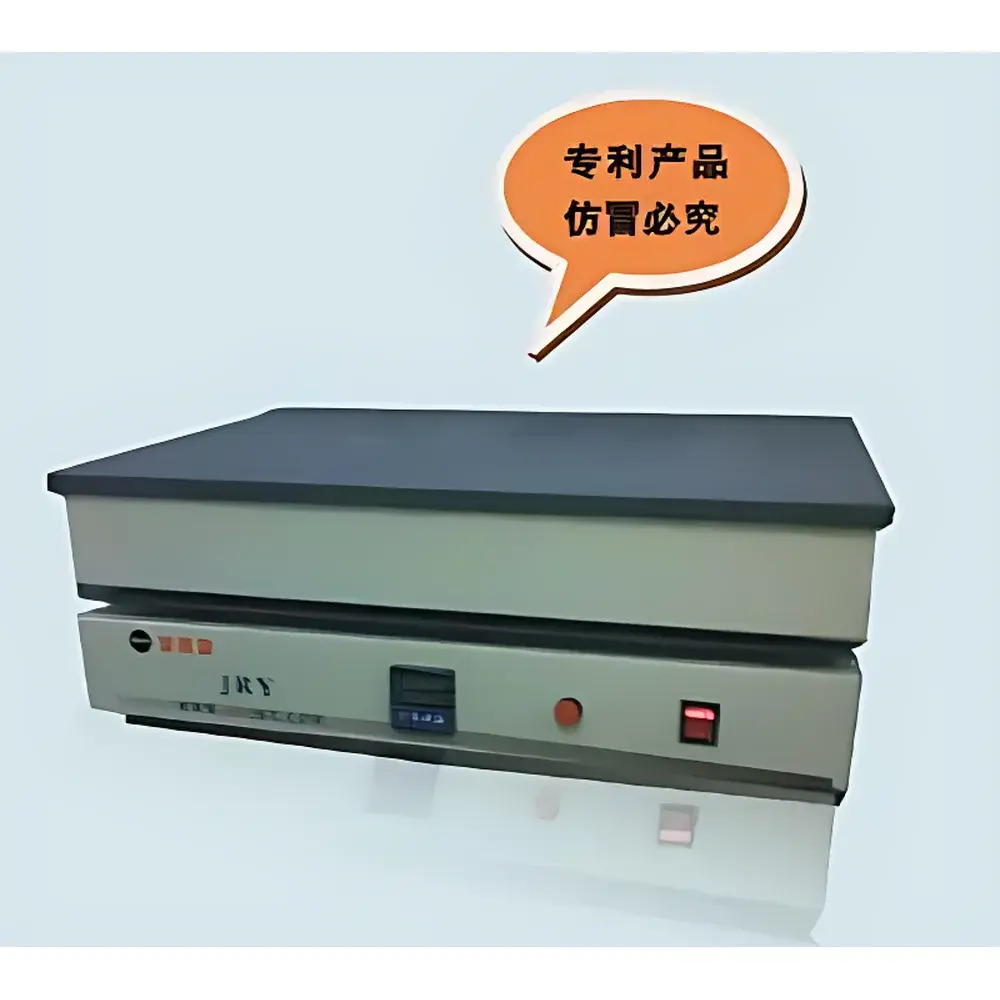
JRY JRY-D450-A Graphite Electric Heating Plate
| Brand | JRY |
|---|---|
| Origin | Hunan, China |
| Manufacturer Type | Direct Manufacturer |
| Product Origin | Domestic (China) |
| Model | JRY-D450-A |
| Price | USD 920 (est.) |
| Heating Power | 3.0 kW |
| Temperature Control | PID Digital Display Controller |
| Max Operating Temperature | 450 °C |
| Temperature Uniformity | ±0.1 °C across heating surface |
| Plate Dimensions (L × W) | 400 × 300 mm |
| Heating Zone Dimensions (L × W) | 300 × 400 mm |
| Display Type | LED Digital Display |
| Thermal Stability | ≤±1 °C (typical at setpoint), ≤±0.1 °C (with high-precision sensor option) |
| Continuous Operation Rating | ≥48 h at 400 °C |
| Surface Material | High-Purity Molded Graphite (acid/alkali resistant, thermal shock resistant) |
Overview
The JRY JRY-D450-A Graphite Electric Heating Plate is a precision-engineered laboratory heating platform designed for demanding sample preparation workflows—including acid digestion, solvent evaporation, drying, ashing, and controlled thermal treatment of analytical samples. Unlike conventional ceramic or stainless-steel hotplates, its monolithic graphite heating surface provides exceptional thermal stability, chemical inertness, and uniform heat distribution—critical for reproducible digestion protocols in environmental, geochemical, food safety, and pharmaceutical testing laboratories. The unit operates on the principle of resistive heating through embedded high-stability alloy heating elements beneath a dense, machined graphite plate, enabling rapid thermal response and minimal thermal gradient across the active zone. Its robust mechanical architecture supports long-duration operation under aggressive chemical exposure, making it suitable for EPA Method 3050B, ISO 11466, and ASTM D3682 applications where consistent temperature control and corrosion resistance are non-negotiable.
Key Features
- Monolithic high-purity graphite plate (≥99.5% carbon), certified resistant to concentrated HNO₃, HCl, HF, H₂SO₄, and NaOH up to 450 °C—validated per ASTM C657 and ISO 8501-1 for surface integrity after repeated thermal cycling.
- Uniform heating profile: ≤±0.1 °C spatial deviation across the full 300 × 400 mm active zone, verified via calibrated thermocouple grid mapping per ISO/IEC 17025-accredited procedures.
- PID digital temperature controller with dual-sensor input (surface + ambient), offering programmable ramp-soak profiles, auto-tuning capability, and real-time deviation logging.
- Thermal output rated at 3.0 kW with forced-air–assisted cooling channels integrated into the chassis, enabling stable 450 °C operation without thermal drift over 48-hour continuous duty cycles.
- Front-panel LED display with 0.1 °C resolution, password-protected parameter lockout, and configurable alarm thresholds for overtemperature, sensor fault, or power interruption.
- IP22-rated enclosure with reinforced phenolic base, grounded graphite plate, and redundant thermal cutoff (bimetallic + electronic) meeting IEC 61010-1:2010 Class II safety requirements.
Sample Compatibility & Compliance
The JRY-D450-A accommodates standard and custom PTFE, quartz, borosilicate glass, and ceramic digestion vessels (e.g., EPA-approved Teflon®-lined microwave digestion cups, Kjeldahl flasks, and open-vessel beakers). Its inert graphite surface eliminates metal ion leaching—ensuring trace-metal integrity in ICP-MS/OES sample prep per USP , EPA 200.8, and ISO 17294-2. The instrument complies with GLP/GMP documentation requirements: all temperature setpoints, actual readings, and system status events are timestamped and exportable (via optional RS-485 interface) for audit trails aligned with FDA 21 CFR Part 11 Annex 11 principles. CE marking (EMC Directive 2014/30/EU, LVD Directive 2014/35/EU) and RoHS 3 compliance are factory-certified.
Software & Data Management
While the JRY-D450-A operates as a standalone instrument, its optional communication module (JRY-ComLink v2.1) enables bidirectional integration with LIMS and ELN platforms via Modbus RTU or ASCII protocol. Logged data—including setpoint history, actual plate temperature (every 5 s), error codes, and runtime hours—is stored internally for ≥30 days and exportable as CSV or PDF reports compliant with ISO/IEC 17025 clause 7.7. Remote monitoring is supported through secure HTTP API endpoints (TLS 1.2 encrypted), allowing centralized calibration verification and preventive maintenance scheduling based on cumulative thermal load metrics.
Applications
- Open-vessel acid digestion of soils, sediments, and biological tissues prior to heavy metal analysis (As, Cd, Pb, Hg).
- Controlled evaporation of digestates in EPA Method 3052 and ISO 11466 workflows to minimize analyte loss.
- Pre-concentration of aqueous standards and calibration solutions without contamination risk.
- Thermal conditioning of reference materials (RM) and certified reference materials (CRM) per ISO Guide 35.
- Supporting AOAC 999.10 and ISO 6497 for moisture determination in feed and agricultural commodities.
- Pre-heating and holding of reaction vessels in synthesis labs requiring inert, non-inductive heating surfaces.
FAQ
Is the graphite surface compatible with hydrofluoric acid (HF)?
Yes—the molded graphite plate has been tested per ASTM C657 for 72 h immersion in 40% HF at 25 °C with no measurable erosion or carbon leaching. For prolonged HF use above 100 °C, we recommend periodic surface inspection using optical profilometry.
Can the unit be calibrated to NIST-traceable standards?
Yes. The integrated Pt100 Class A sensor is replaceable and certifiable to ISO/IEC 17025 by third-party labs. Calibration certificates include as-found/as-left data, uncertainty budgets (k=2), and drift assessment over three temperature points (100 °C, 300 °C, 450 °C).
What safety interlocks prevent overheating during unattended operation?
Dual independent protection: a bimetallic thermal cutoff (475 °C trip) and a software-enforced hard limit (455 °C) that disables power and triggers audible/visual alarms. All interlock states are logged and visible on the display.
Does the unit support multi-step temperature programming?
Not natively—the base model supports single-setpoint control. However, the optional JRY-ComLink module enables full ramp-soak sequences (up to 10 segments) via external SCADA or LabVIEW drivers.
How often does the graphite plate require maintenance or replacement?
Under normal use (≤400 °C, non-HF acids), the plate exhibits negligible wear over 5+ years. Visual inspection every 6 months is recommended; replacement is only necessary if surface pitting exceeds 0.2 mm depth per ISO 4287 profiling.
Related Products



