
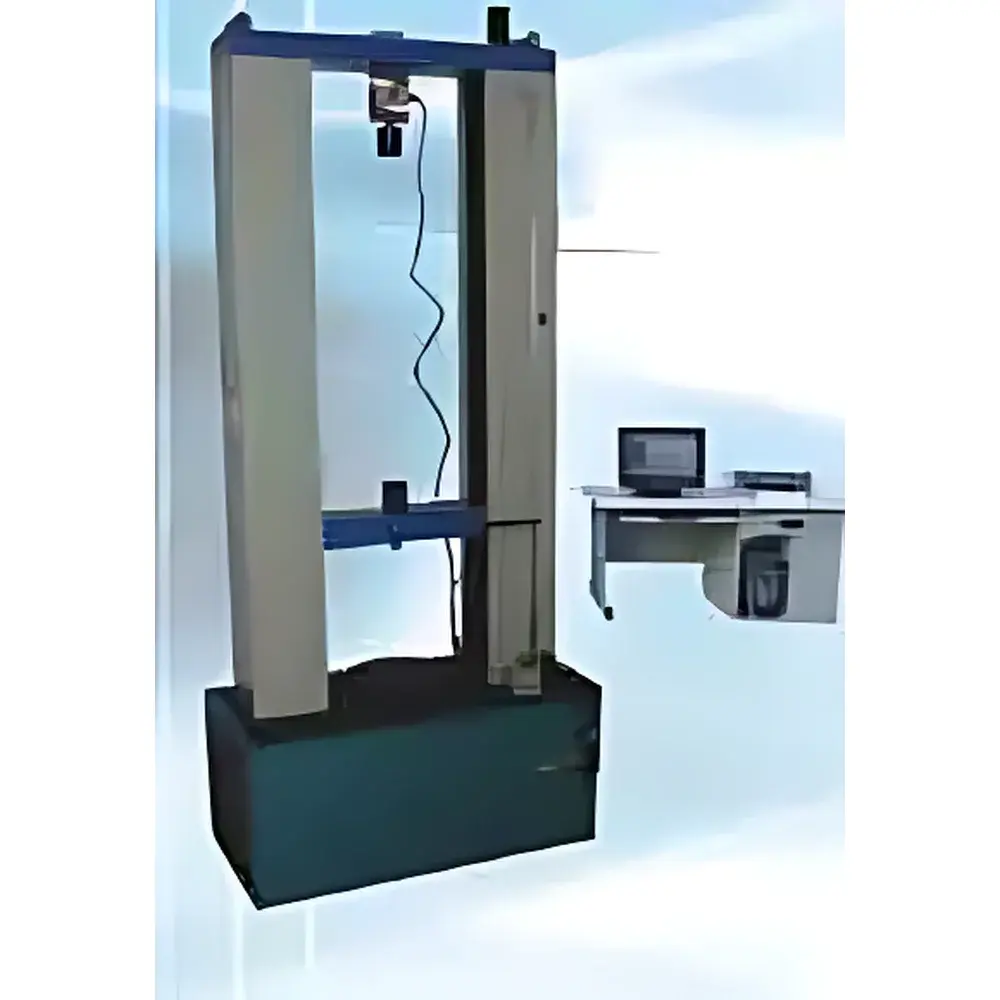
JuBin JB-124A Universal Tensile and Compression Testing Machine
| Brand | JuBin |
|---|---|
| Model | JB-124A |
| Load Capacity | 0–20 ton (user-selectable) |
| Force Sensing | High-precision load cell (USA-made) |
| Force Accuracy | ±0.5% of full scale |
| Effective Test Width | 380 mm |
| Max. Traverse Travel | 1000 mm |
| Drive System | Servo motor (Japan-made) + AC motor (Taiwan-made) |
| Mechanical Transmission | Precision ball screw (Taiwan-made) + High-strength backlash-free screw (Korea-made) |
| Test Speed Range | 0.001–500 mm/min (infinitely variable) |
| Displacement Resolution | 1/200,000 |
| Displacement Accuracy | ±0.005% of full stroke |
| Safety Features | Upper/lower mechanical limits, emergency stop button |
| Display Interface | Dual-mode — PC-based software + embedded microcomputer display |
| Unit Options | g, kg, N, kN, lb, lbf |
| Power Supply | 220 V / 380 V, 50 Hz |
| Net Weight | 1180 kg |
| Dimensions (W×D×H) | 1280 × 950 × 1800 mm |
| Origin | Taiwan |
| Compliance | Designed for ASTM E4, ASTM E8, ISO 6892-1, ISO 7500-1, GB/T 228.1 |
Overview
The JuBin JB-124A Universal Tensile and Compression Testing Machine is an electromechanically integrated static materials testing system engineered for precision mechanical property evaluation under controlled uniaxial loading conditions. It operates on the fundamental principle of force-displacement transduction: a high-fidelity load cell measures applied axial force while a calibrated encoder tracks crosshead displacement, enabling calculation of stress–strain behavior in accordance with standardized test methods. Designed for laboratory and quality control environments, the JB-124A supports both tensile and compressive loading modes—accommodating standard specimen geometries per ASTM E8/E21, ISO 6892-1, and GB/T 228.1—and delivers traceable, repeatable data for structural integrity assessment across metals, polymers, elastomers, composites, textiles, and electrical insulation materials.
Key Features
- Modular dual-drive architecture: Combines a high-torque servo motor (Japan-sourced) for low-speed precision and an industrial-grade AC motor (Taiwan-sourced) for rapid positioning—ensuring optimal dynamic response across the full speed range (0.001–500 mm/min).
- High-resolution force measurement: USA-manufactured load cell with ±0.5% full-scale accuracy and 1/200,000 internal resolution, calibrated to ISO 7500-1 Class 0.5 standards.
- Rigid mechanical frame: Heavy-duty base and column assembly (1180 kg net weight) incorporating dual transmission systems—precision-ground ball screws (Taiwan) and preloaded backlash-free leadscrews (Korea)—to minimize deflection and ensure axial alignment stability during high-load testing.
- Dual-display control interface: Synchronized real-time monitoring via embedded microcomputer panel and Windows-based PC software—enabling simultaneous local operation and networked data logging.
- Comprehensive safety infrastructure: Dual mechanical end-stop limit switches, fail-safe emergency stop circuitry, and programmable software-based overload protection.
- Configurable test environment: Standard 380 mm effective test width accommodates common specimen fixtures; optional extensometer integration (e.g., two-point clip-on or video-based) supports strain-controlled protocols per ASTM E83.
Sample Compatibility & Compliance
The JB-124A is validated for use with standardized test specimens defined in ASTM E8 (metals), ASTM D638 (plastics), ISO 527-2 (thermoplastics), ISO 179 (impact-modified polymers), and GB/T 3923.1 (woven fabrics). Its 0–20 ton capacity range (user-selectable in software) allows scalable testing from fine-wire tensile samples to structural component compression blocks. All hardware and firmware comply with electromagnetic compatibility (EMC) requirements per IEC 61326-1 and functional safety principles aligned with ISO 12100. Calibration documentation adheres to ISO/IEC 17025 traceability requirements when used with accredited calibration services.
Software & Data Management
The included Windows-compatible testing software provides full test sequence programming—including multi-step ramp-hold cycles, automatic yield point detection (0.2% offset method), modulus calculation (tangent/secant), and fracture energy integration. Data export conforms to ASTM E1432 and ISO/IEC 17025 reporting guidelines, supporting CSV, PDF, and XML formats. Audit trail functionality logs user actions, parameter changes, and calibration events—meeting FDA 21 CFR Part 11 requirements when deployed with electronic signature modules. Raw data files retain full 20-bit acquisition fidelity, enabling post-test reanalysis of stress–strain derivatives without loss of resolution.
Applications
- Tensile strength and elongation at break evaluation for metal sheets, stainless steel wires, and aluminum extrusions.
- Compression testing of polymer foams, ceramic tiles, and composite laminates per ASTM D3574 and ISO 844.
- Three-point bending analysis of PCB substrates, fiber-reinforced beams, and biomedical implants per ASTM D790.
- Peel and shear adhesion quantification for pressure-sensitive tapes, laminated films, and medical device bonding interfaces.
- Creep and relaxation profiling under constant load using time-stamped displacement tracking (requires optional dwell control module).
- Quality assurance benchmarking against internal specifications or industry standards including UL 94, IEC 60695, and MIL-STD-810G.
FAQ
What standards does the JB-124A support out-of-the-box?
It natively supports test method templates for ASTM E8, ASTM D638, ISO 6892-1, ISO 527-2, and GB/T 228.1—with customizable parameters for strain rate, preload, and failure criteria.
Can the system be integrated into a GLP-compliant laboratory workflow?
Yes—when configured with user access controls, electronic signatures, and audit-trail-enabled software, it satisfies core GLP requirements per OECD Principles of Good Laboratory Practice and FDA 21 CFR Part 11.
Is third-party calibration certification available?
Calibration certificates traceable to NIST or national metrology institutes (e.g., ITRI in Taiwan) are provided upon request, with optional on-site verification by ISO/IEC 17025-accredited service partners.
What fixture options are supported for non-standard specimens?
Standard wedge-action grips accommodate flat and round specimens up to 20 mm thickness; custom hydraulic, pneumatic, or vise-type fixtures can be supplied based on dimensional drawings and clamping force requirements.
Does the machine support closed-loop strain control?
Strain-controlled testing requires external extensometry—either contact-type (e.g., clip-on LVDT or digital caliper) or non-contact (digital image correlation)—with analog/digital input integration into the controller’s feedback loop.



