
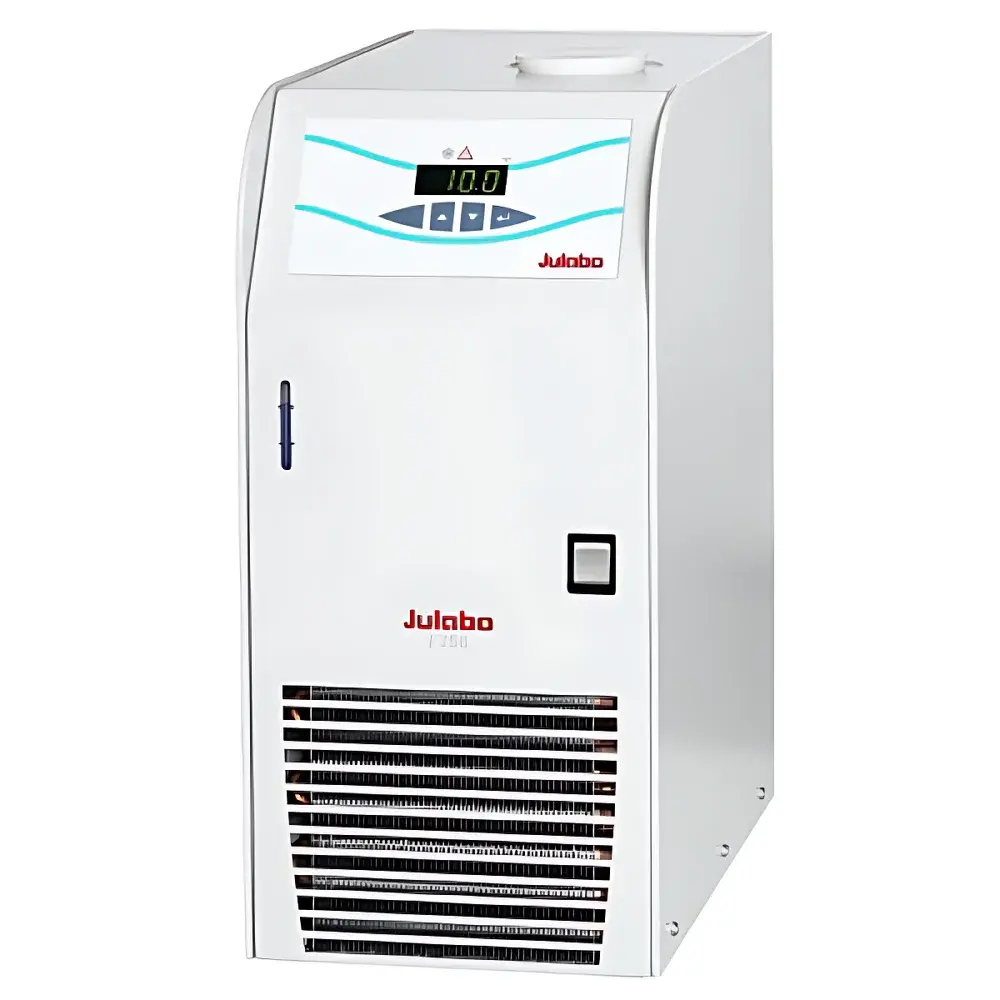
JULABO F250 Circulating Chiller
| Brand | JULABO |
|---|---|
| Origin | Germany |
| Model | F250 |
| Instrument Type | Integrated Circulating Chiller |
| Cooling Method | Air-Cooled |
| Temperature Range | −10 to +40 °C |
| Temperature Stability | ±0.5 °C |
| Refrigeration Capacity | 250 W at 20 °C |
| Circulation Pump Flow Rate | 15 L/min |
| Circulation Pump Pressure | 0.35 bar |
| Reservoir Volume | 2.6 L |
| Operating Mode | Continuous |
| Refrigerant | R134a (GWP = 1430) |
| Sound Pressure Level (1 m) | 59 dBA |
| Dimensions (W×L×H) | 24 × 40 × 52 cm |
| Weight | 27 kg |
| IP Rating | IP20 (splash-proof control panel) |
| Temperature Control | PID with 0.1 °C setpoint/display resolution |
| Safety Features | Over-temperature alarm, low-level alarm, compressor & pump overload protection |
| Wetted Materials | Stainless steel (316L) and chemically resistant engineering plastics |
| Standard Fittings | Two conical hose connectors (for 8 mm and 12 mm ID tubing), M16×1 external thread pump ports |
Overview
The JULABO F250 Circulating Chiller is a compact, air-cooled laboratory chiller engineered for precise, stable thermal management of heat-generating analytical and process equipment. Based on vapor-compression refrigeration using R134a—a zero-ozone-depletion-potential (ODP = 0) refrigerant—the F250 delivers consistent cooling across a wide operational temperature range of −10 °C to +40 °C, with a maximum refrigeration capacity of 250 W at 20 °C ambient. Its sealed, recirculating design eliminates dependence on municipal tap water, reducing water consumption by up to 95% compared to conventional once-through cooling methods—making it compliant with ISO 14001 environmental management principles and supporting institutional sustainability goals. The unit operates continuously under load, maintaining temperature stability within ±0.5 °C via high-gain PID control and a calibrated Pt100 sensor immersed in the reservoir. Its footprint (24 × 40 × 52 cm) and side-free ventilation enable seamless integration into densely configured lab benches, including placement adjacent to spectrometers, rotary evaporators, or chromatography systems without compromising airflow or thermal performance.
Key Features
- Compact, space-saving chassis designed for benchtop deployment in regulated laboratory environments
- Air-cooled condenser with optimized fin geometry and low-noise axial fan (59 dBA at 1 m), eliminating need for external cooling water infrastructure
- Stainless steel (AISI 316L) reservoir and wetted components ensure long-term chemical compatibility with aqueous buffers, ethanol/water mixtures, and JULABO Thermal series heat-transfer fluids
- Splash-proof membrane keypad with high-contrast LED display (0.1 °C resolution) and intuitive navigation for rapid parameter entry and real-time monitoring
- Integrated safety architecture: dual-stage over-temperature cutoff, ultrasonic low-level detection with audible/visual alert, motor current monitoring for pump and compressor overload protection
- Translucent level sight window with graduated scale (1.7–2.6 L operating range) and ergonomic fill/drain ports with quick-connect fittings
- Factory-calibrated circulation pump delivering 15 L/min at 0.35 bar pressure, compatible with standard 8 mm and 12 mm ID silicone or fluoropolymer tubing (included)
Sample Compatibility & Compliance
The F250 is validated for use with instruments requiring stable, low-flow, low-pressure coolant delivery—including rotary evaporators (e.g., Buchi R-300), Kjeldahl digestion units (e.g., Gerhardt Vapodest), CCD-based imaging systems, calorimeters (e.g., TA Instruments Discovery), and optical instrumentation such as polarimeters and refractometers. All wetted surfaces comply with USP Class VI biocompatibility requirements for indirect contact with pharmaceutical process streams. The unit meets EN 61000-6-3 (EMC emission) and EN 61000-6-2 (immunity) standards, and its electrical design conforms to IEC 61010-1:2010 for laboratory equipment safety. While not certified for GMP manufacturing environments, its audit-ready features—including non-volatile event logging (power-on/off, alarm triggers, temperature excursions) and traceable calibration history—support GLP-aligned workflows per OECD Principles of Good Laboratory Practice.
Software & Data Management
The F250 operates as a standalone instrument with no embedded software stack or network interface; all control logic resides in a hardened microcontroller with EEPROM-based parameter retention. Temperature setpoints, stability thresholds, and alarm hysteresis are configurable via front-panel interface only—ensuring deterministic behavior and eliminating cybersecurity attack vectors associated with remote connectivity. For laboratories requiring electronic recordkeeping, optional RS232 serial output (available via accessory cable kit) enables time-stamped temperature and status data streaming to validated LIMS or SCADA platforms. Data export complies with FDA 21 CFR Part 11 requirements when paired with appropriate system validation documentation and user access controls.
Applications
- Cooling condensers and cold fingers in rotary evaporation systems to improve solvent recovery efficiency and prevent bumping
- Thermal stabilization of detectors and optics in UV-Vis, FTIR, and Raman spectrometers to minimize thermal drift in baseline and peak position
- Heat extraction from electrophoresis power supplies, cell culture incubators, and PCR thermal cyclers during extended runs
- Temperature control of reaction jackets in automated synthesis platforms and flow chemistry reactors
- Supporting ASTM D2878 (viscosity measurement) and ISO 2555 (solution viscosity) protocols where bath temperature uniformity directly impacts kinematic viscosity reproducibility
- Providing auxiliary cooling to HPLC column ovens and mass spectrometer ion sources to maintain optimal desolvation and ion transmission
FAQ
What is the minimum ambient temperature required for continuous operation?
The F250 is rated for ambient temperatures between 5 °C and 40 °C. Operation below 5 °C may cause refrigerant migration and oil foaming; extended exposure below 0 °C is not recommended.
Can the F250 be used with ethylene glycol/water mixtures?
Yes—up to 50% v/v ethylene glycol is compatible. Viscosity increase above this concentration reduces effective flow rate and may trigger low-flow alarms; consult JULABO Technical Bulletin TB-F250-GLY for viscosity-compensated pump curves.
Is the unit suitable for use in cleanrooms?
While not ISO Class 5-certified, the F250 emits no particulates or volatile organic compounds (VOCs) under normal operation and features sealed electronics and stainless steel housing—making it suitable for ISO Class 7–8 environments when installed with HEPA-filtered intake air.
How often does the refrigerant require servicing?
R134a is a sealed-system refrigerant; no scheduled replenishment is required. Leak testing per EN 378-1 is advised annually in high-use facilities, with service performed only if measured loss exceeds 10 g/year.
Does the F250 support external temperature feedback control?
No—the F250 regulates based solely on internal reservoir temperature. For process-loop control (e.g., jacket temperature), the FC-series or FL-series models with external Pt100 input capability are recommended.



