
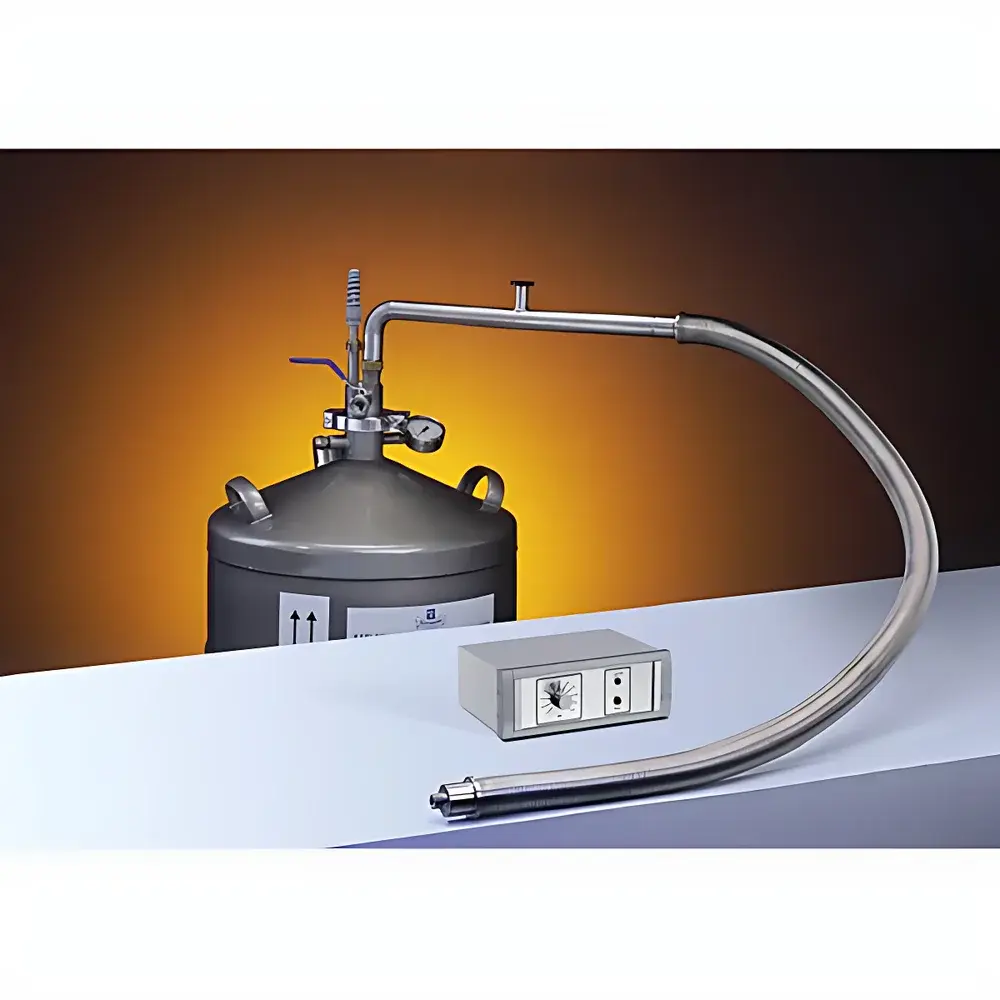
JULABO T-G Series Cryogenic Gas Temperature Control System
| Brand | JULABO |
|---|---|
| Origin | Germany |
| Model Variants | T-G 50, TG-LKF-H 63/50, TG-LKF-H 63/100, TG-LKF-A 63/50, TG-LKF-A 63/100 |
| Temperature Range | −180 °C to +100 °C |
| LN₂ Consumption | 1.1–22 L/h |
| Vaporizer Power | 500 W or 1000 W |
| Heater Power | 630 W |
| Cryogenic Gas Line | V2A stainless steel, 1.8 m flexible vacuum-insulated tubing |
| Connection Interface | KF NW 50 with optional Swagelok, threaded, clamp, or nut-style fittings |
Overview
The JULABO T-G Series Cryogenic Gas Temperature Control System is an engineered solution for precise, dynamic temperature regulation of external samples and experimental chambers using evaporated liquid nitrogen (LN₂) as the primary cooling medium. Unlike conventional cryostats or mechanical refrigeration units, the T-G system leverages controlled phase-change thermodynamics: LN₂ stored in a standard dewar undergoes regulated evaporation within a high-efficiency vaporizer, generating a stable, low-temperature nitrogen gas stream. This gas—cooled to as low as −180 °C—is delivered via vacuum-insulated, flexible V2A stainless steel tubing directly to the target zone. Integrated post-vaporization heating modules enable bidirectional thermal control across a continuous range from −180 °C to +100 °C. The system operates on a closed-loop gas flow principle, where mass flow and thermal energy are decoupled yet co-regulated—allowing independent adjustment of cooling power and setpoint accuracy without compromising stability or reproducibility. Its design conforms to fundamental requirements for cryogenic process validation under ISO/IEC 17025-accredited laboratories and supports GLP-compliant thermal challenge studies.
Key Features
- Wide operational temperature span: −180 °C to +100 °C, fully programmable and digitally stabilized
- Modular architecture: Interchangeable vaporizers (500 W / 1000 W), heating modules (630 W), and gas delivery assemblies permit configuration-specific optimization
- Vacuum-insulated flexible cryo-line (1.8 m, V2A stainless steel) minimizes parasitic heat ingress and ensures rapid thermal response
- Precision mass-flow control via integrated SL1 safety controller; enables repeatable gas delivery at defined volumetric rates
- KF NW 50 standardized interface for seamless integration with vacuum chambers, environmental test enclosures, and custom sample holders
- Multi-fitting compatibility: Supports Swagelok® compression, male/female NPT, clamp-type, and nut-style connections for flexible system integration
- LN₂ consumption optimized between 1.1–22 L/h depending on vaporizer rating and thermal load—enabling extended runtime and cost-efficient operation
Sample Compatibility & Compliance
The T-G system is designed for direct interfacing with diverse experimental platforms—including tensile testing frames, impact testers, environmental chambers, semiconductor thermal cycling stations, and cryo-microscopy stages. It accommodates samples ranging from polymer specimens and metallic alloys to biological tissues and pharmaceutical formulations. All wetted components comply with ASTM F899-22 (standard specification for stainless steel for surgical instruments) and EU Regulation (EC) No 1935/2004 for materials intended to come into contact with foodstuffs. The system supports audit-ready operation per FDA 21 CFR Part 11 when paired with JULABO’s optional data logging software featuring electronic signatures, audit trails, and user access levels. Calibration certificates traceable to PTB (Physikalisch-Technische Bundesanstalt) are available upon request for ISO/IEC 17025 compliance.
Software & Data Management
While the base T-G hardware operates via front-panel digital controls with real-time display of gas temperature, flow rate, and vaporizer status, optional connectivity includes RS485 Modbus RTU or Ethernet TCP/IP interfaces for integration into LabVIEW™, MATLAB®, or SCADA environments. JULABO’s proprietary TempControl Pro software (sold separately) provides full remote monitoring, multi-channel logging (≥1 kHz sampling), alarm scripting, and automated calibration reporting. All recorded datasets include timestamped metadata (operator ID, ambient conditions, LN₂ batch ID if entered), satisfying ALCOA+ data integrity principles required for GxP-regulated workflows. Export formats include CSV, PDF reports, and .tdms for NI-based analysis pipelines.
Applications
- Dynamic thermal characterization of polymers, composites, and metals per ASTM D696 (Coefficient of Linear Thermal Expansion) and ISO 11359 (Thermomechanical Analysis)
- Cryogenic stress-strain evaluation during tensile, torsional, or Charpy impact testing at sub-ambient temperatures
- Rapid vitrification of biological samples for cryo-EM specimen preparation and preservation
- Thermal management of high-power electronic components under accelerated life testing protocols
- Process simulation in low-temperature chemical synthesis, including cryo-catalysis and solvent-free reactions
- Calibration and verification of infrared cameras, pyrometers, and cryogenic sensors against NIST-traceable references
- Controlled cooling ramps for food science applications such as freeze-thaw cycle analysis and ice crystal morphology studies
FAQ
What is the minimum achievable temperature, and how is it maintained?
The system achieves a stable output gas temperature of −180 °C under nominal LN₂ supply pressure and flow conditions. Temperature stability ±0.3 °C is maintained via proportional-integral-derivative (PID) control of both vaporizer power and post-heating module output.
Can the T-G system operate without an external LN₂ dewar?
No. The T-G series requires a standard 10–200 L liquid nitrogen dewar with KF NW 50-compatible虹吸 (siphon) tube connection. It does not incorporate onboard LN₂ storage.
Is vacuum insulation of the gas line mandatory?
Yes. The 1.8 m V2A flexible line includes high-vacuum multilayer insulation (MLI) to limit radial heat leak to <0.5 W/m at −150 °C—critical for maintaining gas temperature fidelity over distance.
How does the SL1 safety controller enhance operational safety?
The SL1 unit monitors gas temperature, flow rate, and dewar level in real time; it automatically shuts off LN₂ supply if outlet temperature exceeds user-defined limits or if flow drops below safe thresholds—preventing condensation-induced blockage or thermal shock.
Are replacement modules field-serviceable?
Yes. Vaporizers, heating cartridges, and gas line assemblies are tool-free swappable; no recalibration is required after module exchange, provided factory calibration records are retained.



