
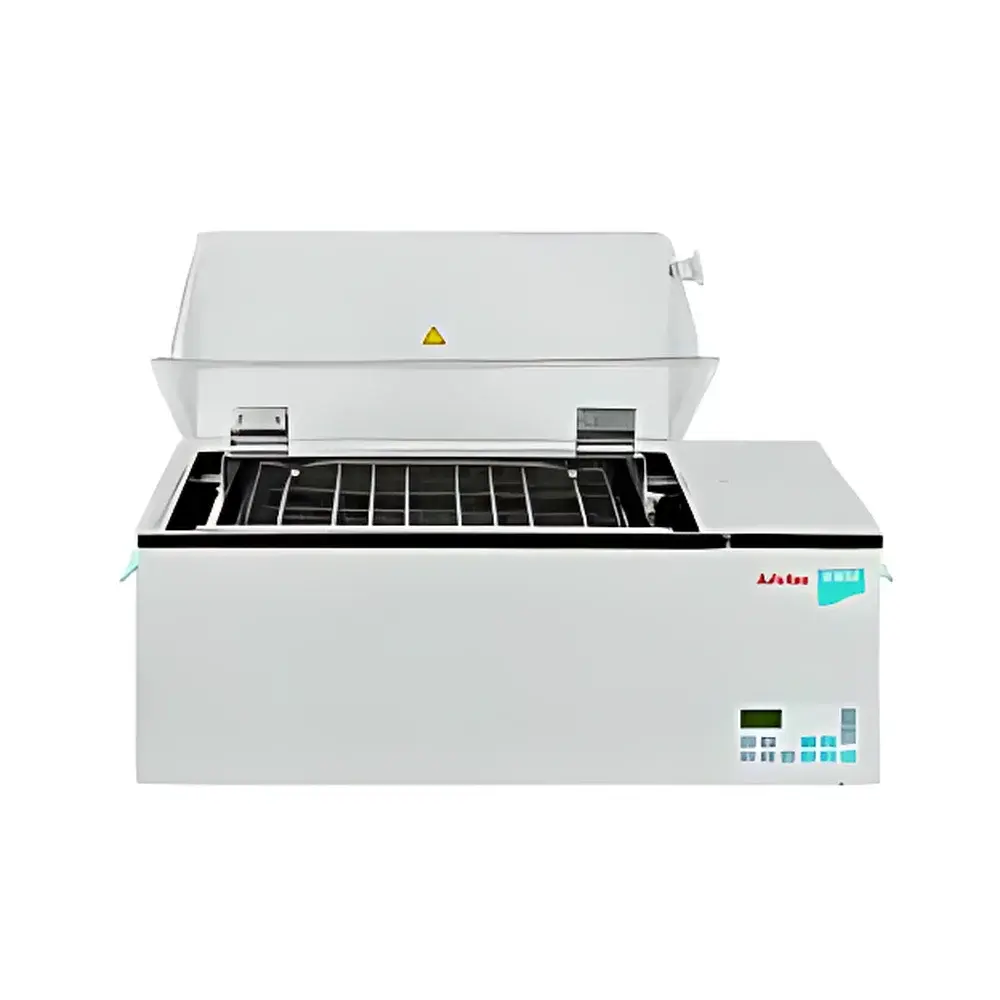
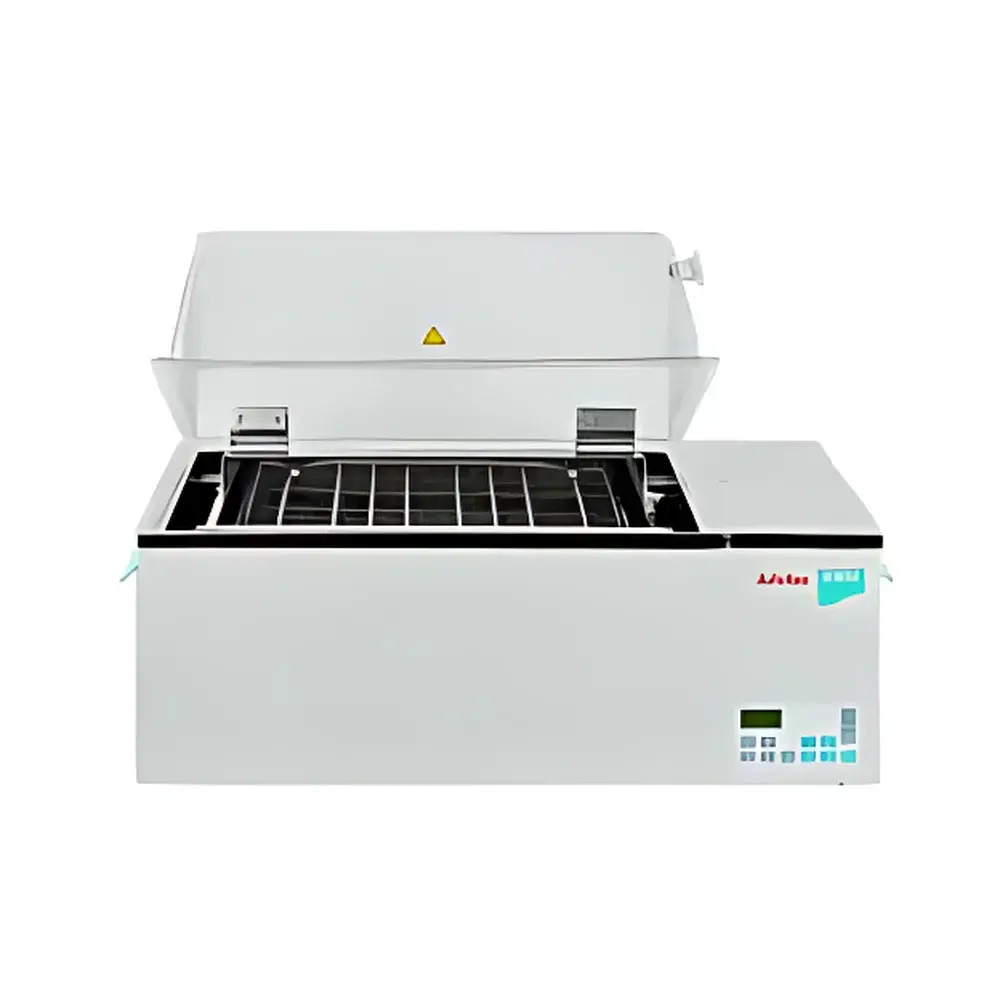
JULABO SW23-40 High-Amplitude Programmable Temperature-Controlled Orbital Shaking Water Bath
| Brand | JULABO |
|---|---|
| Model | SW23-40 |
| Origin | Germany |
| Temperature Range | +5 °C above ambient to +99.9 °C |
| Temperature Stability | ±0.02 °C |
| Resolution | 0.1 °C |
| Heating Power | 2 kW |
| Bath Volume | 8–20 L |
| Bath Opening (W × L × H) | 50 × 30 × 18 cm |
| External Dimensions (W × L × H) | 70 × 35 × 43 cm |
| Amplitude | 40 mm |
| Circulation | Internal & External |
| Control Interface | RS232 for PC-based automation |
| Application Class | Pharmaceutical dissolution & solubility testing |
Overview
The JULABO SW23-40 is a high-precision, programmable temperature-controlled orbital shaking water bath engineered specifically for pharmaceutical dissolution and solubility studies—particularly for extended-release formulations such as microspheres, implants, and polymeric drug delivery systems. Unlike standard incubator shakers or fixed-temperature baths, the SW23-40 integrates tightly regulated thermal control with large-amplitude orbital motion (40 mm), enabling reproducible hydrodynamic conditions critical for simulating in vivo release kinetics under accelerated test protocols. Its core operating principle combines Peltier-assisted heating/cooling regulation with a robust servo-driven shaking mechanism, maintaining thermal stability within ±0.02 °C across its full operating range (+5 °C above ambient to +99.9 °C). This level of thermal fidelity meets the stringent requirements of method development per USP , , and ICH Q5C guidelines, where temperature deviation directly impacts dissolution rate interpretation and batch comparability.
Key Features
- High-amplitude orbital shaking (40 mm) optimized for uniform suspension and enhanced mass transfer in viscous or particulate-laden media
- Programmable temperature ramping and step profiles—enabling controlled thermal acceleration during microsphere dissolution studies
- ±0.02 °C temperature stability at setpoint, verified via calibrated PT100 sensor and dual-stage PID feedback loop
- Dual-circulation system supporting both internal bath homogenization and external recirculation to auxiliary vessels or flow-through cells
- RS232 serial interface compliant with SCPI command syntax, allowing integration into automated lab platforms and LIMS via third-party software (e.g., LabVIEW, Python pySerial)
- Stainless steel bath chamber with corrosion-resistant finish and integrated drain valve for solvent compatibility (water, ethanol, phosphate buffers, PEG solutions)
Sample Compatibility & Compliance
The SW23-40 accommodates standard USP Apparatus 4 (flow-through cell) sample holders, multi-vial racks (up to 20 × 20 mL scintillation vials), and custom fixtures for syringe-based or membrane diffusion assays. Its open-bath architecture supports real-time sampling without interrupting thermal or mechanical equilibrium. The instrument complies with ISO/IEC 17025 calibration traceability requirements when operated with certified reference thermometers. For GMP-regulated environments, audit trails can be generated via external data logging synchronized to RS232 timestamps—supporting alignment with FDA 21 CFR Part 11 electronic record integrity expectations when paired with validated acquisition software.
Software & Data Management
While the SW23-40 operates autonomously via front-panel controls, its RS232 interface enables full remote orchestration: setting temperature ramps, defining shaking start/stop times, reading real-time bath temperature and motor status, and triggering external peripherals (e.g., autosamplers). JULABO provides a basic terminal emulator configuration guide; however, most QC laboratories implement custom scripts using Python or MATLAB to log temperature vs. time datasets alongside dissolution sampling events. All communication adheres to ASCII-based SCPI commands, ensuring interoperability with enterprise-grade laboratory automation frameworks. No proprietary cloud service or vendor lock-in is involved—data ownership remains fully with the user.
Applications
- Accelerated dissolution profiling of PLGA-based microspheres and liposomal suspensions
- Solubility mapping across temperature gradients (van’t Hoff analysis)
- Stability-indicating release testing under stressed thermal conditions (e.g., 45 °C, 55 °C) per ICH Q1A(R2)
- Method qualification for modified-release dosage forms prior to bioequivalence study submission
- Excipient interaction screening during early-phase formulation development
- Validation of sink condition maintenance in high-solubility compound testing
FAQ
Can the SW23-40 maintain ±0.02 °C stability while shaking at maximum amplitude?
Yes—the thermal control system dynamically compensates for mechanical energy input and evaporative cooling effects through continuous PT100 feedback and adaptive power modulation.
Is external circulation compatible with organic solvents like DMSO or chloroform?
External pump and tubing must be chemically selected separately; JULABO recommends Viton or PTFE-lined components for aggressive solvents—standard silicone tubing is rated only for aqueous and mild alcohol solutions.
Does the unit support GLP-compliant electronic signatures and audit trails?
The hardware itself does not embed user authentication or digital signature logic; however, when integrated with validated third-party acquisition software, full Part 11 compliance—including operator ID, timestamped parameter changes, and immutable raw data export—is achievable.
What is the maximum allowable load weight on the platform during orbital motion?
The shaking platform is rated for 5 kg distributed load; exceeding this may compromise amplitude linearity and long-term bearing life.
How frequently should the temperature sensor be recalibrated?
Annual calibration against a NIST-traceable reference thermometer is recommended for regulatory submissions; in-house verification using a calibrated handheld probe should occur before each critical study series.



