
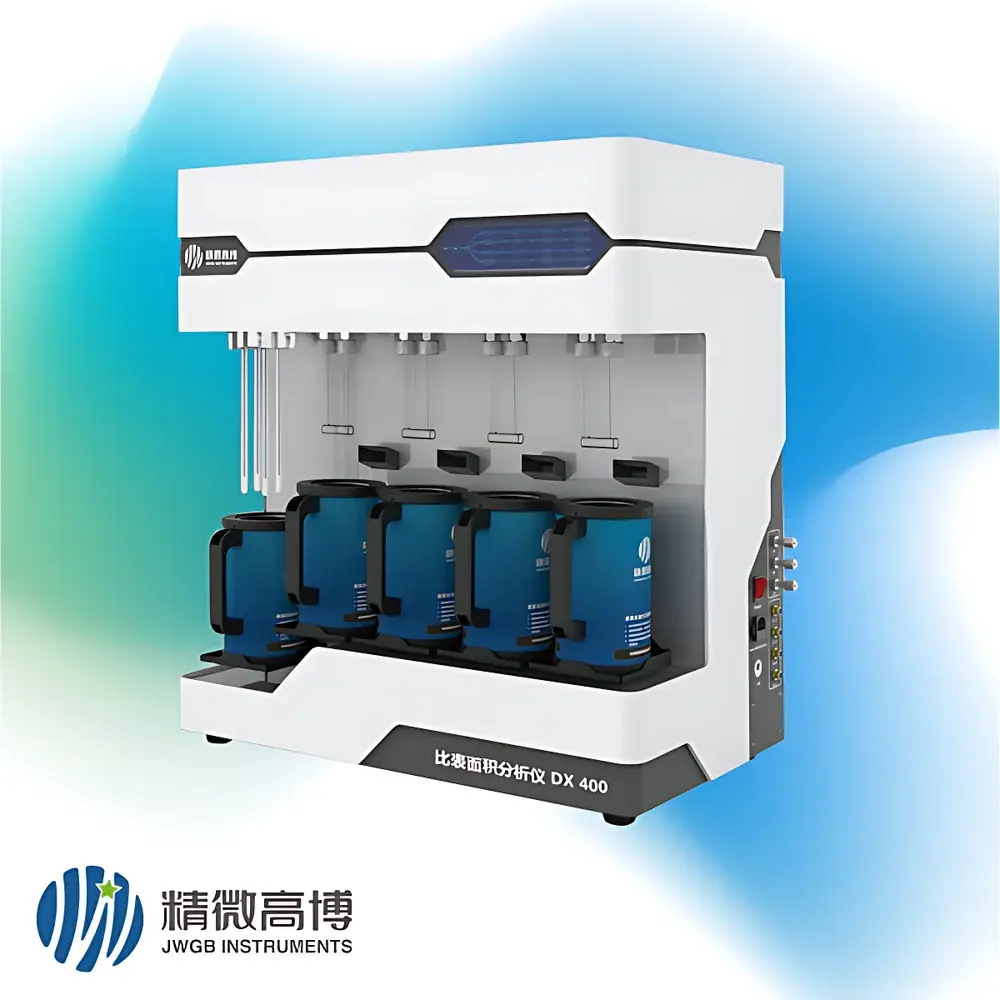
JWGB DX400 Hard Carbon Anode-Specific Specific Surface Area Analyzer (28 Samples per Hour)
| Brand | JWGB |
|---|---|
| Origin | Beijing, China |
| Manufacturer | Yes |
| Product Type | Domestic |
| Model | DX400 Hard Carbon Anode-Specific Specific Surface Area Analyzer (28 Samples per Hour) |
| Instrument Category | Specific Surface Area Analyzer |
| Operating Principle | Dynamic Flow Method (Gas Chromatography-Based) |
| Number of Analysis Stations | 4 |
| Measurement Range | 0.01 m²/g to unlimited upper limit |
| Pressure Condition | Ambient Pressure |
| Theoretical Basis | Dynamic Chromatographic Adsorption Theory |
Overview
The JWGB DX400 Hard Carbon Anode-Specific Specific Surface Area Analyzer is an engineered solution for high-throughput, precision surface area quantification of battery electrode materials—particularly hard carbon anodes used in sodium-ion and next-generation lithium-ion batteries. Unlike conventional static volumetric (BET) analyzers requiring cryogenic liquid nitrogen dosing and vacuum manifold operation, the DX400 implements a robust dynamic flow method grounded in gas chromatographic principles. In this configuration, a precisely regulated mixture of nitrogen and helium flows continuously over the sample at ambient pressure and −196 °C (liquid nitrogen temperature). Adsorption-induced changes in thermal conductivity are detected in real time by a high-stability dual-channel TCD (Thermal Conductivity Detector), generating characteristic adsorption/desorption peaks. Peak area integration—calibrated against certified reference standards—yields absolute nitrogen uptake, enabling surface area calculation via either the single-point direct comparison method or multi-point BET analysis. This architecture eliminates vacuum pump dependency, reduces cycle time, and enhances operational stability in production QC environments.
Key Features
- Four independent analysis stations operating in parallel, enabling true concurrent measurement without cross-talk or thermal interference.
- Throughput-optimized workflow: up to 28 standardized samples per hour under routine QC conditions—validated using NIST-traceable silica gel and activated carbon reference materials.
- Dedicated hardware and software calibration routines for low-surface-area carbonaceous materials (0.01–5 m²/g), including automated baseline drift compensation and peak deconvolution for overlapping adsorption events.
- Ambient-pressure operation eliminates need for high-vacuum components, reducing maintenance frequency and increasing instrument uptime in 24/7 manufacturing settings.
- Integrated liquid nitrogen level monitoring with auto-refill interface compatibility (optional), ensuring consistent thermal stabilization across extended batch runs.
- Ruggedized TCD sensor with <10 nV baseline noise and <0.5% RSD repeatability across 50+ consecutive measurements on identical hard carbon batches.
Sample Compatibility & Compliance
The DX400 is validated for powders with particle sizes ranging from 1 µm to 200 µm and densities between 1.2–2.3 g/cm³—covering commercial hard carbon anodes, graphite, silicon-carbon composites, cathode precursors (e.g., NMC, LFP), and pharmaceutical excipients such as microcrystalline cellulose and spray-dried lactose. Sample preparation follows ASTM D3663-22 (Standard Test Method for Specific Surface Area of Catalysts and Catalyst Carriers) and ISO 9277:2010 (Determination of Specific Surface Area — Gas Adsorption Method). Data acquisition and reporting comply with GLP documentation requirements, supporting audit-ready export of raw chromatograms, calibration logs, and instrument performance verification records.
Software & Data Management
JWGB SurfaceSoft v5.2 provides intuitive method setup, real-time chromatogram visualization, and automated report generation compliant with 21 CFR Part 11 Annex 11 expectations—including electronic signatures, audit trails for parameter changes, and role-based user access control. All raw detector voltage vs. time data are stored in HDF5 format with embedded metadata (sample ID, operator, timestamp, calibration certificate ID). Batch processing supports statistical comparison across shifts or production lots, with configurable pass/fail thresholds aligned to internal QC specifications or customer-facing datasheets.
Applications
- Quality control of hard carbon anode batches during electrode slurry formulation—correlating SSA with first-cycle Coulombic efficiency and solid-electrolyte interphase (SEI) formation kinetics.
- In-process monitoring of carbonization and activation parameters (temperature ramp rate, dwell time, atmosphere composition) to optimize pore structure development.
- Comparative analysis of surface oxidation states via post-treatment SSA shifts—e.g., after air exposure or acid washing—supporting root-cause investigation of capacity fade.
- Regulatory submission support for battery material dossiers requiring documented surface characterization per UN GHS or IEC 62619 testing frameworks.
- Method transfer from R&D labs to contract manufacturing organizations (CMOs) due to standardized column geometry, carrier gas flow profiles, and TCD response calibration protocols.
FAQ
Does the DX400 require liquid nitrogen for every analysis cycle?
Yes—consistent thermal stabilization at −196 °C is essential for reproducible nitrogen adsorption thermodynamics; however, the system supports continuous-fill dewars and level-sensing integration to minimize manual intervention.
Can the instrument quantify micropore volume or perform full isotherm generation?
No—the DX400 is purpose-built for rapid, high-precision surface area determination only. It does not acquire multi-point isotherms or perform BJH/KJS pore size distribution calculations.
Is ASTM D3663 validation data available for hard carbon materials?
Yes—JWGB provides application notes and third-party verification reports demonstrating linearity (R² > 0.999), accuracy (±2.3% vs. gravimetric reference), and intermediate precision (RSD < 1.8%) across 12 commercial hard carbon grades.
How is detector sensitivity maintained during extended operation?
The TCD undergoes automatic zero-balance correction before each analysis, and optional helium purity monitoring ensures carrier gas consistency—critical for maintaining signal-to-noise ratio over 100+ daily cycles.



