
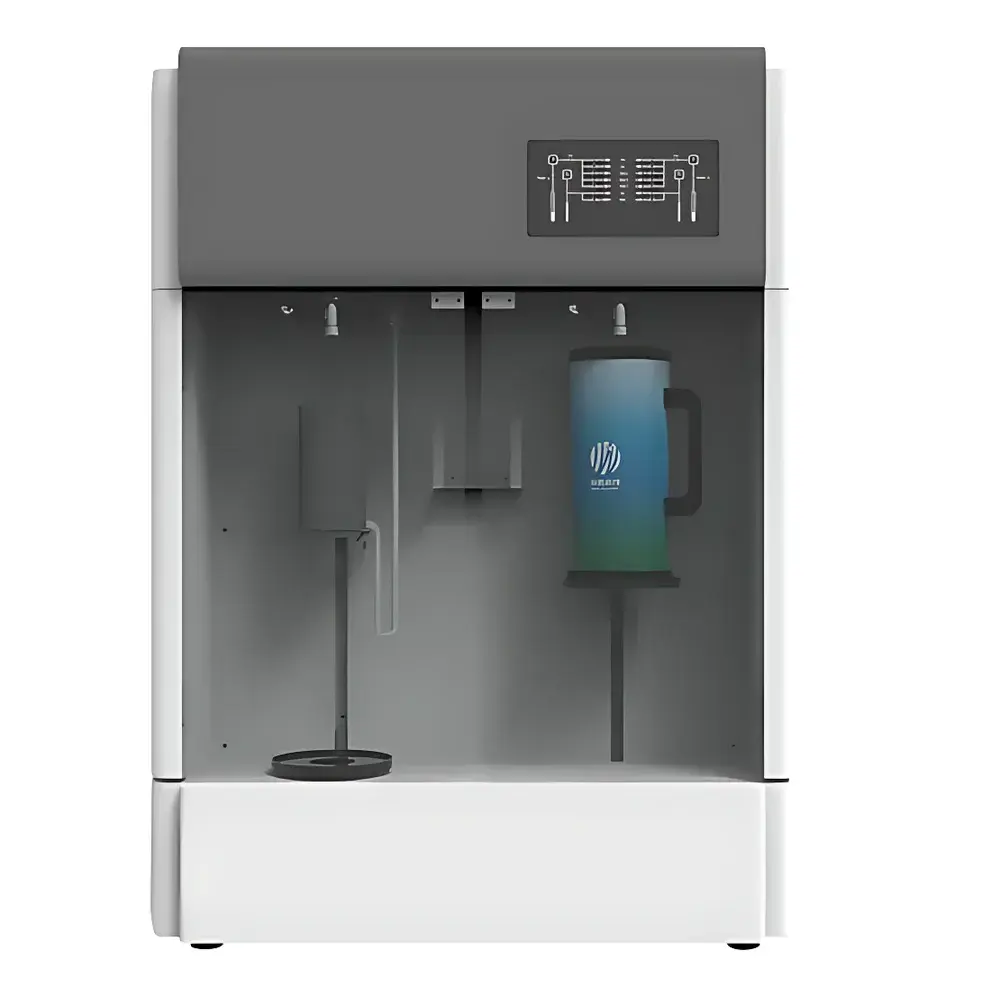
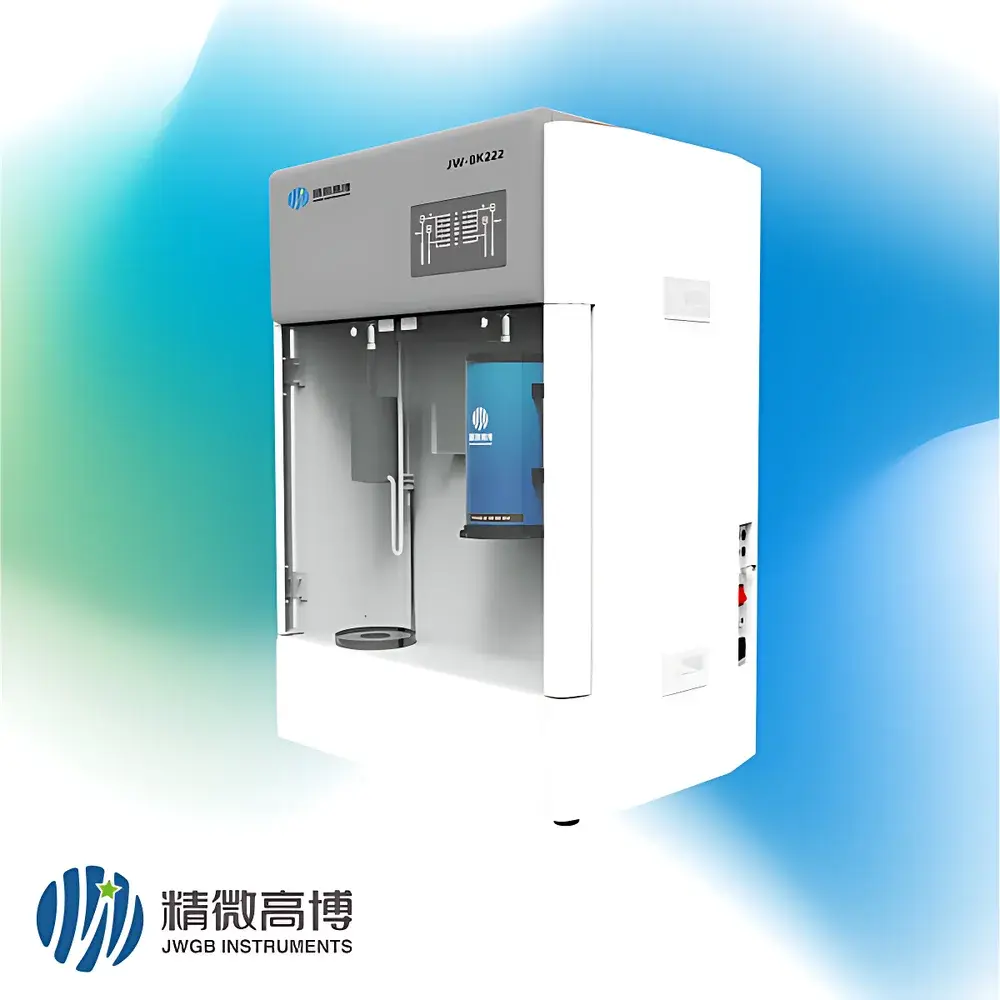
JWGB JW-BK222 Basic Specific Surface Area and Pore Size Analyzer
| Brand | JWGB |
|---|---|
| Origin | Beijing, China |
| Manufacturer Type | Direct Manufacturer |
| Product Category | Domestic |
| Model | JW-BK222 Basic Specific Surface Area and Pore Size Analyzer |
| Instrument Type | Specific Surface Area and Pore Size Analyzer |
| Measurement Principle | Static Volumetric Gas Adsorption (Static Capacity Method) |
| Number of Analysis Stations | 2 independent parallel stations with simultaneous in-situ degassing |
| Specific Surface Area Range | ≥0.0005 m²/g |
| Relative Pressure Range (p/p₀) | 1×10⁻⁶ to 0.998 |
| Adsorption Theory | Gas adsorption-based static volumetric method |
| Compatible Adsorbates | N₂, Ar, Kr, H₂, O₂, CO₂, CO, NH₃, CH₄ (non-corrosive gases only) |
Overview
The JWGB JW-BK222 Basic Specific Surface Area and Pore Size Analyzer is an engineered solution for precise characterization of porous and powdered materials using the static volumetric gas adsorption principle. Designed around the Brunauer-Emmett-Teller (BET) theory for specific surface area determination and the Barrett-Joyner-Halenda (BJH), Dollimore-Healy (DH), and Density Functional Theory (DFT) models for pore size distribution analysis, this instrument delivers metrologically traceable results compliant with ISO 9277, ISO 15901, and ASTM D3663 standards. Its dual-station architecture enables parallel, independent operation — each station equipped with dedicated pressure transducers, temperature-controlled sample ports, and isolated vacuum manifolds — ensuring high reproducibility without cross-contamination or sequential delay. The system employs a rigorously calibrated static capacity method, where known quantities of inert adsorptive gas (typically N₂ at 77 K) are introduced into a fixed-volume manifold, and equilibrium pressures are measured via high-stability capacitance manometers. This approach eliminates flow-dependent artifacts inherent in dynamic (flow-through) systems and provides superior accuracy for low-surface-area materials and narrow-pore distributions.
Key Features
- Dual parallel analysis stations with fully independent vacuum, dosing, and pressure measurement pathways — enabling true concurrent testing and in-situ degassing of two samples.
- High-resolution pressure sensing: dual 1000 torr transducers (one per station) plus optional low-range 10 torr sensor for enhanced micropore resolution down to p/p₀ = 1×10⁻⁶.
- Integrated degassing module with two independently programmable heating zones (ambient to 400 °C, ±1 °C stability) and simultaneous vacuum application via dual-stage rotary vane pump (base pressure ≤7×10⁻¹ Pa).
- Robust vacuum architecture incorporating optional secondary adsorption pump stage, improving system base pressure by 1–2 orders of magnitude for ultra-low-pressure isotherm acquisition.
- Modular gas handling system compatible with N₂, Ar, Kr, H₂, O₂, CO₂, CO, NH₃, and CH₄ — all non-corrosive adsorbates — supporting both cryogenic and ambient-temperature physisorption studies.
- Structural design optimized for laboratory stability: 740 mm × 500 mm × 940 mm footprint, 70–80 kg mass, and vibration-dampened internal mounting to minimize thermal drift and mechanical noise.
Sample Compatibility & Compliance
The JW-BK222 accommodates standard 6–8 mm OD quartz sample tubes and supports heterogeneous solid matrices including catalysts (e.g., γ-Al₂O₃, zeolites), activated carbons, metal–organic frameworks (MOFs), ceramic powders (Al₂O₃, ZrO₂, SiC), nanometals (Ag, Fe, Ni), carbon nanotubes, coal/rock cores, and fibrous composites. All hardware components contacting gas or sample surfaces are electropolished stainless steel or borosilicate glass — certified non-reactive per ASTM E2913 for adsorption integrity. Data acquisition and reporting conform to GLP and GMP requirements, with full audit-trail capability (user logins, parameter change timestamps, raw isotherm export). Instrument validation follows ISO/IEC 17025 guidelines, and BET surface area repeatability meets RSD ≤ ±1.0% on certified reference materials (e.g., NIST SRM 1990). Pore size reproducibility is validated at ≤0.02 nm SD for mesopores (>2 nm) and ≤0.2 nm SD for broader distributions.
Software & Data Management
The proprietary JWGB Analysis Suite (v4.x) provides full control over degassing protocols, isotherm acquisition, and model-based interpretation. It supports automated multi-point BET, t-plot, αs-plot, and DFT kernel selection with real-time error propagation mapping. Raw data (pressure vs. time, dose volume, temperature) are stored in HDF5 format with embedded metadata (instrument ID, operator, calibration certificates, gas lot numbers). Export options include CSV, XML, and PDF reports compliant with FDA 21 CFR Part 11 (electronic signatures, role-based access, immutable audit logs). Remote monitoring via secure HTTPS interface allows lab-wide access without compromising data sovereignty. Software updates are delivered through authenticated firmware channels with SHA-256 verification.
Applications
- Catalysis R&D: Quantification of active surface area and pore accessibility in supported metal catalysts, acidic/basic zeolites, and sulfided CoMo/Al₂O₃ systems.
- Environmental engineering: Performance benchmarking of activated carbons and MOF-based sorbents for VOC, CO₂, and heavy metal capture.
- Energy materials: Characterization of battery electrode coatings (LiFePO₄, NMC), solid electrolytes, and hydrogen storage media (e.g., MgH₂ composites).
- Geoscience: Pore network analysis of shale, coal, and reservoir rock analogues for permeability modeling and enhanced oil recovery (EOR) screening.
- Advanced manufacturing: QC of ceramic feedstocks, metal AM powders, and aerogel insulation matrices where surface chemistry dictates sintering behavior and interfacial adhesion.
FAQ
What adsorption theories does the JW-BK222 support for data interpretation?
BET (specific surface area), Langmuir, t-plot (micropore volume), BJH/DH (mesopore size distribution), and non-local DFT kernels for slit/cylindrical carbon and silica models.
Can the instrument perform both surface area and pore size analysis in a single run?
Yes — full isotherms from p/p₀ = 1×10⁻⁶ to 0.998 are acquired in one automated sequence, enabling simultaneous BET, t-plot, and DFT analysis without re-instrumentation.
Is compliance with regulatory documentation standards supported?
Yes — software includes 21 CFR Part 11-compliant electronic signatures, user-level permissions, and immutable audit trails for GxP environments.
What vacuum performance is achievable with the optional secondary pump configuration?
Base pressure improves from ≤7×10⁻¹ Pa to ≤1×10⁻² Pa, enabling reliable measurement below p/p₀ = 1×10⁻⁵ for ultramicroporous materials.
How is thermal stability maintained during long-duration degassing?
Each degassing port features independent PID-controlled heating with platinum RTD feedback (±0.5 °C uniformity across 30 mm zone) and passive thermal shielding to prevent manifold heating.
Related Products



