
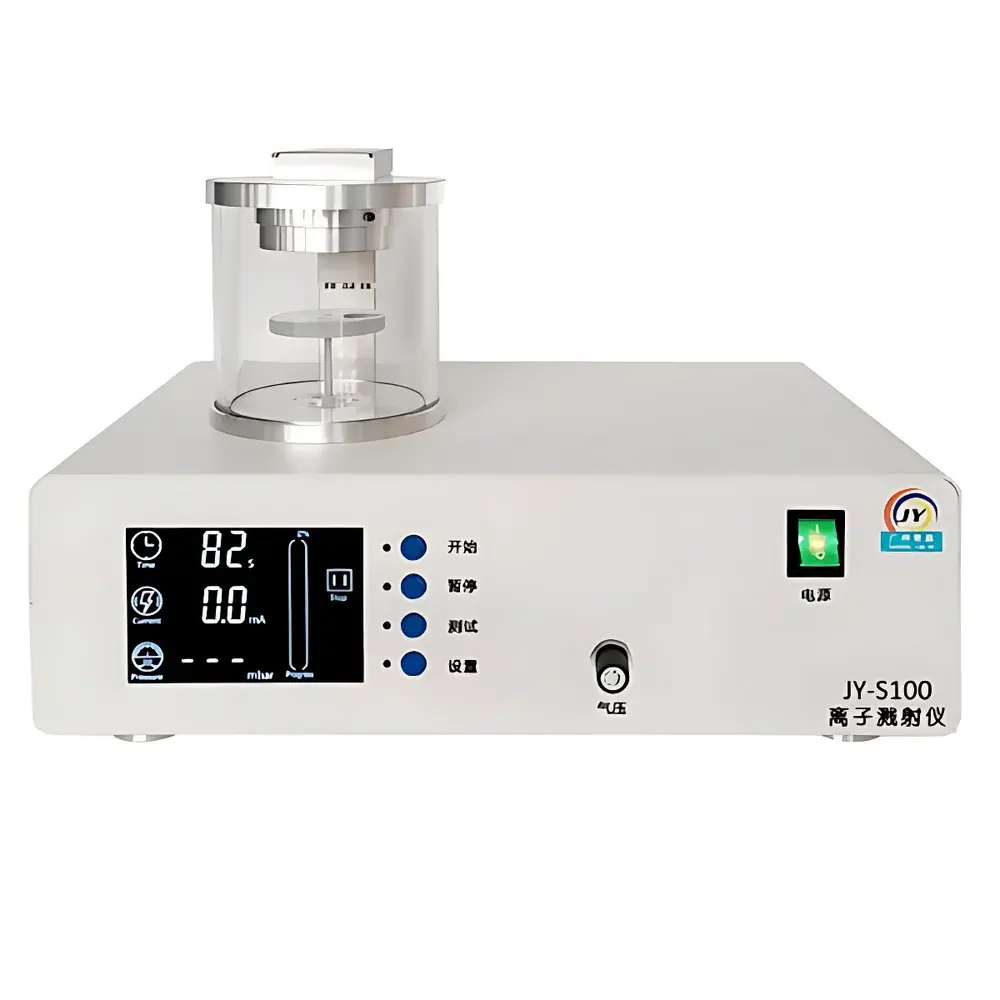
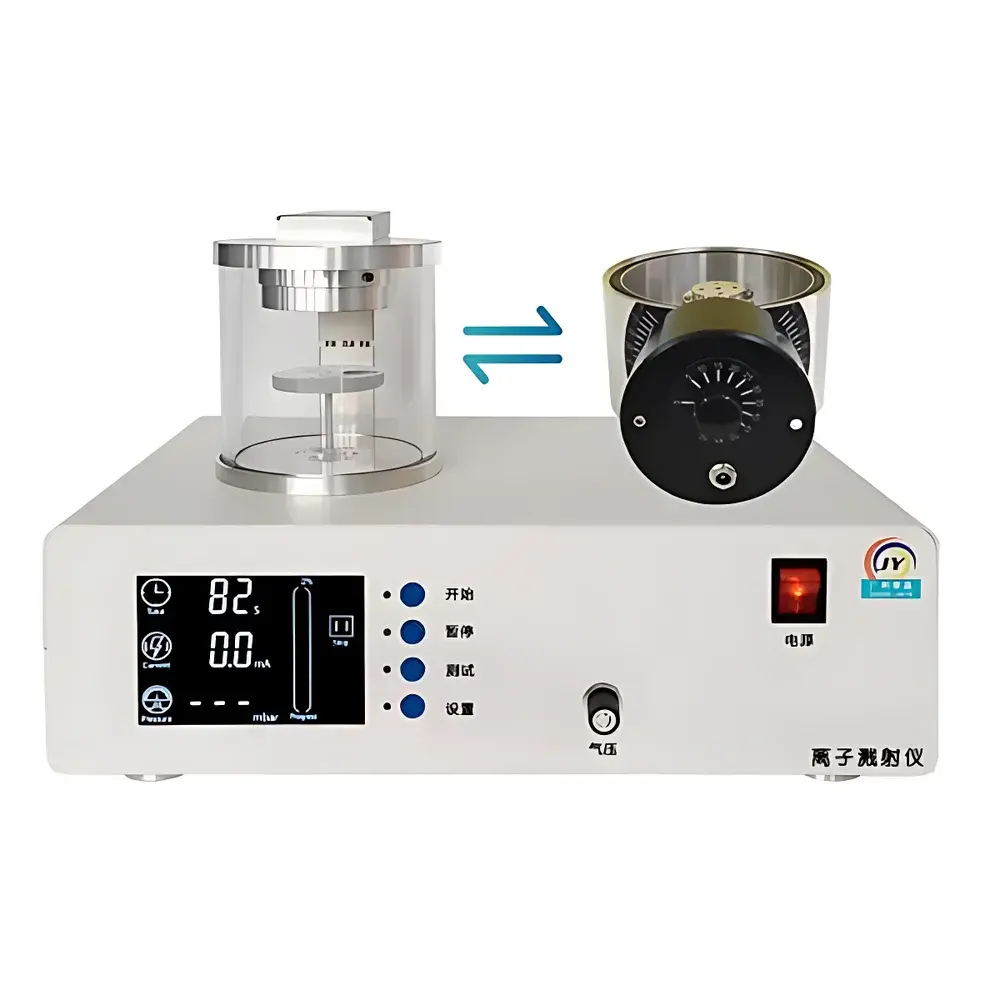
JY-S100 Ion Sputter Coater by Guangzhou Jingying
| Brand | Guangzhou Jingying |
|---|---|
| Origin | Guangdong, China |
| Manufacturer Type | Direct Manufacturer |
| Region Classification | Domestic (China) |
| Model | JY-S100 |
| Target Materials | Au, Pt (standard), Au/Pd, Pt/Pd |
| Target Diameter | 57 mm |
| Control Method | Manual Microprocessor-Based Controller |
| Sample Stage Diameter | 63 mm |
| Sputtering Gases | Argon (primary), Air (limited use) |
| Chamber Dimensions | Ø120 mm × H75 mm |
| Viewport | Ø120 mm × H45 mm |
| Base Vacuum | ≤0.05 Pa |
| Operating Pressure Range | Atmosphere to 3 Pa |
| Sputtering Current Range | 0–99 mA (digitally regulated, pressure-independent) |
| Timer Range | 1–999 s |
| Pumping Speed | 133 L/min |
| Noise Level | 56 dB(A) |
| Standard Sample Capacity | 12 SEM stubs (Ø25 mm) on fixed stage |
| Optional Rotating/Tilting Stage | 0–60 rpm, –90° to +90° tilt, Ø40 mm platform for 4 stubs |
| Safety | Interlocked chamber door, dual mechanical locking mechanism |
| Power Supply | AC 220 V, 50 Hz |
Overview
The JY-S100 Ion Sputter Coater is a compact, benchtop magnetron sputtering system engineered for high-fidelity conductive coating of non-conductive specimens prior to scanning electron microscopy (SEM) analysis. It operates on the principle of direct-current (DC) magnetron sputtering: under low-pressure argon atmosphere, a plasma discharge is generated between the cathode (metal target) and anode (chamber wall), accelerating Ar⁺ ions toward the target surface. This ion bombardment dislodges target atoms, which then condense uniformly onto the sample surface as a nanoscale conductive film. Unlike thermal evaporation, this cold deposition process minimizes beam-induced damage and preserves delicate ultrastructural integrity—critical for biological tissues, polymers, ceramics, and insulating composites. Designed for routine laboratory use, the JY-S100 delivers reproducible sub-5 nm thickness control with minimal grain coalescence, enabling optimal secondary electron yield and signal-to-noise ratio in high-magnification SEM imaging.
Key Features
- DC magnetron sputtering source with permanent magnet array for stable plasma confinement and enhanced target utilization efficiency
- Digitally regulated sputtering current (0–99 mA), decoupled from chamber pressure fluctuations—ensuring consistent deposition rate across variable vacuum conditions
- Stainless steel vacuum chamber (Ø120 mm × H75 mm) with large-diameter borosilicate viewport (Ø120 mm × H45 mm) for real-time process monitoring
- Manually operated microprocessor controller with intuitive interface: start/pause buttons, programmable timer (1–999 s), automatic pump-down, sputtering cycle, and post-cycle venting sequence
- Standard platinum (Pt) target (57 mm Ø × 0.1 mm thick); compatible with Au, Au/Pd, and Pt/Pd targets for tailored conductivity, grain size, and X-ray transparency
- Fixed sample stage (Ø63 mm) accommodating up to twelve standard SEM stubs (Ø25 mm); height-adjustable (60 mm range) for optimal target-to-sample distance
- Optional motorized rotating/tilting stage (–90° to +90°, 0–60 rpm) with dual mechanical locking to prevent specimen displacement during dynamic coating
- Integrated safety interlocks: chamber door lockout, overpressure protection, and current-limiting circuitry compliant with IEC 61010-1 requirements
Sample Compatibility & Compliance
The JY-S100 supports a broad spectrum of non-conductive and beam-sensitive specimens—including hydrated or freeze-dried biological sections (e.g., plant epidermis, insect cuticle, mammalian tissue), polymer films, glass-ceramic interfaces, geological thin sections, and nanoporous aerogels. Its low-energy sputtering regime avoids carbon migration, surface amorphization, or localized heating that may compromise elemental distribution in subsequent energy-dispersive X-ray spectroscopy (EDS) or electron backscatter diffraction (EBSD). While not certified to ISO/IEC 17025 or GLP standards out-of-the-box, the instrument’s repeatable process parameters (pressure, current, time) support traceable method development aligned with ASTM E1558 (Standard Guide for Preparation of Specimens for SEM) and ISO 27207 (Electron microscopy — Preparation of specimens for SEM). Full audit trails require external logging; however, all operational states (pump status, current setpoint, timer value, chamber pressure) are displayed and manually recordable per lab SOP.
Software & Data Management
The JY-S100 employs embedded firmware without proprietary PC software. All process parameters are entered and monitored via a front-panel LCD display and tactile push-button interface. No drivers, cloud connectivity, or data export functions are included—intentionally minimizing cybersecurity exposure and ensuring long-term operational continuity in regulated environments. For laboratories requiring electronic records, manual entry into LIMS or ELN systems is supported via standardized parameter notation (e.g., “JY-S100-Pt-30s-45mA-1.2Pa”). The absence of USB/Ethernet ports satisfies FDA 21 CFR Part 11 Annex 11 principles for instruments where electronic signatures are not implemented—reducing validation burden during GMP or ISO 13485 audits.
Applications
- Routine SEM sample preparation for life sciences: coating of cryo-fractured cells, fungal hyphae, pollen grains, and vascular tissues to suppress charging without masking fine surface topography
- Materials science: uniform Pt or Au/Pd coating of oxide ceramics (Al₂O₃, ZrO₂), carbon-fiber composites, and MOF powders to enable accurate particle size distribution analysis and phase contrast imaging
- Forensic and archaeological analysis: low-damage metallization of fragile textile fibers, charred wood, or degraded parchment prior to high-resolution BSE imaging
- Quality control labs: rapid turnaround coating for incoming polymer pellets or injection-molded parts prior to defect mapping and dimensional metrology
- Teaching laboratories: robust, low-maintenance platform for introducing vacuum physics, plasma behavior, and surface engineering concepts
FAQ
What vacuum level is required before initiating sputtering?
The system must reach ≤3 Pa (typically 1–2 Pa) using the integrated rotary vane pump. Ultimate base pressure of ≤0.05 Pa is achievable after extended pumping but not required for standard operation.
Can air be used instead of argon for sputtering?
Air is not recommended: oxygen content oxidizes metal targets (especially Pt and Pd), degrading film quality and shortening target lifespan. Argon is the only validated process gas.
Is the JY-S100 suitable for coating TEM grids?
No—the chamber geometry and stage design are optimized for SEM stubs (Ø25 mm). TEM grid holders are not supported, and film thickness control at sub-2 nm levels required for TEM is outside its specification envelope.
How often should the target be replaced?
Target lifetime depends on cumulative sputtering time and current. A standard 57 mm Pt target typically lasts 150–200 minutes of total operation at 40–60 mA before erosion compromises uniformity.
Does the instrument comply with electromagnetic compatibility (EMC) directives?
Yes—it meets CE marking requirements per EN 61326-1 (2013) for laboratory equipment, including conducted/radiated emissions and electrostatic discharge immunity testing.



