
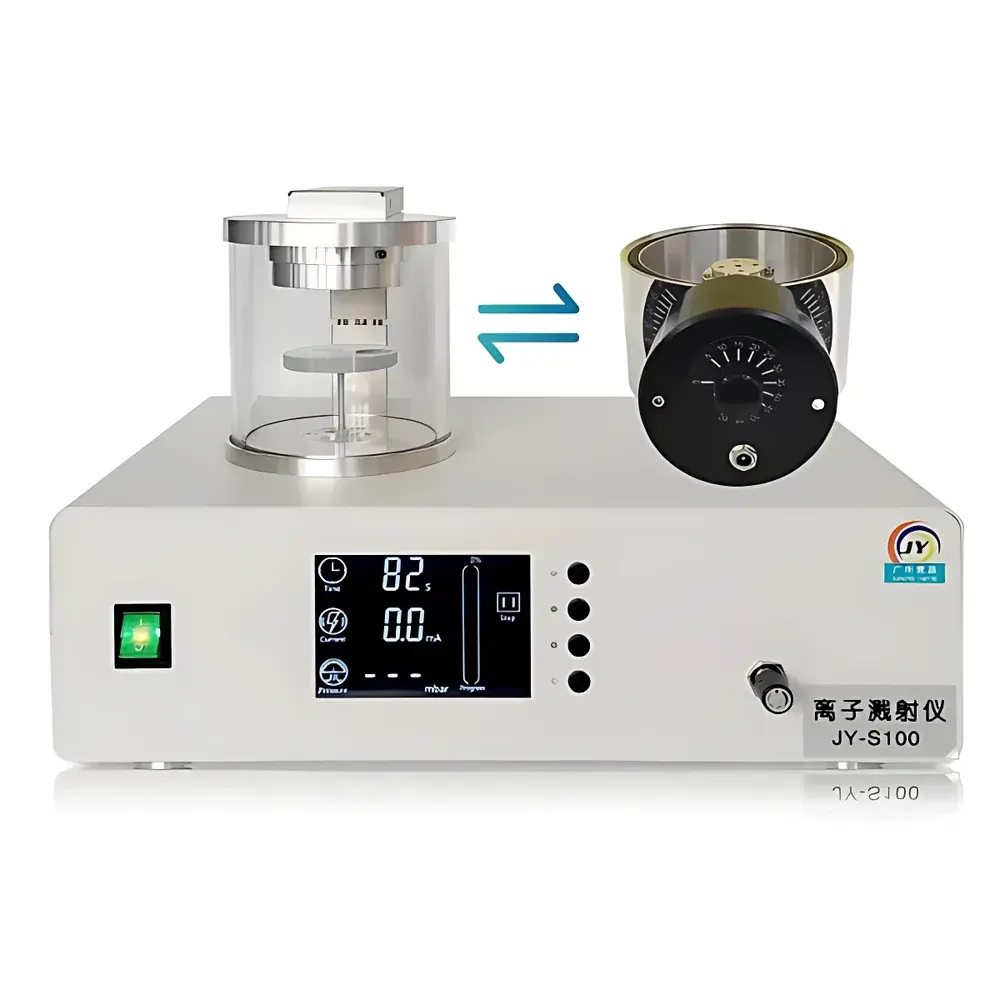
JY-S100 PLUS Ion Sputter Coater
| Brand | Guangzhou Jingying |
|---|---|
| Origin | Guangdong, China |
| Manufacturer Type | Direct Manufacturer |
| Region | Domestic (China) |
| Model | JY-S100 PLUS |
| Price Range | USD 7,000 – 8,500 (FOB) |
| Target Materials | Pt (standard), Au, Au/Pd, Pt/Pd |
| Target Diameter | 57 mm |
| Control Mode | Microprocessor-Controlled Automatic Operation |
| Chamber Dimensions | 120 mm (D) × 75 mm (H) |
| Sample Stage Diameter | 40 mm |
| Sputtering Gases | Argon (recommended), Air (limited use) |
| Rotating/Tilting Stage | 0–60 rpm (adjustable), ±45° tilt (adjustable) |
| Sputtering Current Range | 0–40 mA |
| Vacuum Range | Atmospheric pressure to ≤3 Pa (operating), ≤0.05 Pa (ultimate) |
| Pumping Speed | 133 L/min |
| Acoustic Noise Level | ≤56 dB(A) |
Overview
The JY-S100 PLUS Ion Sputter Coater is a benchtop, cold-cathode magnetron sputtering system engineered for high-fidelity conductive coating of non-conductive specimens prior to scanning electron microscopy (SEM) analysis. It operates on the principle of direct-current (DC) magnetron sputtering, where energetic argon ions—generated under low-pressure vacuum conditions—bombard a metallic target (e.g., Pt, Au, or alloy), dislodging atoms that subsequently condense as a uniform, nanoscale conductive film on the sample surface. Unlike thermal evaporation methods, this cold-process minimizes beam-sensitive specimen damage, preserving fine topographical features and enabling high-resolution, low-voltage SEM imaging. The system integrates a novel low-voltage magnetron head design with optimized magnetic field geometry to enhance plasma confinement and sputter yield at sub-10 Pa pressures—critical for achieving consistent film thickness, minimal grain size, and low charging artifacts across heterogeneous or irregularly shaped samples.
Key Features
- Microprocessor-controlled automatic cycle: integrated sequence for evacuation, sputtering, and venting with user-defined time (1–999 s), eliminating manual intervention and ensuring process repeatability.
- Cold magnetron sputtering architecture: DC-powered, low-voltage (≤40 mA) operation reduces thermal load on samples—essential for polymers, biological tissues, ceramics, and fragile nanostructures.
- Rotating and tilting sample stage: motorized stage (0–60 rpm, ±45° continuous tilt) enables uniform coating coverage on complex geometries and cross-sectional specimens; dual mechanical locking ensures positional stability during rotation.
- Dual-valve gas management: independent electromagnetic valves for purge, vent, and exhaust enable rapid chamber cycling (<60 s typical pump-down to operating pressure) and precise gas flow control.
- Modular target assembly: 57 mm diameter targets (Pt standard; optional Au, Au/Pd, Pt/Pd) mount via quick-release mechanism; integrated dark-space shield minimizes peripheral deposition and improves film purity.
- Robust stainless-steel chamber: 120 mm diameter × 75 mm height cylindrical vacuum chamber with 120 mm × 45 mm borosilicate viewport for real-time process monitoring.
Sample Compatibility & Compliance
The JY-S100 PLUS accommodates a wide range of non-conductive and semi-conductive specimens—including biological sections, geological thin sections, polymer films, ceramic powders, and semiconductor wafers—without requiring pre-treatment or conductive adhesives. Its low-energy sputtering regime complies with routine SEM sample preparation workflows outlined in ASTM E1558 and ISO/IEC 17025-accredited laboratories. While not certified to FDA 21 CFR Part 11, its deterministic timing logic, hardware interlocks, and vacuum-safety cutoffs support GLP-compliant documentation when paired with external loggers. All electrical components meet IEC 61010-1 safety standards for laboratory equipment.
Software & Data Management
The JY-S100 PLUS employs an embedded microcontroller interface with tactile push-button operation (“Start”, “Pause”) and LED status indicators. No external PC or proprietary software is required; all parameters—including sputtering duration, current setpoint, and vacuum status—are retained in non-volatile memory. For traceability, users may manually record cycle logs (date/time, target type, duration, current) in accordance with internal QA protocols. Optional RS-232 or USB-to-serial adapters (third-party) allow integration into lab information management systems (LIMS) for automated metadata capture.
Applications
- Routine SEM sample preparation for life sciences (e.g., freeze-fractured tissues, pollen grains, insect cuticles).
- Metallurgical and materials science applications: coating of oxide ceramics, battery electrode cross-sections, and MEMS devices prior to FIB-SEM analysis.
- Quality control in electronics manufacturing: thin-film deposition on PCB traces and solder joints for conductivity verification.
- Forensic and environmental analysis: carbon-free metal coating of fiber, soil, or particulate samples to suppress charging without masking elemental signatures in EDS mapping.
- Academic research labs requiring cost-effective, maintenance-light sputter coating with reproducible nanoscale film thickness (typically 2–10 nm, dependent on time/current/target).
FAQ
What vacuum level is required for stable sputtering operation?
Stable DC magnetron sputtering initiates at ≤3 Pa and performs optimally between 0.5–2.5 Pa; ultimate vacuum (≤0.05 Pa) supports faster pump-down and reduced residual gas contamination.
Can air be used instead of argon?
Air may be used for basic demonstration or low-resolution work, but introduces oxygen and nitrogen—leading to oxide/nitride formation, higher resistivity, and inconsistent morphology. Argon is strongly recommended for analytical-grade coatings.
Is the system compatible with carbon or chromium targets?
The JY-S100 PLUS is mechanically and electrically configured for conductive metallic targets only (Pt, Au, Pd alloys). Non-conductive or reactive targets (e.g., C, Cr, Ti) require RF sputtering capability, which this model does not support.
How often does the vacuum pump oil require replacement?
With typical usage (5–10 cycles/day), rotary vane pump oil should be replaced every 3–6 months or after 200 hours of cumulative operation—per manufacturer guidelines for the included 133 L/min pump.
Does the unit include a vacuum gauge calibration certificate?
No factory calibration certificate is supplied; however, the analog vacuum meter is factory-zeroed and traceable to standard manometric references. Users may validate accuracy using a calibrated Pirani or capacitance manometer.



