
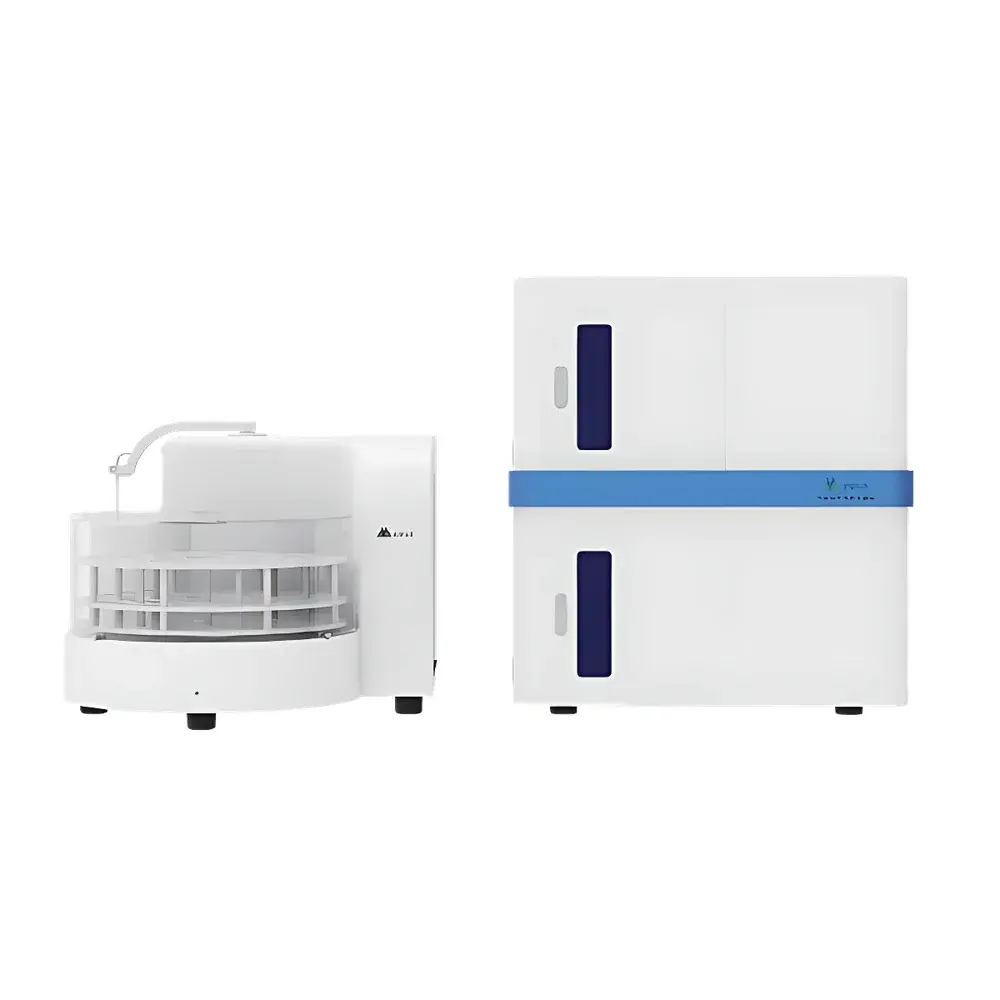
BEIYU TECHNOLOGIES HGMA-460 Dual-Channel Gas-Phase Molecular Absorption Spectrometer
| Brand | BEIYU TECHNOLOGIES |
|---|---|
| Origin | Shanghai, China |
| Manufacturer Type | Authorized Distributor |
| Product Origin | Domestic (China) |
| Model | HGMA-460 |
| Pricing | Upon Request |
| Light Source | Deuterium Lamp |
| Detector | Multi-wavelength Simultaneous CCD Detector |
| Autosampler Capacity | 51 or 87 positions |
| Dilution Range | Up to 50× (programmable or AI-assisted auto-dilution) |
| Detection Limit | Compliant with HJ Standards (e.g., HJ/T 195–2005, HJ/T 199–2005) |
| Precision | RSD < 1% (n = 6, 0.5 mg/L NO₂⁻–N) |
| Analysis Time per Sample | 2–5 min |
| Dual-Channel Capability | Simultaneous quantification of two analytes (identical or different) |
Overview
The BEIYU TECHNOLOGIES HGMA-460 is a fourth-generation dual-channel gas-phase molecular absorption spectrometer engineered for high-throughput, regulatory-compliant water quality analysis. It operates on the principle of gas-phase molecular absorption spectroscopy (GPMAS), wherein target nitrogen- and sulfur-containing species—such as ammonia, nitrite, nitrate, total nitrogen, sulfide, and Kjeldahl nitrogen—are chemically converted into volatile molecular gases (e.g., NO, NO₂, SO₂, NH₃) under controlled reaction conditions. These gaseous analytes are then swept into an optical cell where their characteristic UV-Vis absorption bands are measured using a deuterium lamp light source and a multi-wavelength simultaneous CCD detector. Unlike conventional wet-chemistry or single-channel instruments, the HGMA-460 implements true parallel dual-channel architecture, enabling independent spectral acquisition and quantification pathways for two analytes within a single run—thereby eliminating sequential measurement delays and cross-contamination risks inherent in shared fluidic paths.
Key Features
- Dual-channel optical and fluidic architecture: Enables concurrent, fully independent analysis of two parameters—e.g., NH₃–N and NO₂⁻–N—without hardware reconfiguration or software switching.
- Multi-wavelength simultaneous detection: The high-sensitivity CCD detector captures absorbance across multiple discrete wavelengths (190–400 nm) in a single exposure, supporting method flexibility and internal wavelength validation per measurement cycle.
- Intelligent dilution system: Combines programmable fixed-ratio dilution (1× to 50×) with adaptive dilution logic that evaluates initial signal intensity and automatically selects optimal dilution factor—minimizing manual intervention while preserving quantitative linearity.
- Modular autosampler: Configurable 51- or 87-position sample trays accommodate standard 16-mm or 20-mm vials; integrated barcode reading and positional calibration ensure traceability and alignment with LIMS workflows.
- Open-system integration interface: Equipped with RS-232, Ethernet (TCP/IP), and Modbus TCP protocols; provides native support for ASTM E1384-compliant data exchange and direct handshake with无人实验室 (unmanned lab) platforms, including robotic sample handlers and central monitoring dashboards.
Sample Compatibility & Compliance
The HGMA-460 is validated for use with raw, filtered, and preserved aqueous matrices—including surface water, groundwater, wastewater effluent, and drinking water—per Chinese environmental standards HJ/T 195–2005 (ammonia nitrogen), HJ/T 199–2005 (total nitrogen), HJ 667–2013 (nitrate/nitrite), and HJ 666–2013 (sulfide). Its reagent delivery and gas-transfer modules meet ISO 8655-5 requirements for precision liquid handling. All analytical methods implemented on the platform are structured to satisfy GLP audit requirements, including full electronic record retention, user-access controls, and audit-trail-enabled parameter changes. While not FDA 21 CFR Part 11-certified out-of-the-box, the instrument’s software architecture supports third-party validation packages for regulated environments requiring electronic signature and data integrity compliance.
Software & Data Management
The HGMA-460 runs on BEIYU’s proprietary GPMAS Control Suite v4.2—a Windows-based application built on .NET Framework with SQLite backend and optional SQL Server integration. The software provides real-time spectral visualization, dynamic baseline correction, multi-point calibration curve fitting (linear, quadratic, or weighted), and automated QC flagging (e.g., drift alerts, blank excursion, carryover detection). Raw spectral data (.spc), processed results (.csv), and method files (.gpm) are stored with embedded metadata (operator ID, timestamp, instrument serial, calibration history). Export modules support ASTM E1461-compliant report templates and direct upload to cloud-based environmental data management systems via HTTPS RESTful API.
Applications
- Regulatory compliance monitoring: Routine analysis of NH₃–N, NO₂⁻–N, NO₃⁻–N, TN, and sulfide in municipal wastewater treatment plants and industrial discharge points per national discharge standards.
- Drinking water safety assessment: Rapid verification of nitrogen species post-chlorination and during distribution system surveillance.
- Environmental research: High-temporal-resolution profiling of nutrient dynamics in eutrophication studies, sediment porewater characterization, and wetland biogeochemical flux modeling.
- Method development labs: Platform for validating alternative digestion or reduction protocols due to its flexible reagent injection timing, temperature-controlled reaction zones, and spectral resolution sufficient for interference identification (e.g., Cl⁻–NO₂⁻ overlap mitigation).
FAQ
What nitrogen species can the HGMA-460 quantify simultaneously?
It supports concurrent measurement of any two from the following: ammonia nitrogen, nitrite nitrogen, nitrate nitrogen, total nitrogen, sulfide, and Kjeldahl nitrogen—subject to compatible reagent chemistry and gas-generation kinetics.
Does the instrument require external gas supplies?
No compressed carrier gases (e.g., N₂ or Ar) are needed; all gas-phase transport is achieved via vacuum-driven flow control with integrated pressure regulation and flow monitoring.
Is method validation documentation available for international standards?
Yes—application notes and validation reports aligned with ISO 15681-2 (phosphate), ISO 11905-1 (ammonia), and EPA Method 353.2 (nitrate/nitrite) are available upon request for technical evaluation.
Can the HGMA-460 be operated remotely?
Yes—via secure RDP or VNC over corporate LAN/WAN; remote diagnostics and firmware updates are supported through BEIYU’s authorized service portal with role-based access control.
What maintenance intervals are recommended for routine operation?
Optical window cleaning every 200 runs; reaction coil replacement every 5,000 analyses; annual calibration verification against NIST-traceable standards is advised per ISO/IEC 17025 laboratory practice guidelines.
Related Products







