
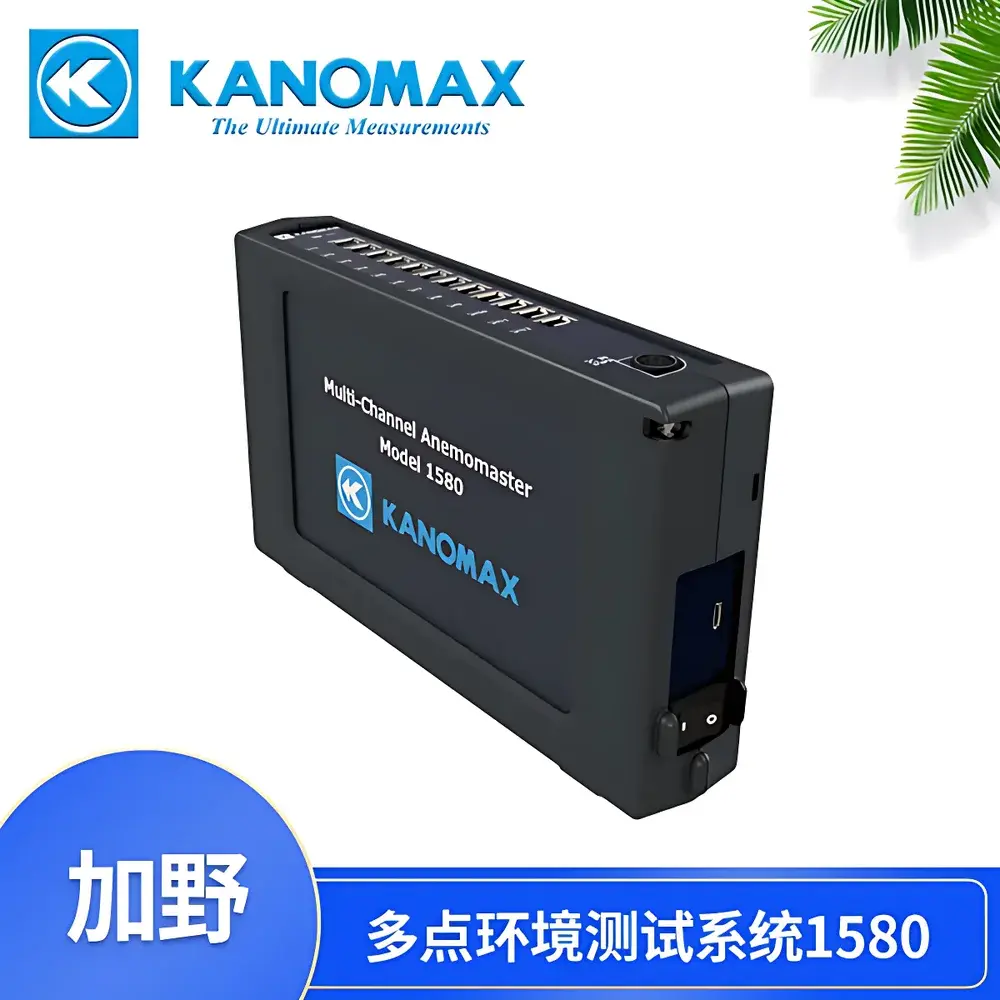
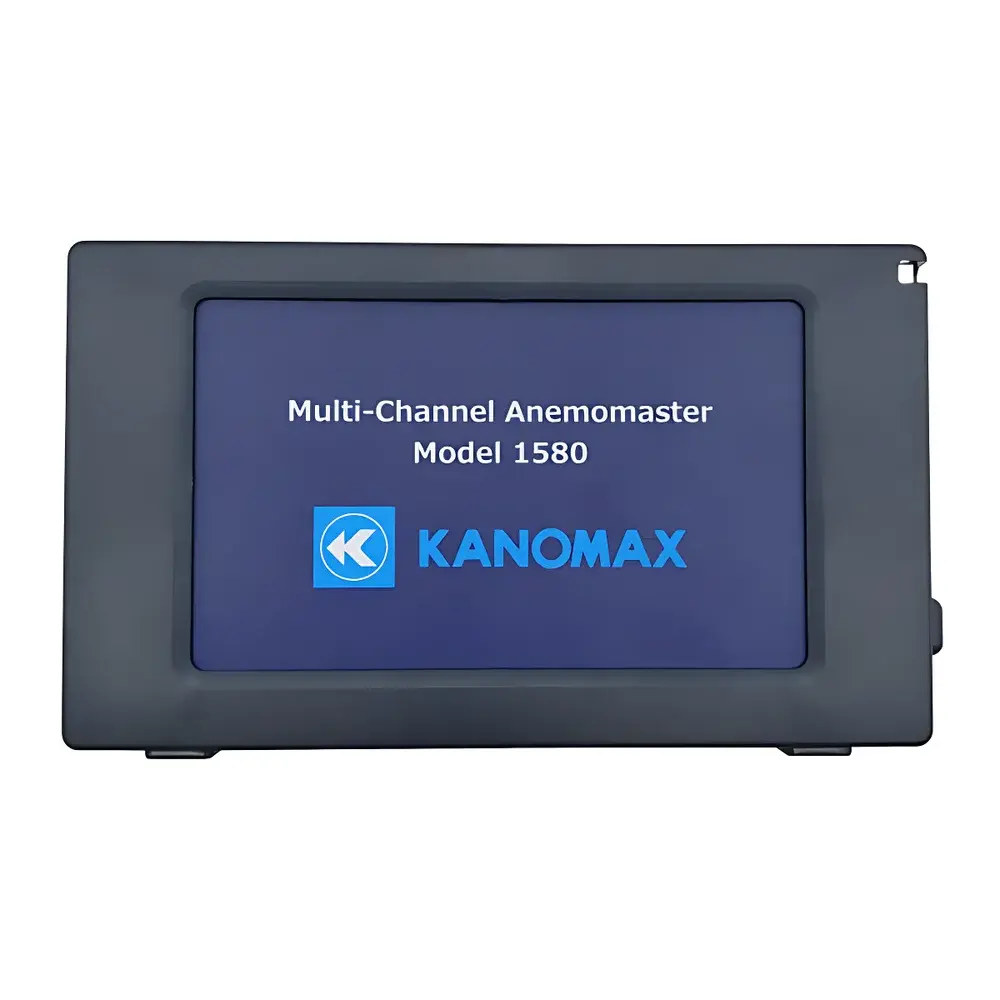
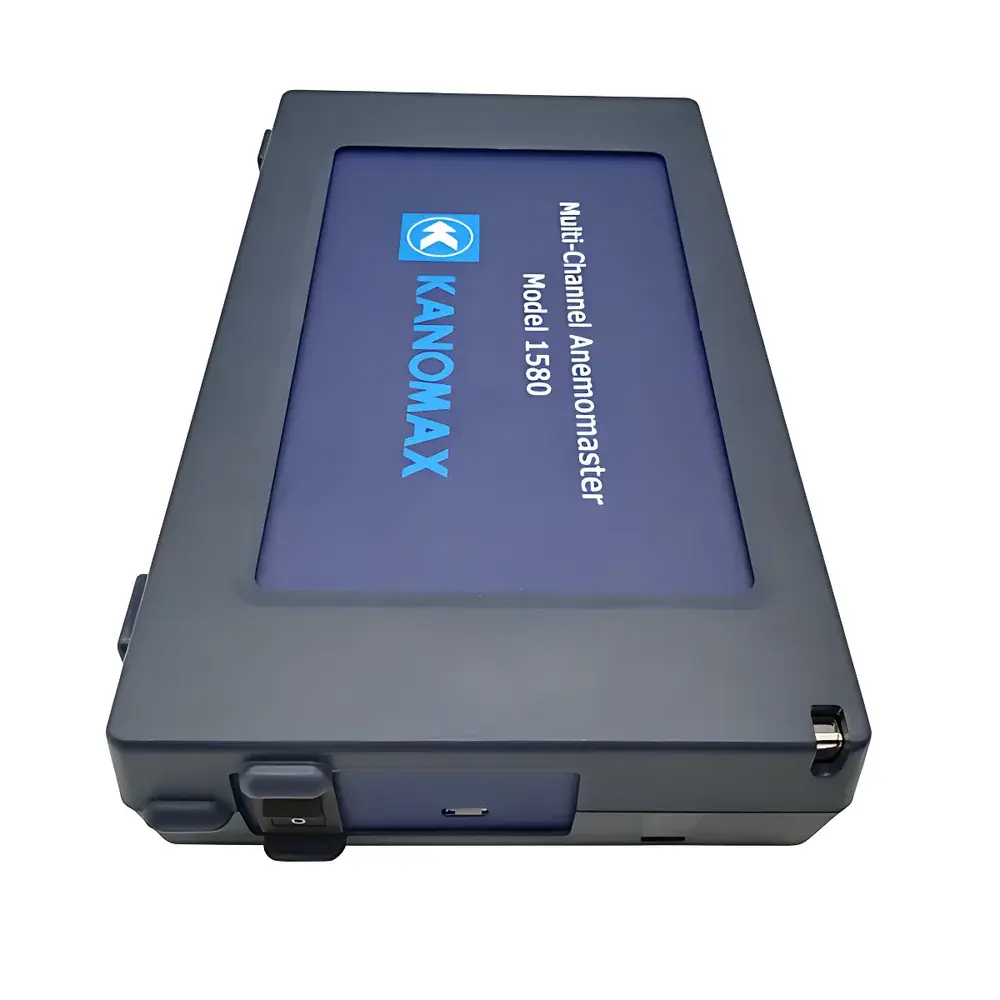
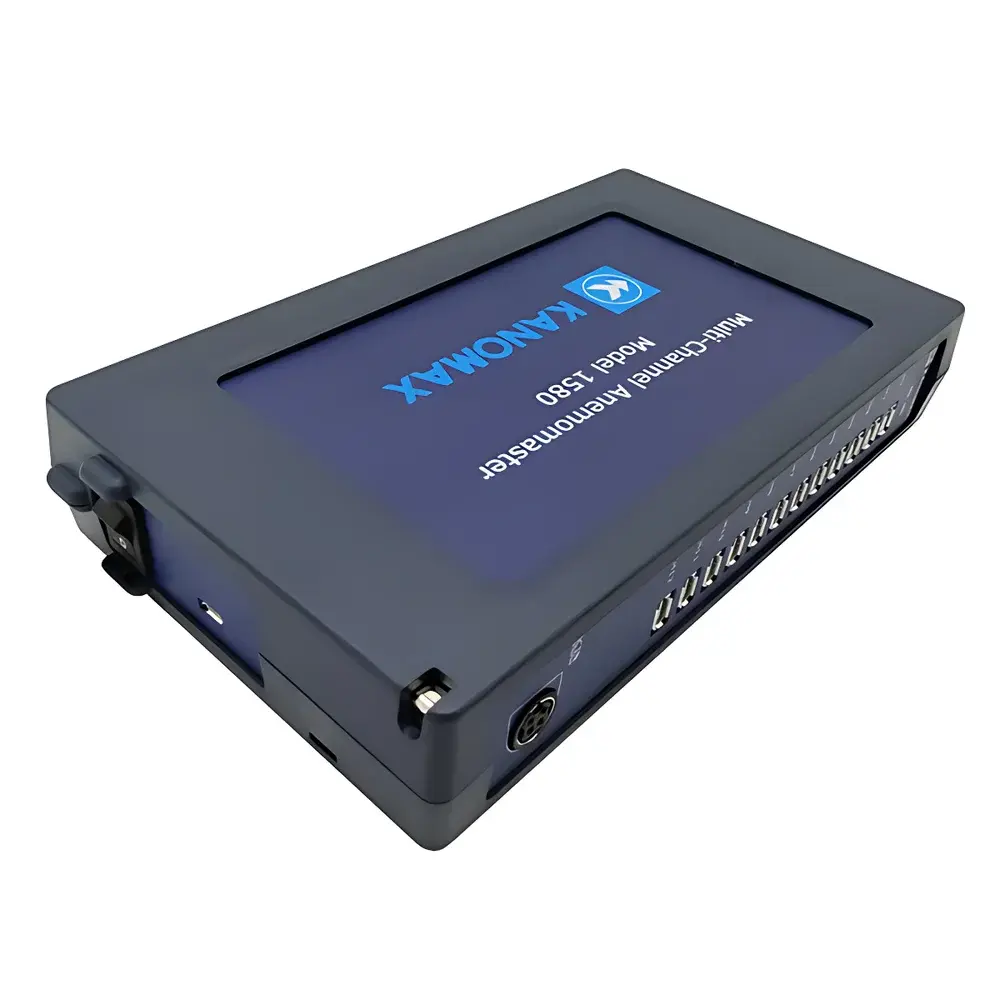
Kanomax 1580-0C Multi-Point Environmental Monitoring System
| Brand | Kanomax |
|---|---|
| Origin | Japan |
| Model | 1580-0C |
| Instrument Type | Thermal Anemometer |
| Resolution | 0.01 m/s |
| Measurement Range | 0.01–50.0 m/s |
| Accuracy | ±2% of reading or ±0.02 m/s (whichever is greater) |
| Operating Temperature | 5–40 °C |
| Operating Humidity | 0–85% RH (non-condensing) |
| Channels | 12 simultaneous inputs |
| Power Supply | AC 100–240 V or DC 12–24 V |
| Dimensions (Unit) | 220 × 130 × 40 mm |
| Weight (Unit) | 0.6 kg |
| Communication | USB Micro-B, RS-485 serial interface |
| Compliance | CE, RoHS, JIS B 7951 (thermal anemometry), ISO 14644-3 (cleanroom monitoring support) |
Overview
The Kanomax 1580-0C Multi-Point Environmental Monitoring System is a modular, high-precision platform engineered for continuous, synchronized measurement of air velocity, temperature, and relative humidity across up to 12 spatially distributed locations. Designed specifically for validation-critical environments—including ISO Class 5–8 cleanrooms in pharmaceutical manufacturing, semiconductor fabrication, medical device assembly, and aseptic processing—the system employs thermal anemometry as its core airflow sensing principle. Each probe utilizes constant-temperature anemometer (CTA) technology, where a heated sensor element maintains a fixed temperature differential above ambient; convective heat loss correlates directly with local air velocity, enabling sub-0.01 m/s resolution and robust low-flow stability. The 1580-0C main unit serves as the central data acquisition hub, supporting hot-swappable probe configurations via standardized serial interfaces and providing real-time synchronization across all channels without time skew or latency-induced averaging artifacts.
Key Features
- 12-channel synchronous acquisition architecture—supports mixed-sensor deployments (e.g., velocity-only, velocity + temperature, or full tri-parameter probes) within a single chassis.
- 15 interchangeable probe models—including directional and omnidirectional variants—with calibrated wind speed ranges from 0.01–50.0 m/s and thermal operating limits up to 120 °C (for high-temperature duct or oven validation).
- Miniaturized probe designs (smallest available in class) enable installation in confined spaces such as HEPA filter housings, laminar flow hoods, and narrow interstitial zones.
- Integrated temperature compensation across all probe types ensures accuracy stability under dynamic thermal gradients—critical for ISO 14644-3 Annex B compliance during cleanroom certification.
- Dual power flexibility: AC mains (100–240 V) or wide-range DC input (12–24 V), permitting mobile deployment on carts, in gloveboxes, or battery-backed field setups.
- Front-panel status LEDs and intuitive channel mapping simplify commissioning and reduce operator training burden in regulated QC labs.
Sample Compatibility & Compliance
The 1580-0C system is validated for use with non-corrosive, particle-free airstreams typical of GMP-compliant clean environments. Probe selection must align with application-specific constraints: e.g., Model 0976-15 (velocity + temperature + RH) is suitable for ISO 14644-1 occupancy-mode testing at ambient conditions (5–40 °C, ≤85% RH), while Model 0976-07 supports high-temperature validation up to 120 °C in sterilization tunnels. All probes meet JIS B 7951 requirements for thermal anemometers and are compatible with FDA 21 CFR Part 11–enabled software configurations when paired with audit-trail-capable data logging. The system supports GLP/GMP documentation workflows through timestamped metadata embedding, probe calibration ID tracking, and user-access-controlled parameter locking.
Software & Data Management
The included Windows 10–compatible software (v3.x+) provides native USB and LAN connectivity, supporting up to 144 total channels when cascaded with multiple 1580-0C units and optional MODEL 1592-0C analog output modules. Real-time visualization includes synchronized time-series plots, statistical overlays (min/mean/max), and auto-generated Excel export (.xlsx) with embedded metadata (probe ID, calibration date, operator ID). Each channel permits independent scaling, offset correction, and alarm threshold definition. Audit trail functionality records all configuration changes, including probe assignment, range selection, and unit conversion settings—enabling full traceability per ALCOA+ principles. Language support includes English, Japanese, and Simplified Chinese UI switching without reinstallation.
Applications
- Cleanroom airflow uniformity mapping per ISO 14644-3 Section B.5.2 (supply air velocity profiling at filter face and work surface levels).
- HEPA filter integrity verification through upstream/downstream velocity correlation analysis.
- Laminar flow cabinet validation (ISO 14644-7) using multi-point velocity vector assessment across the working plane.
- Environmental monitoring during lyophilizer chamber leak testing and HVAC commissioning.
- Temperature-humidity-velocity correlation studies in controlled temperature/humidity (CTH) rooms per ICH Q5C.
- Mobile validation of portable clean air devices (e.g., isolators, RABS) using DC-powered operation and compact probe form factors.
FAQ
What is the maximum number of probes supported per 1580-0C unit?
A single MODEL 1580-0C supports up to 12 probes simultaneously, with full parameter independence per channel.
Can the system be used in environments exceeding 40 °C?
The main unit must remain within 5–40 °C, but high-temperature probes (e.g., 0976-07, 0976-17) operate up to 120 °C—ideal for duct or oven validation where only the probe tip is exposed.
Is analog output capability built-in or optional?
Analog output requires the separate MODEL 1592-0C module (12-channel, 4–20 mA or 0–5 V selectable per channel); up to 12 modules may be daisy-chained for large-scale SCADA integration.
Does the software comply with 21 CFR Part 11 requirements?
Yes—when deployed with password-protected user roles, electronic signatures, and enabled audit trail logging, the software meets baseline Part 11 technical controls for electronic records and signatures.
Are calibration certificates provided with each probe?
Each probe ships with a factory calibration certificate traceable to JCSS (Japan Calibration Service System); NIST-traceable recalibration services are available through Kanomax-certified labs.







