
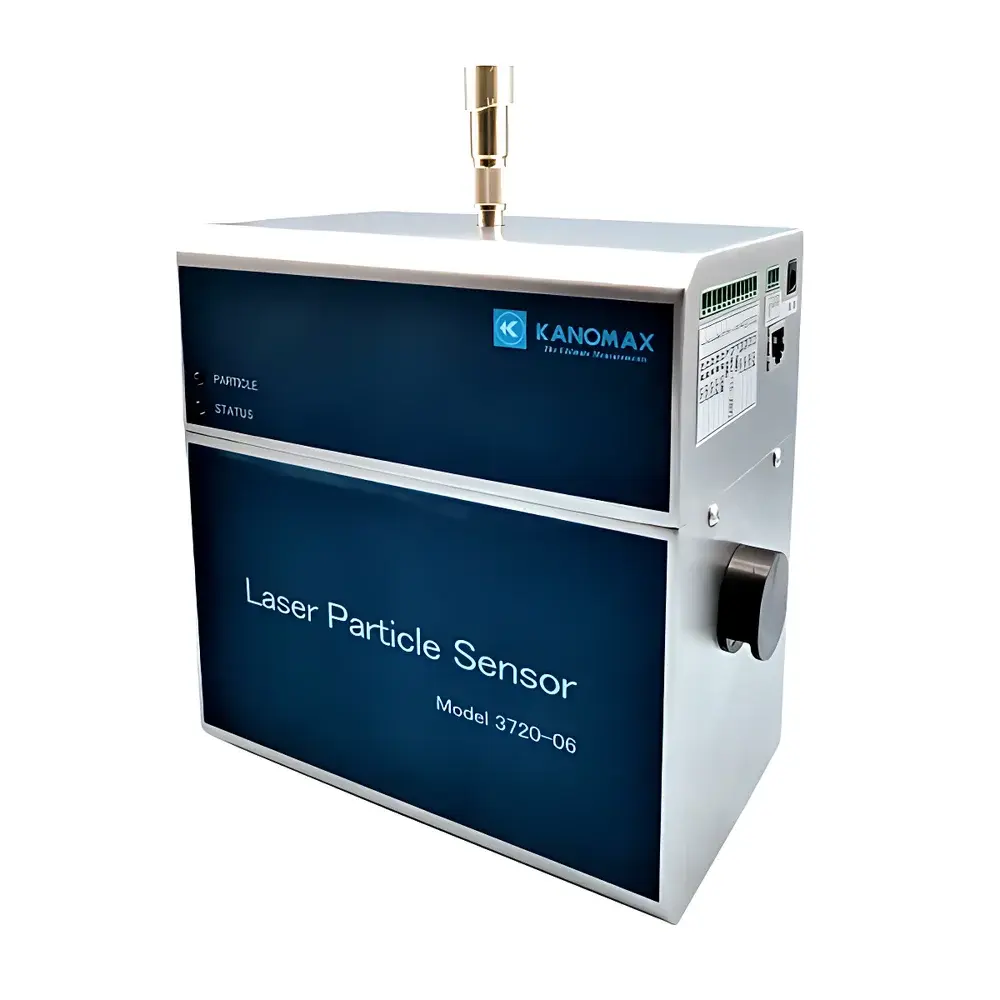
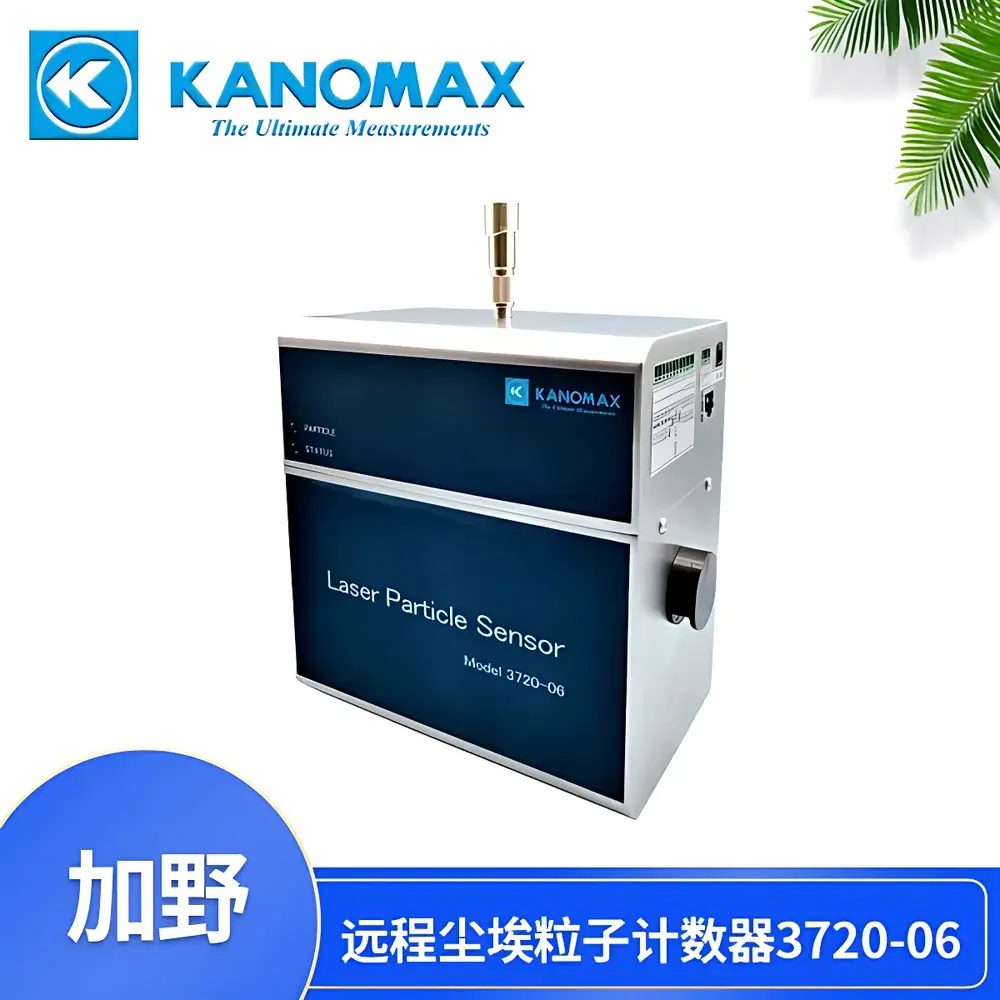
KANOMAX 3720-06 Online Cleanroom Particle Counter for Pharmaceutical Grade Air Monitoring
| Brand | KANOMAX |
|---|---|
| Origin | Japan |
| Model | 3720-06 |
| Instrument Type | Online Particle Counter |
| Flow Rate | 28.3 L/min (1.0 CFM) |
| Detectable Particle Sizes | 0.3, 0.5, 0.7, 1.0, 3.0, 5.0, 10.0 µm (2–4 sizes configurable at factory) |
| Light Source | Long-life Class II laser diode |
| Counting Efficiency | Compliant with ISO 21501-4 and JIS B9921 |
| Max. Concentration | 1,000,000 counts/ft³ |
| Data Storage | 5,000 full measurement records + 4,320 buffered samples |
| Output Interfaces | Ethernet, RS-485, 4–20 mA analog, Modbus RTU/TCP |
| Power Supply | DC 15–28 V, PoE (IEEE 802.3af), or AC 100–240 V |
| Housing Material | 316 stainless steel with VHP- and alcohol vapor-resistant sealed enclosure |
| Operating Environment | 10–30 °C, 20–85% RH (non-condensing) |
| Dimensions | 180 × 110 × 19 mm |
| Weight | 4.0 kg |
Overview
The KANOMAX 3720-06 is an ISO 21501-4–compliant online airborne particle counter engineered for continuous, high-integrity environmental monitoring in regulated pharmaceutical manufacturing environments. It operates on the principle of light scattering photometry—using a stable Class II laser diode to illuminate particles drawn through its calibrated 28.3 L/min (1.0 CFM) isokinetic sampling flow path. Each scattered photon pulse is converted into a digital count and classified by size using multi-channel pulse height analysis. Designed for permanent installation in Grade A/B/C cleanrooms per ISO 14644-1 and EU GMP Annex 1, the 3720-06 delivers traceable, repeatable particle concentration data across two to four user-selectable size channels (0.3–10.0 µm), supporting real-time compliance with USP , , ISO 14644-2, and FDA guidance on environmental monitoring programs.
Key Features
- Robust 316 stainless steel housing with IP65-rated hermetic sealing—validated for resistance to vaporized hydrogen peroxide (VHP) and 70% isopropyl alcohol (IPA) sterilization cycles without performance degradation.
- Modular vacuum sampling pump with tool-free detachability—enabling rapid replacement during routine maintenance without system downtime or recalibration.
- Triple power redundancy: supports IEEE 802.3af Power over Ethernet (PoE), wide-range DC input (15–28 V), and universal AC (100–240 V) — ensuring uninterrupted operation in diverse facility infrastructure configurations.
- Embedded dual-data architecture: 5,000 timestamped measurement records stored non-volatile memory, plus 4,320-sample ring-buffer cache with automatic redundancy backup to prevent data loss during network interruption or firmware update.
- Factory-configurable particle sizing: users select 2–4 discrete channels from the standard set (0.3, 0.5, 0.7, 1.0, 3.0, 5.0, 10.0 µm); no field recalibration required post-configuration.
- Comprehensive alarm logic engine: independent upper-limit thresholds per channel (0–100% of user-defined limit), with dry-contact relay output and Modbus-triggered event logging for integration into SCADA or MES platforms.
Sample Compatibility & Compliance
The 3720-06 is validated for continuous sampling of compressed air, nitrogen, and ambient cleanroom air in ISO Class 3–8 (FED-STD-209E Class 1–100,000) environments. Its isokinetic probe design ensures representative sampling across laminar and turbulent airflow regimes. All optical and fluidic components comply with ISO 21501-4 calibration traceability requirements, with factory-certified counting efficiency ≥50% at 0.3 µm and ≥100% ±10% at ≥0.5 µm. The instrument meets electromagnetic compatibility (EMC) per IEC 61326-1 and safety standards IEC 61010-1. For GxP applications, it supports audit-ready data integrity when deployed with compliant software systems adhering to 21 CFR Part 11 (electronic signatures, audit trails, role-based access control).
Software & Data Management
Data export is supported via native Modbus TCP/RTU registers for direct PLC or DCS integration, alongside standardized 4–20 mA analog outputs (per channel or composite alarm status). Ethernet interface enables HTTP-based configuration and CSV log retrieval; optional KANOMAX ParticleView™ software provides centralized fleet management, trend visualization, and automated report generation (PDF/Excel) aligned with ISO 14644-2 periodic testing requirements. All stored records include UTC timestamps, instrument ID, flow verification status, and temperature/humidity metadata—enabling full traceability for internal audits and regulatory inspections.
Applications
- Continuous Grade A isolator and RABS environmental monitoring per EU GMP Annex 1 (2022 revision).
- In-line compressed gas quality verification for aseptic processing lines (e.g., filling, lyophilization).
- Automated alerting for ISO 14644-2 scheduled testing—triggering alerts upon deviation from action/alert limits defined in site SMPs.
- Supporting contamination control strategy (CCS) documentation under ICH Q5A(R2) and PDA TR13.
- Integration into facility-wide environmental monitoring systems (EMS) with alarm escalation to MES/QMS platforms such as TrackWise or Veeva Vault.
FAQ
Is the 3720-06 suitable for Grade A laminar airflow monitoring?
Yes—it is designed for permanent installation in ISO Class 3 (Grade A) environments, with validated isokinetic sampling, low particle loss in tubing, and immunity to VHP decontamination cycles.
Can particle size channels be reconfigured in the field?
No—channel selection (2–4 sizes from the 7 available) is performed at the factory and固化 in firmware; changes require return to KANOMAX authorized service center.
Does the unit support 21 CFR Part 11 compliance?
The hardware provides necessary controls (audit trail-capable memory, secure clock, user authentication interface); full Part 11 compliance requires validation of the connected software system and procedural controls per organizational SOPs.
What is the expected lifetime of the laser source?
Rated for ≥10 years mean time between failures (MTBF) under continuous operation, consistent with IEC 62471 photobiological safety classification for Class II lasers.
How is flow rate accuracy maintained over time?
The integrated mass flow sensor performs automatic zero-point compensation daily; annual verification against NIST-traceable flow calibrators is recommended per ISO 14644-2.
Related Products







