
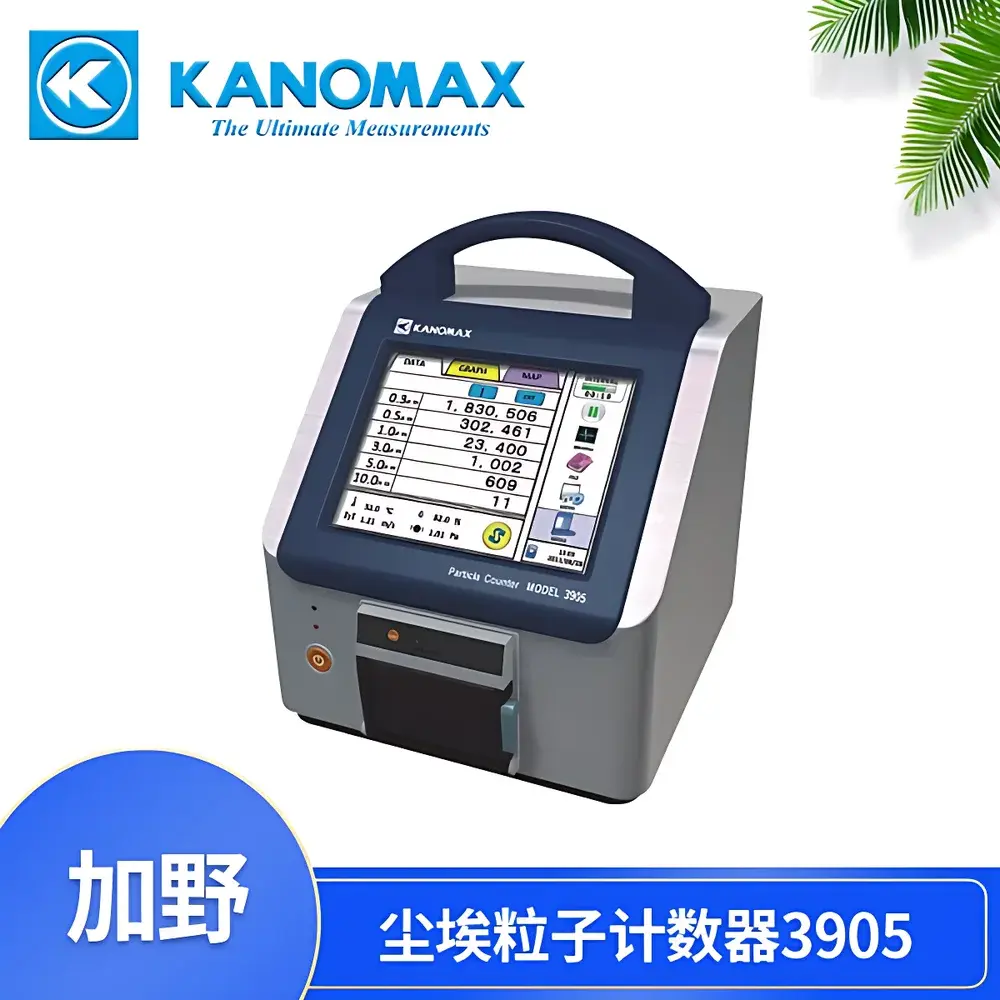
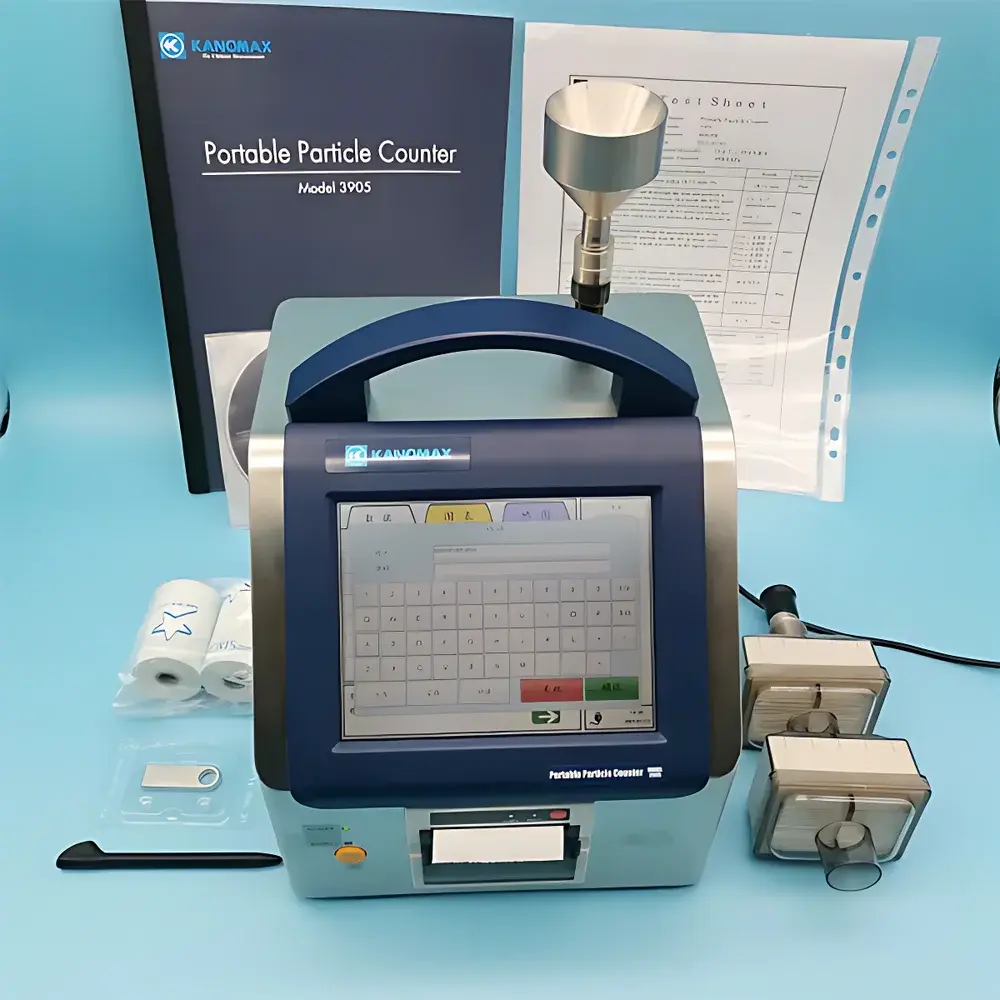
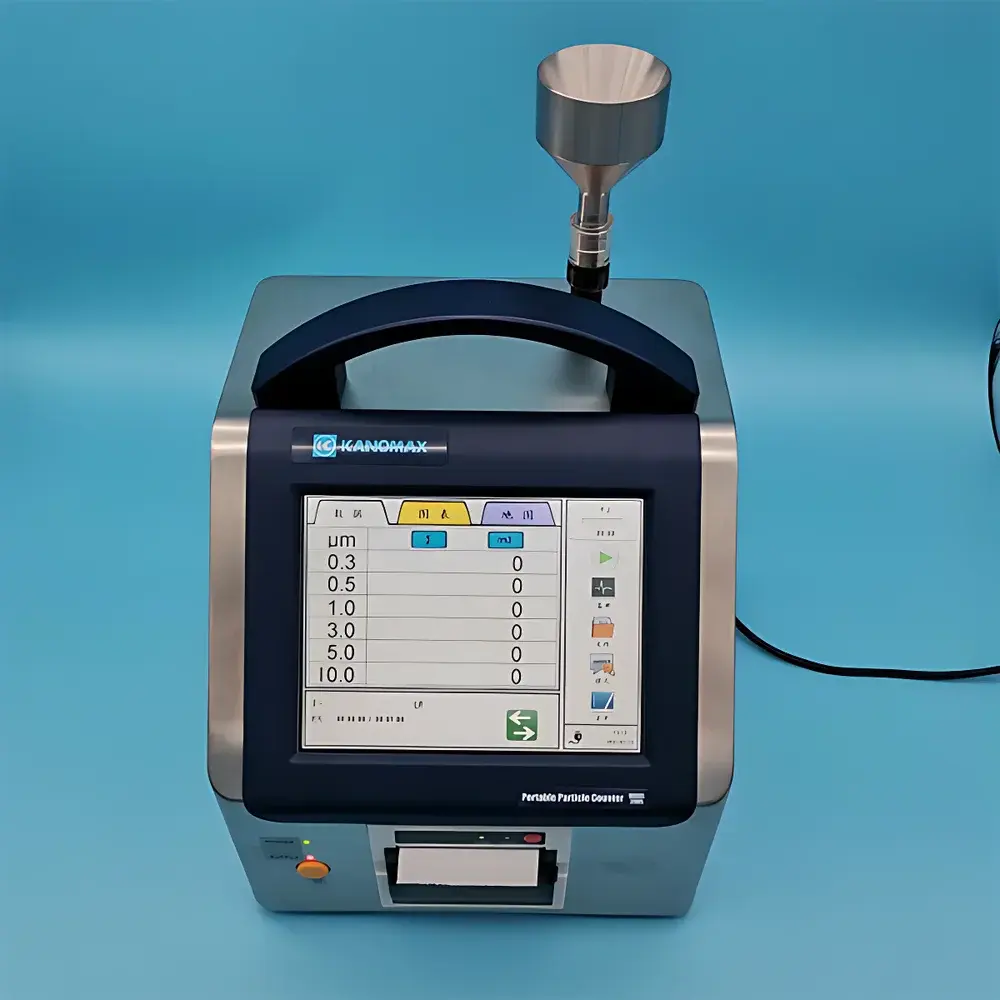
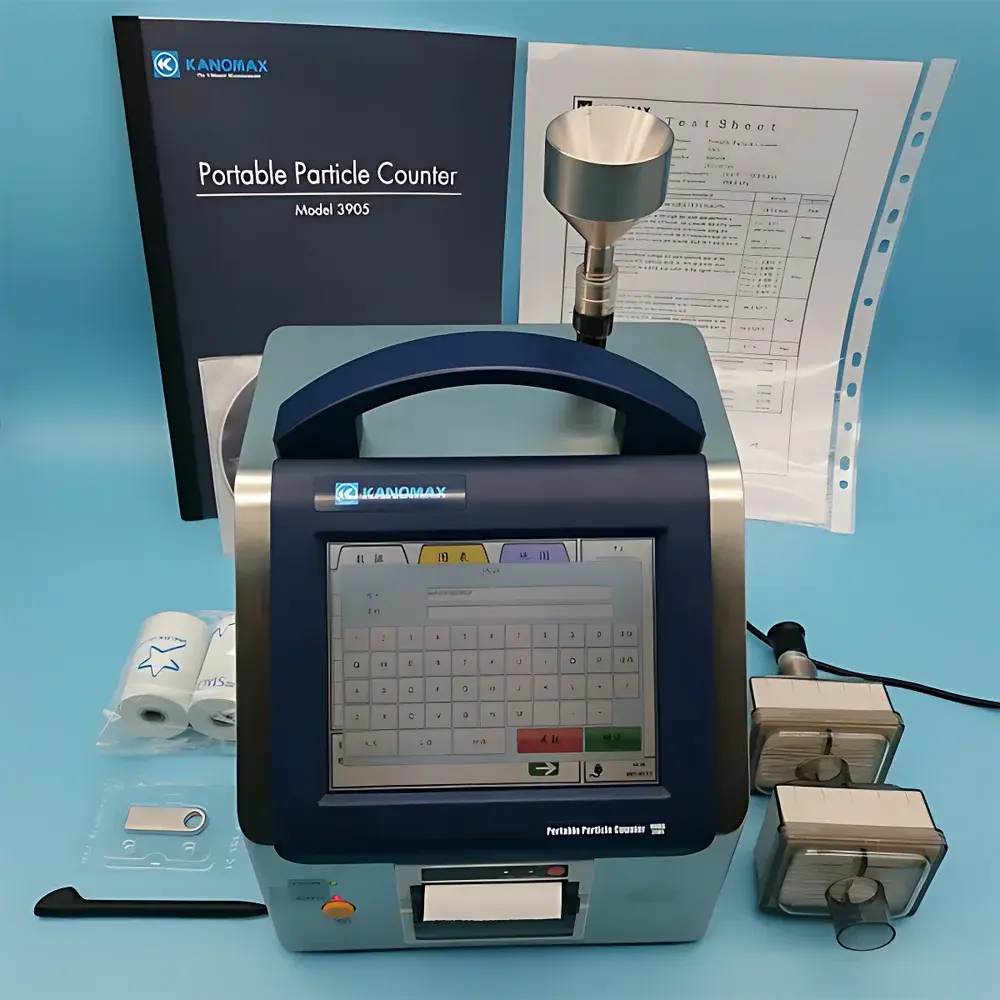
Kanomax 3905 High-Flow Airborne Particle Counter
| Brand | Kanomax |
|---|---|
| Origin | Japan |
| Model | 3905 |
| Flow Rate | 28.3 L/min |
| Particle Size Channels | 0.3, 0.5, 1.0, 3.0, 5.0, 10.0 µm |
| Counting Efficiency | ≥50% ±20% at 0.3 µm (ISO 21501-4 compliant) |
| Maximum Concentration | 500,000 particles/ft³ |
| Repeatability | ≤±10% FS |
| Size Distribution Error | ≤±30% |
| Indication Error | <±30% FS |
| Timing Accuracy | ±1 s within 6-min sampling |
| Flow Accuracy | <1 particle deviation per 5 min |
| Data Storage | 10,000 sample records (internal), USB-expandable |
| Display | 6.4-inch full-color touchscreen |
| Compliance | ISO 14644-1:2015, ISO 14644-2:2015, GB/T 16292–2010, JJF 1190–2008, FDA 21 CFR Part 11 (audit trail enabled), EC GMP Annex 1, JIS B 9921 |
Overview
The Kanomax 3905 High-Flow Airborne Particle Counter is a precision-engineered instrument designed for real-time, quantitative monitoring of airborne particulate contamination in controlled environments. Based on the principle of light scattering from a stable 650 nm laser diode source, the 3905 detects and classifies particles via single-particle optical sensing in accordance with ISO 21501-4:2018. Its fixed flow rate of 28.3 L/min (1 ft³/min) ensures high statistical confidence in low-concentration environments while maintaining compliance with international cleanroom certification protocols—including ISO 14644-1:2015, EU GMP Annex 1 (2022), and Chinese national standard GB/T 16292–2010. The device is calibrated traceably to NIST-traceable reference aerosols and validated for counting efficiency across six user-selectable size thresholds: 0.3, 0.5, 1.0, 3.0, 5.0, and 10.0 µm—enabling direct comparison against Class 5 (ISO 5) through Class 9 (ISO 9) cleanroom limits per ISO 14644-1 Table 1.
Key Features
- High-flow sampling at 28.3 L/min with flow stability <±1% over 6-minute intervals, minimizing statistical uncertainty in low-particulate environments.
- Laser-based optical detection system meeting ISO 21501-4 requirements for counting efficiency (≥50% ±20% at 0.3 µm), resolution (<15% at 0.3 µm), and false count rate (<0.2 particles/ft³).
- Integrated 6.4-inch full-color resistive touchscreen interface supporting multi-language operation (English/Chinese) and intuitive navigation for setup, real-time monitoring, and report generation.
- Built-in thermal printer enabling immediate hardcopy output of ISO-compliant test reports—including date/time stamp, location ID, operator ID, and pass/fail evaluation against user-defined cleanliness classes.
- Internal non-volatile memory stores up to 10,000 complete sampling records (including timestamp, location tag, particle counts per channel, and environmental metadata); expandable via USB 2.0 interface for mass data export.
- Dual-bay rechargeable Li-ion battery system supports continuous operation >4 hours at full flow; AC adapter (100–240 V, 50–60 Hz) included for lab or facility wall-mount use.
- Robust mechanical architecture (200 × 205 × 200 mm, ~4.5 kg without batteries) optimized for portable deployment in cleanrooms, isolators, and HVAC validation studies.
Sample Compatibility & Compliance
The Kanomax 3905 is intended for sampling filtered or conditioned air streams in ISO-classified environments, pharmaceutical manufacturing suites, semiconductor fabrication facilities, and hospital isolation rooms. It accepts standard isokinetic sampling probes and accommodates optional external sensors for simultaneous measurement of temperature (±0.5 °C), relative humidity (±3% RH), differential pressure (±1 Pa), and air velocity (±0.05 m/s)—all synchronized and time-stamped within the same data record. Instrument calibration and performance verification adhere to JJF 1190–2008 (China’s metrological verification regulation for particle counters) and are fully documented per GLP/GMP requirements. Data integrity is maintained under FDA 21 CFR Part 11 through electronic signature support, audit trail logging, and role-based access control—ensuring regulatory readiness for inspections by EMA, PMDA, NMPA, or FDA.
Software & Data Management
The included Kanomax Data Manager software (Windows-compatible, USB/Ethernet-enabled) provides secure import, visualization, and statistical analysis of raw particle count logs. Users may generate custom reports aligned with ISO 14644-2:2015 trending requirements, including UCL (Upper Confidence Limit) calculations, spatial mapping overlays, and trend charts across multiple locations. All exported files retain embedded metadata (instrument ID, calibration due date, operator credentials) and are digitally signed to prevent tampering. Audit trails record every configuration change, data export event, and user login—retained for minimum 24 months as required under Annex 11 and 21 CFR Part 11 Subpart C.
Applications
- Cleanroom qualification and routine monitoring per ISO 14644-1 and EU GMP Annex 1.
- Filter integrity testing (HEPA/ULPA) and airflow visualization during smoke studies.
- Environmental monitoring programs in aseptic processing areas (Grade A/B/C/D).
- Validation of laminar flow hoods, isolators, and RABS systems.
- Pharmaceutical stability chambers, biotech clean utilities, and medical device packaging lines.
- Research-grade aerosol characterization where high temporal resolution and traceable sizing are critical.
FAQ
Does the Kanomax 3905 comply with FDA 21 CFR Part 11 for electronic records?
Yes—the instrument implements full Part 11 functionality including electronic signatures, audit trail logging, and secure user authentication.
Can the 3905 be used for ISO 14644-2:2015 trending analysis?
Yes—data export includes timestamps, location tags, and raw channel counts required for UCL calculation and long-term trend evaluation.
What is the maximum particle concentration the 3905 can accurately measure?
500,000 particles/ft³ (17.6 × 10⁶ particles/m³) with ≤10% coincidence loss at 0.3 µm threshold.
Is external sensor integration limited to specific models?
No—Kanomax-certified environmental sensors (temperature/humidity/pressure/velocity) connect via standardized analog/digital I/O and are auto-recognized in firmware.
How is zero-count verification performed?
Using the supplied HEPA-filtered zero-count reference filter; instrument automatically validates baseline noise and reports compliance with JIS B 9921.
Related Products







