
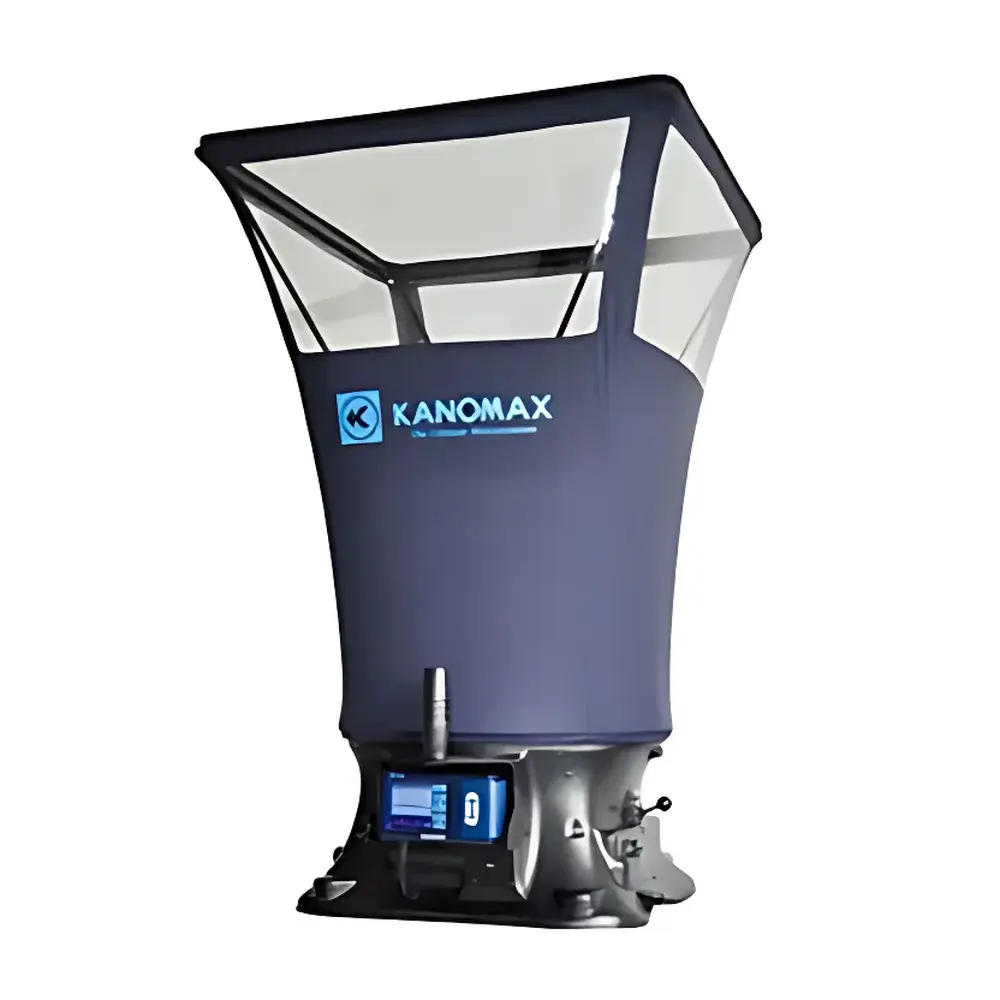
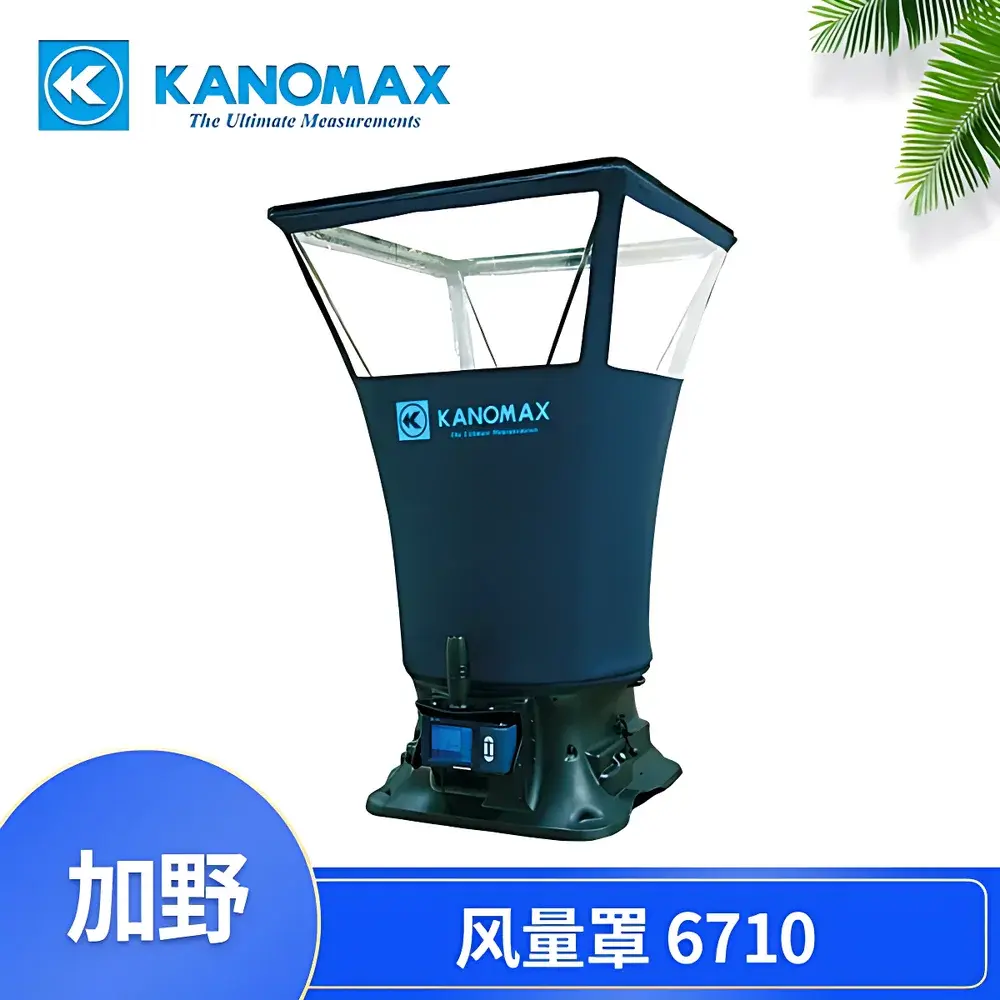
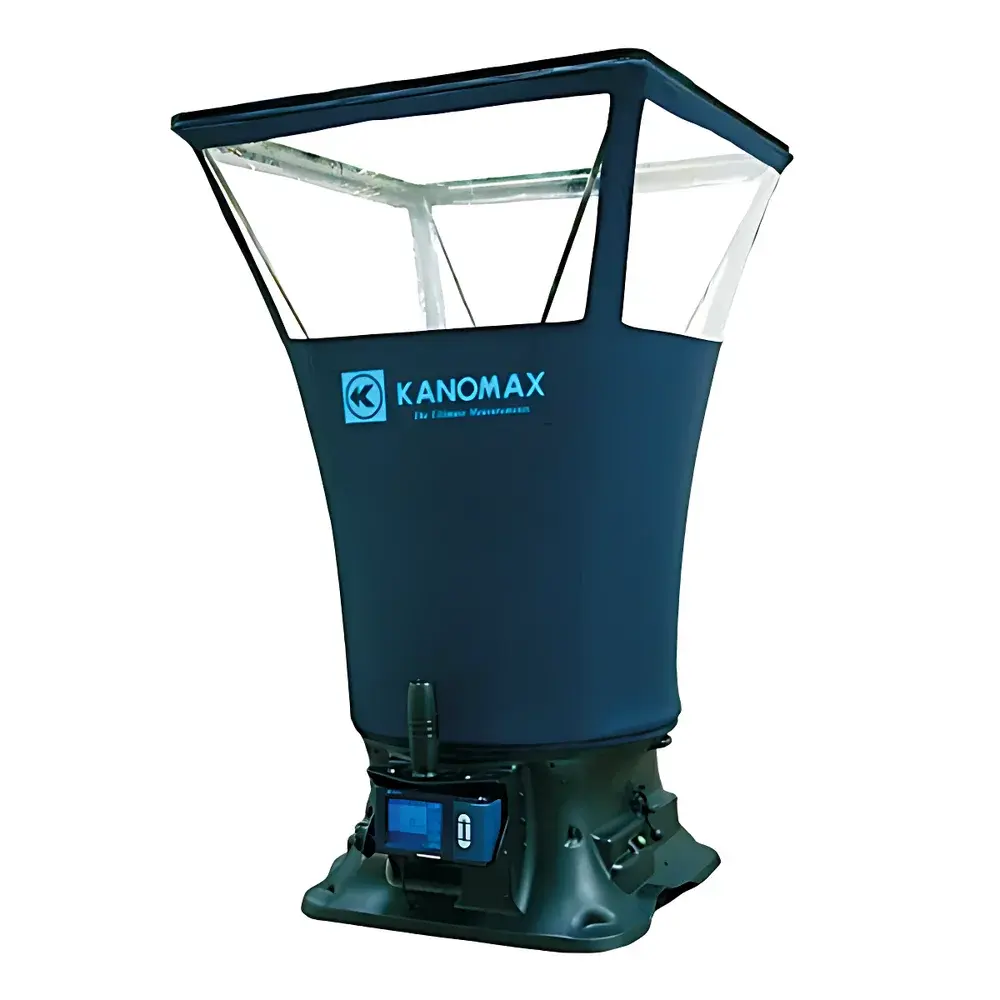
Kanomax 6710 Smart Air Flow Hood
| Brand | Kanomax |
|---|---|
| Origin | Japan |
| Model | 6710 |
| Flow Range | 40–4300 m³/h |
| Resolution | 1 m³/h |
| Accuracy | ±3% of reading ±10 m³/h |
| Temperature Range | 0–60 °C (±0.5 °C) |
| Humidity Range | 0–100% RH (±3% RH, 10–90% RH) |
| Display | 3.5-inch color LCD with auto-rotation |
| Data Storage | 3,000 sets |
| Power | 4 × AA batteries (9 h) or DC 5 V adapter |
| Weight | ~3.5 kg |
| Standard Hood Size | 610 × 610 mm |
| Backpressure Compensation | Yes |
| Connectivity | USB output, RS232 for printer |
| Compliance | Designed for HVAC commissioning and ISO 14644-3 / ISO 14644-4 airflow verification protocols |
Overview
The Kanomax 6710 Smart Air Flow Hood is a precision-engineered handheld instrument designed for quantitative measurement of volumetric air flow at ventilation outlets—including supply diffusers, return grilles, and exhaust registers—in cleanrooms, laboratories, hospitals, and commercial HVAC systems. It operates on the principle of integrated velocity-area measurement: an internal grid of calibrated sensors captures localized air velocities across the hood’s capture face, while real-time temperature and relative humidity readings enable dynamic correction of air density for accurate mass-to-volumetric flow conversion under varying environmental conditions. Unlike basic anemometers, the 6710 incorporates active backpressure compensation to maintain measurement integrity when installed directly against ductwork or diffusers—minimizing flow disturbance and ensuring traceable, repeatable results aligned with ASHRAE Standard 111, ISO 14644-3 Annex B, and EU GMP Annex 1 requirements for airflow uniformity and containment validation.
Key Features
- Simultaneous measurement of air volume flow (m³/h), temperature (°C), and relative humidity (%RH) with synchronized timestamping
- 3.5-inch high-contrast color LCD display with automatic 30° tilt adjustment for ergonomic viewing in overhead or confined installations
- Integrated backpressure compensation algorithm that dynamically corrects for static pressure buildup during hood placement—critical for low-velocity or high-resistance outlets
- 3,000-point internal memory with time/date stamping, USB data export (CSV format), and RS232 interface for direct thermal printer connectivity
- Modular hood system supporting 10 standardized sizes—from compact 305 × 1220 mm to large 1400 × 800 mm—enabling coverage of terminal devices from small HEPA filters to ceiling-mounted laminar flow units
- Robust mechanical architecture rated for continuous operation in ambient conditions from 0–60 °C and 0–100% RH, with IP42-rated housing for dust and splash resistance
- Built-in clock, battery level indicator, and low-power management delivering up to 9 hours of field operation on standard AA alkaline cells
Sample Compatibility & Compliance
The Kanomax 6710 is validated for use with standard rectangular and square supply/return terminals in ISO Class 5–8 cleanrooms, pharmaceutical manufacturing suites, biosafety cabinets, and hospital isolation rooms. Its measurement methodology conforms to the technical basis of ISO 14644-3 (Testing and Certification), ISO 14644-4 (Design and Construction), and ASHRAE Guideline 12–2020 (Managing the Risk of Legionellosis). When used with optional pitot tubes or velocity matrices (e.g., Kanomax 6720 accessories), it supports differential pressure-based flow profiling per ISO 14644-4 Annex D. The device itself does not require external calibration certification but is supplied with NIST-traceable factory calibration documentation—supporting GLP/GMP audit readiness and FDA 21 CFR Part 11-compliant data handling when paired with Kanomax’s certified PC software (v3.2+).
Software & Data Management
Data acquired by the 6710 is stored internally with full metadata: date/time stamp, operator ID (user-configurable), hood size selection, and environmental parameters. Export via USB yields UTF-8 encoded CSV files compatible with Microsoft Excel, LabVIEW, and LIMS platforms. Kanomax’s proprietary KanView™ PC software (included) enables batch analysis, trend plotting, pass/fail threshold comparison against ISO-defined airflow limits (e.g., ≥0.45 m/s ±20% for unidirectional flow), and automated report generation compliant with ISO 14644-3 Table C.1. Audit trail functionality logs all user actions—including data deletion, parameter modification, and firmware updates—meeting ALCOA+ principles for data integrity in regulated environments.
Applications
- HVAC system balancing and TAB (Testing, Adjusting, and Balancing) in healthcare facilities and clean manufacturing
- Periodic performance verification of laminar airflow workbenches per ISO 14644-3 Clause 8.2.3
- Commissioning of variable air volume (VAV) boxes and terminal reheat units
- Leak testing of ductwork sections using hood-based flow differential methods
- Occupational health assessments of local exhaust ventilation (LEV) capture efficiency in industrial labs
- Validation of air change rates in critical zones per EU GMP Annex 1 Section 4.37
FAQ
Does the 6710 require annual recalibration?
While no mandatory annual recalibration is stipulated by Kanomax, users operating under ISO/IEC 17025 or GxP frameworks must establish and document a calibration interval—typically 12 months—using accredited service providers traceable to national standards.
Can the 6710 measure airflow in round ducts?
It is optimized for rectangular/square outlet geometries. For round ducts, Kanomax recommends pairing the 6710 with a pitot traverse kit (Model 6705 accessory) and applying ISO 14644-3 Annex C velocity integration protocols.
Is the USB interface compatible with macOS or Linux?
The device mounts as a standard CDC ACM serial device; raw data streaming is supported on macOS and Linux via terminal emulators or Python-based scripts—but official KanView™ software is Windows-only (Windows 10/11, 64-bit).
What is the uncertainty contribution of temperature/humidity correction?
At 20 °C and 50% RH, the combined effect of sensor accuracy (±0.5 °C, ±3% RH) introduces <±0.2% additional uncertainty into volumetric flow calculation—well within the stated ±3% ±10 m³/h total specification.
How does backpressure compensation improve measurement fidelity?
Without compensation, hood-induced static pressure rise can reduce actual outlet velocity by up to 15%—especially at low-flow, high-resistance terminals. The 6710’s internal differential pressure sensor detects this rise and applies a real-time correction factor derived from its pre-characterized flow-pressure curve.
Related Products







