
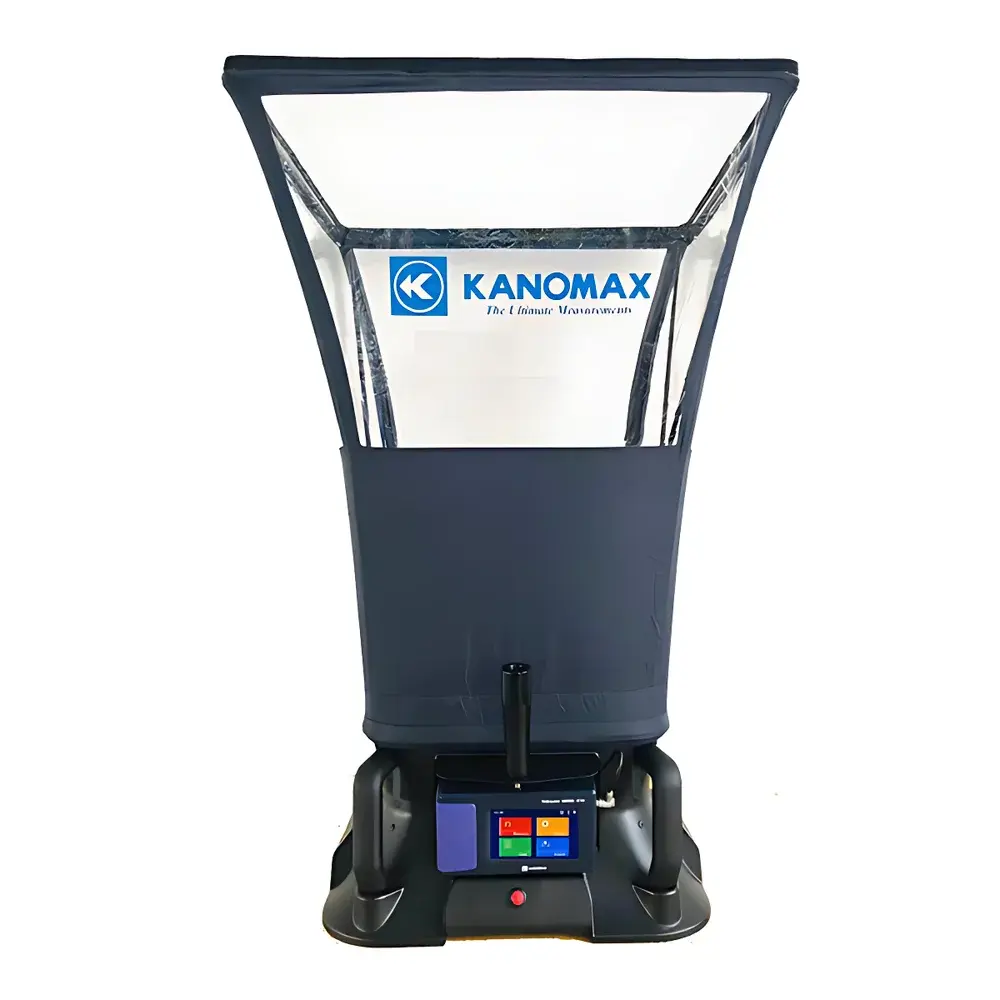
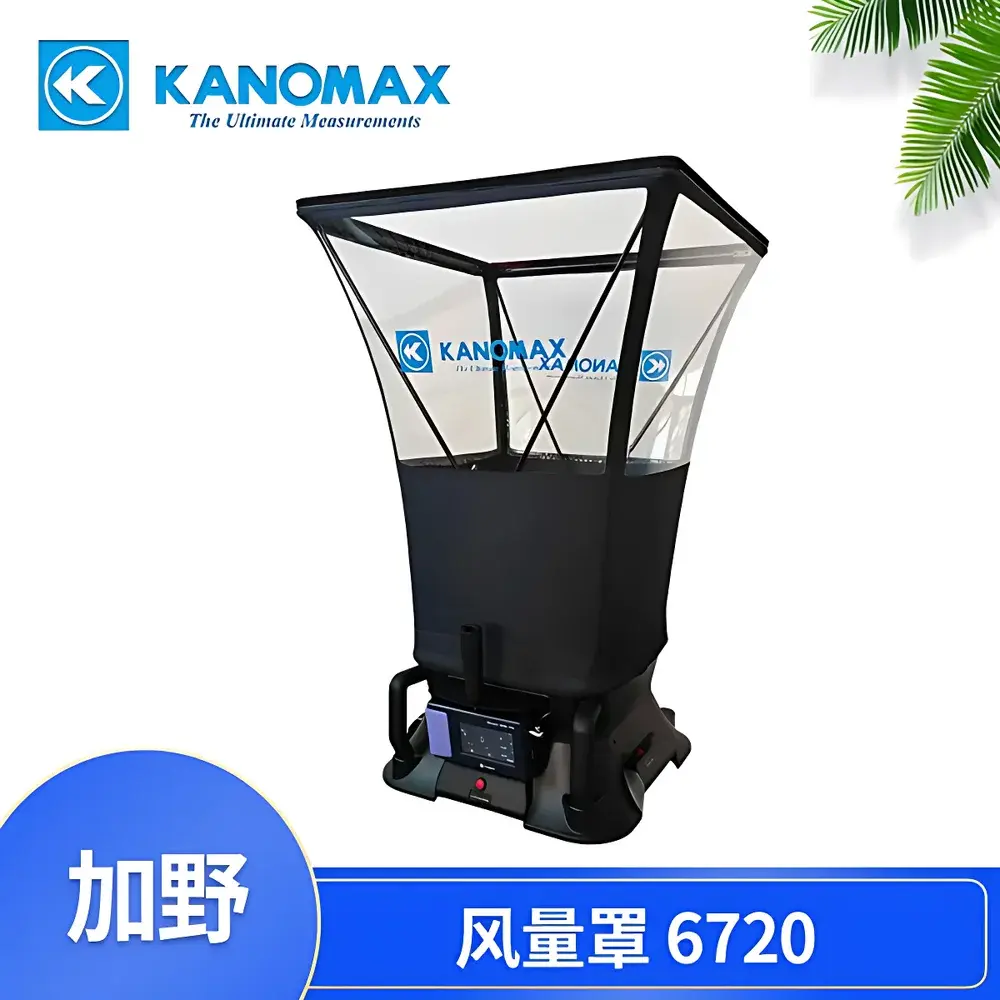
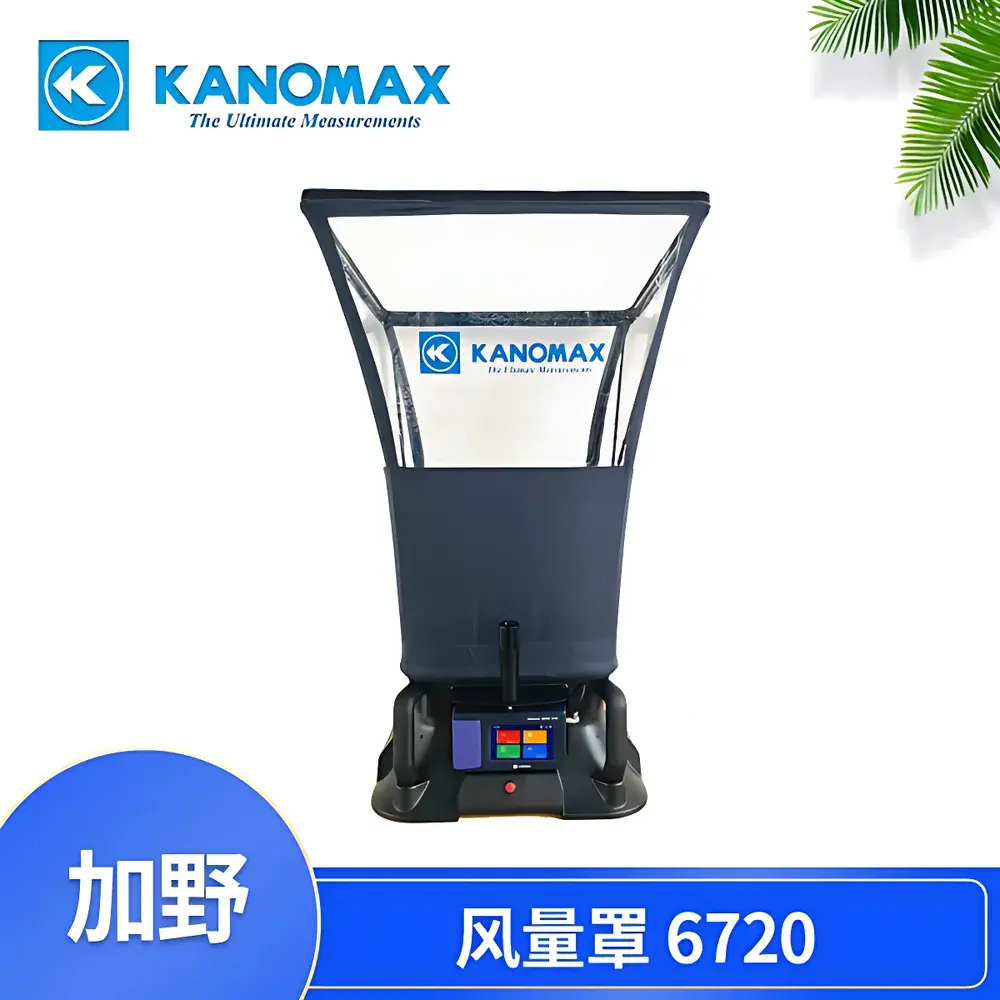
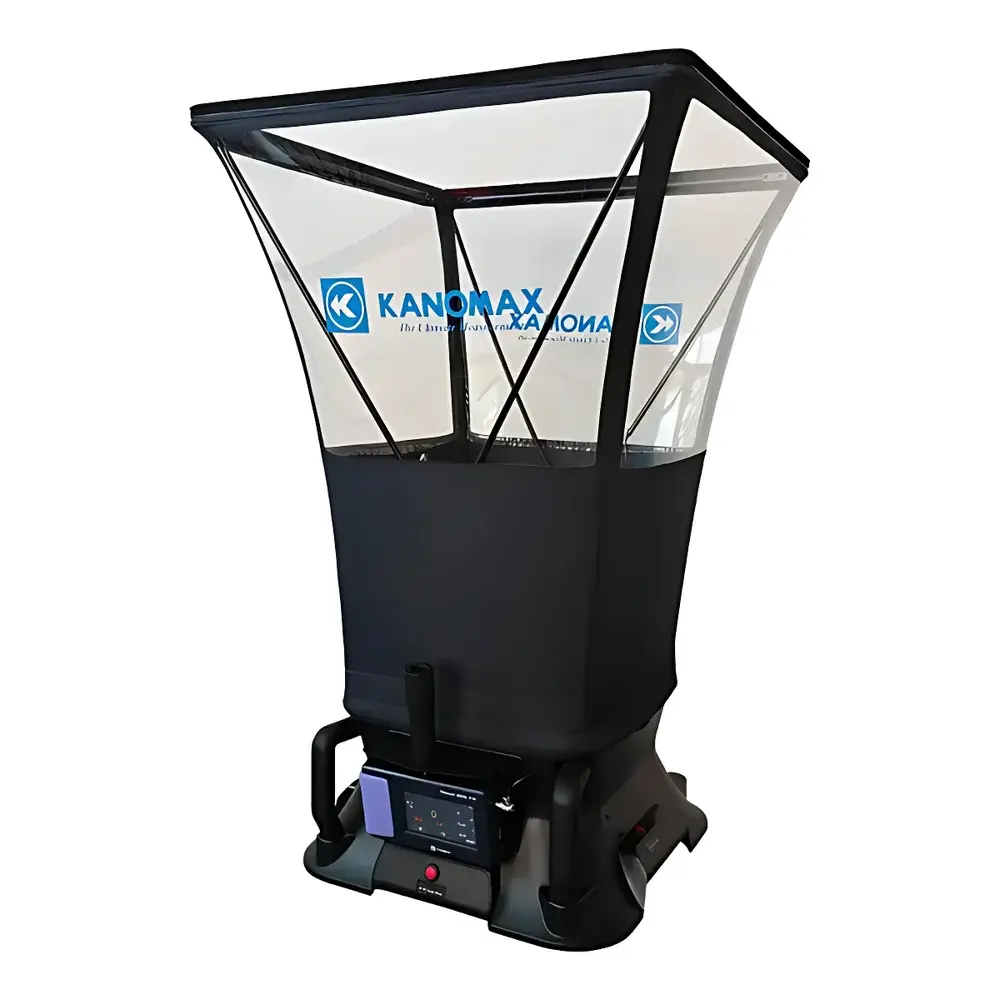
Kanomax 6720 Advanced Air Flow Hood with Integrated Multi-Parameter Environmental Sensing
| Brand | Kanomax |
|---|---|
| Origin | Japan |
| Model | 6720 |
| Air Flow Range | 40–4300 m³/h |
| Accuracy | ±3% of reading ±8 m³/h |
| Operating Temperature | 0–60 °C |
| Operating Humidity | 0–100 %RH |
| Differential Pressure Range | −2500 to +2500 Pa |
| DP Accuracy | ±1.5% of reading ±0.25 Pa |
| Air Velocity Range (Pitot Tube) | 0.15–40 m/s |
| Air Velocity Range (Matrix Sensor) | 0.15–15 m/s |
| Velocity Accuracy | ±3% of reading ±0.05 m/s |
| Temperature Accuracy | ±0.5 °C |
| Relative Humidity Accuracy | ±3 %RH (10–90 %RH) |
| Display | 4.3-inch full-color touchscreen LCD |
| Data Storage | 8,000 measurements (host), 10,000 (via Kanomax Mobile App) |
| Power | 4 × AA batteries (≈9 h) or DC 5 V adapter |
| Weight | 3.6 kg |
| Standard Hood Size | 610 × 610 mm |
| Optional Hood Sizes | 610×1220, 305×1220, 500×500, 915×915, 915×610, 800×1400 mm |
| Key Functions | Backpressure compensation, atmospheric pressure & temperature correction, inlet/exhaust mode auto-detection, 16-point differential pressure array, detachable velocity matrix, Bluetooth 4.2, USB data export, real-time thermal printing support |
Overview
The Kanomax 6720 Advanced Air Flow Hood is an integrated, field-deployable environmental measurement instrument engineered for high-accuracy volumetric airflow quantification in HVAC commissioning, cleanroom certification, and biosafety cabinet validation. It operates on the principle of direct volumetric displacement measurement using a calibrated capture hood coupled with a multi-point differential pressure sensor array and thermohygrometric compensation. Unlike conventional anemometers relying solely on point-velocity extrapolation, the 6720 employs a 16-port static pressure manifold across its internal duct surface—enabling simultaneous measurement of face velocity distribution, total differential pressure drop, ambient temperature, and relative humidity. All parameters are acquired synchronously and processed in real time using built-in backpressure compensation algorithms compliant with ASHRAE Guideline 12–2020 and ISO 14644-3 Annex B methodologies. The device is designed for traceable, repeatable airflow characterization under variable static pressure conditions typical of supply diffusers, exhaust grilles, and laminar flow hoods.
Key Features
- Simultaneous acquisition of air volume (m³/h), face velocity (m/s), differential pressure (Pa), temperature (°C), and relative humidity (%RH) on a single 4.3-inch capacitive touchscreen interface
- Detachable 16-point velocity matrix sensor with dual-range capability: 0.15–15 m/s (matrix) and 0.15–40 m/s (optional Pitot tube integration)
- Backpressure compensation algorithm dynamically corrects for system resistance effects, ensuring accuracy across varying duct static pressures (−2500 to +2500 Pa)
- Atmospheric pressure and temperature correction functions aligned with ISO 5167-2:2003 reference conditions for standardized volumetric flow reporting
- Real-time inlet/exhaust mode identification based on pressure gradient polarity and airflow direction logic—no manual configuration required
- Bluetooth 4.2 wireless protocol supporting bidirectional communication with iOS/Android devices running the official Kanomax Mobile App (v3.2+)
- On-device storage of up to 8,000 complete test records with timestamp, GPS metadata (when paired), and operator ID tagging
- Optically transparent front window enabling visual confirmation of hood-to-grille seal integrity prior to measurement initiation
Sample Compatibility & Compliance
The Kanomax 6720 accommodates a broad range of HVAC terminal devices—including linear slot diffusers, perforated panels, VAV boxes, fume hoods, biological safety cabinets (Class I, II, III), and laminar flow workstations. Its modular hood system supports six optional physical configurations (e.g., 610×1220 mm, 800×1400 mm) to match non-standard outlet geometries without requiring recalibration. The instrument meets IEC 61000-4-2 (ESD immunity), IEC 61000-4-3 (radiated RF immunity), and IP42 ingress protection ratings for field use. Measurement uncertainty budgets comply with ISO/IEC 17025:2017 requirements for accredited laboratories performing HVAC airflow verification. Data logging functionality satisfies FDA 21 CFR Part 11 audit trail prerequisites when used with Kanomax’s validated software suite (Kanomax Data Manager v4.1).
Software & Data Management
The Kanomax Mobile App provides full remote control, including parameter configuration (K-factor adjustment, averaging time, unit selection), live data streaming, and post-test statistical analysis (min/max/avg/cumulative values per test point). Export options include CSV, PDF, and XML formats compatible with LIMS integration. All stored records include embedded calibration certificate IDs, firmware revision stamps, and digital signatures. Host-side USB-C connectivity enables direct transfer to Windows-based Kanomax Data Manager software, which supports GLP-compliant report generation with customizable templates aligned with ISO 14644-3, EU GMP Annex 1, and NSF/ANSI 49 protocols. Audit trails record every user action—including data deletion events—with immutable timestamps and operator credentials.
Applications
- HVAC system balancing and TAB (Testing, Adjusting, and Balancing) per SMACNA and NEBB standards
- Cleanroom airflow uniformity and total air change rate verification (ISO 14644-3, ISO 14644-4)
- Biosafety cabinet inflow and downflow velocity mapping per NSF/ANSI 49 and EN 12469
- Fume hood face velocity surveys for OSHA 1910.1450 and ANSI Z9.5 compliance
- Exhaust stack and laboratory room air exchange rate validation
- Commissioning documentation for LEED EQ Credit 1 and WELL Building Standard Air Quality performance pathways
FAQ
Does the 6720 require annual factory recalibration?
Yes—Kanomax recommends traceable recalibration every 12 months at an ISO/IEC 17025-accredited facility using NIST-traceable airflow standards (e.g., bell prover or laminar flow element). Certificate includes as-found/as-left data and uncertainty statements.
Can the 6720 measure airflow in negative-pressure rooms?
Yes—the differential pressure sensor supports bidirectional measurement (±2500 Pa), and the inlet/exhaust detection logic automatically adapts to reverse airflow direction without manual mode switching.
Is the Bluetooth connection encrypted?
Data transmission uses AES-128 encryption; pairing requires explicit user authorization on both host and mobile device. No persistent credential storage occurs on the instrument.
What is the K-factor, and how is it applied?
The K-factor is a dimensionless coefficient accounting for hood geometry, sensor placement, and turbulence effects. It is preloaded per hood size and adjustable within ±10% via the touchscreen interface to accommodate site-specific duct losses or non-ideal installation conditions.
How does the backpressure compensation improve accuracy?
It applies real-time correction to raw velocity readings using the measured ΔP across the hood and empirically derived flow resistance curves—reducing systematic error from static pressure buildup behind the hood face, particularly critical for low-velocity, high-resistance outlets.







