
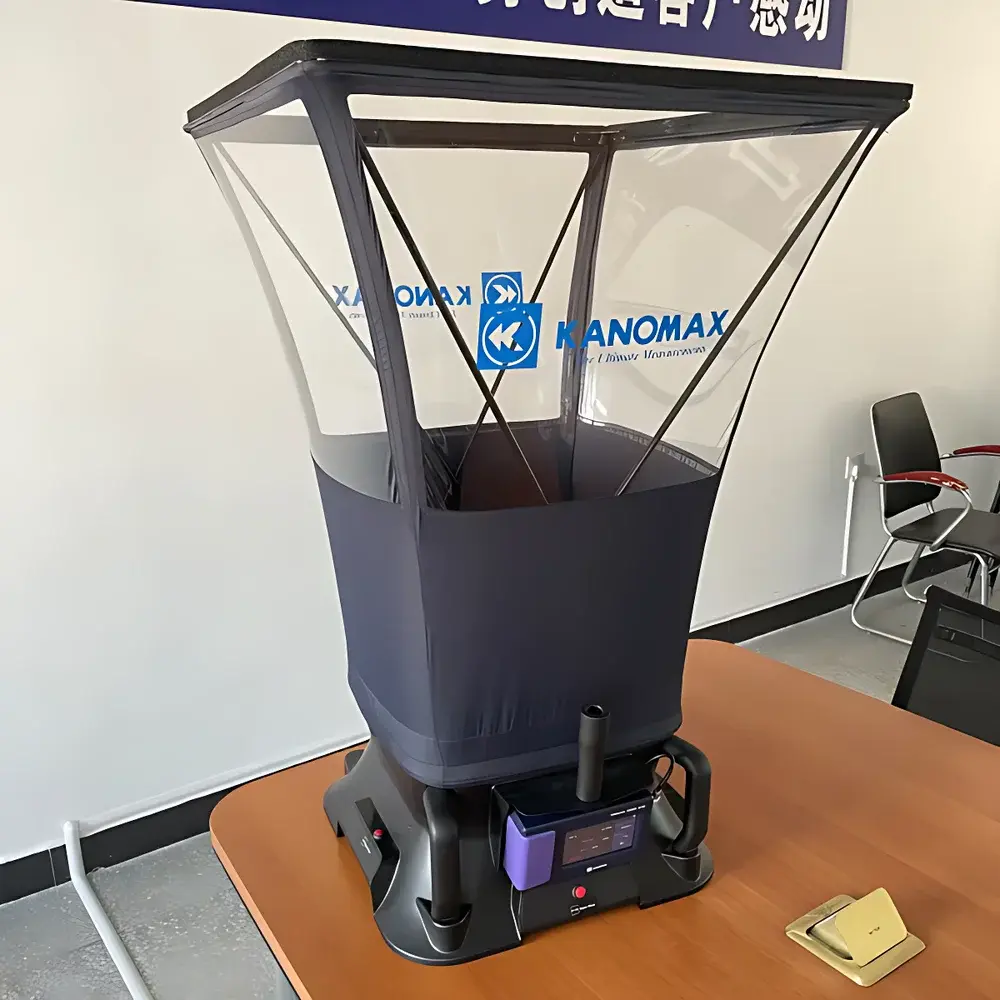
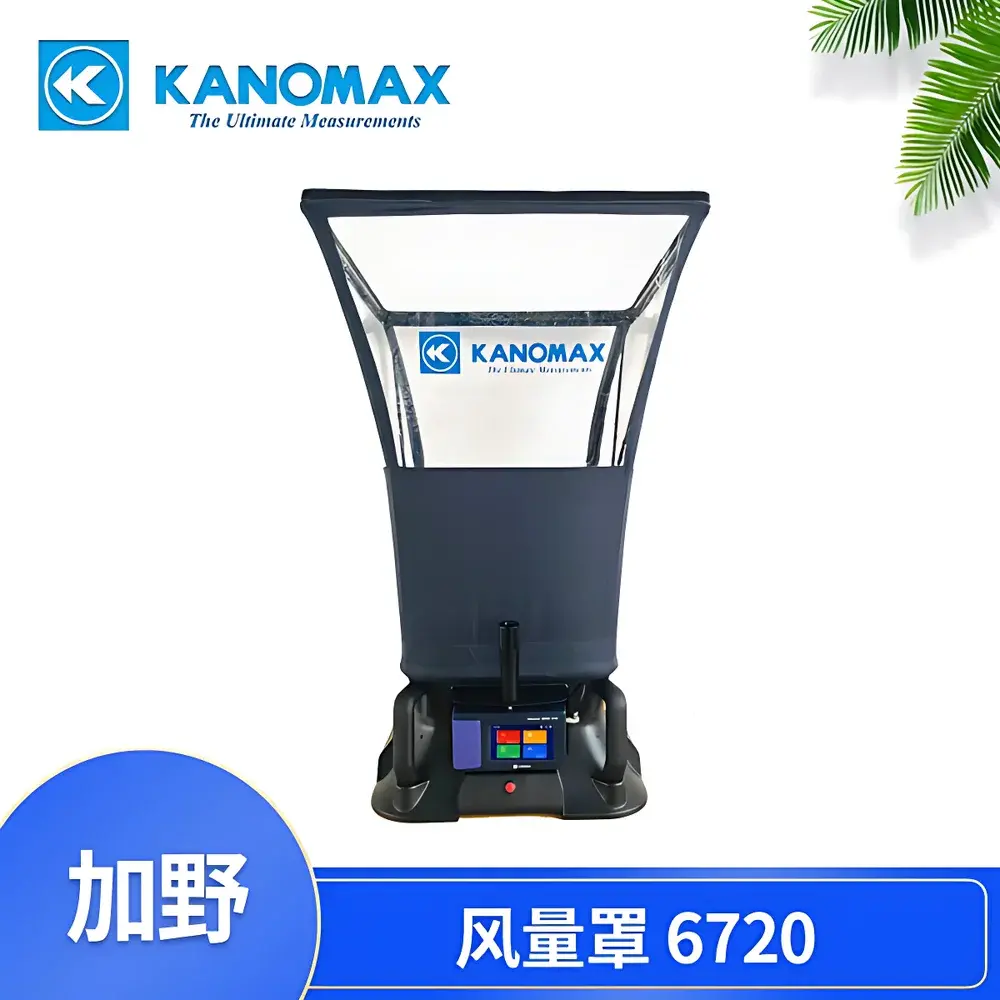
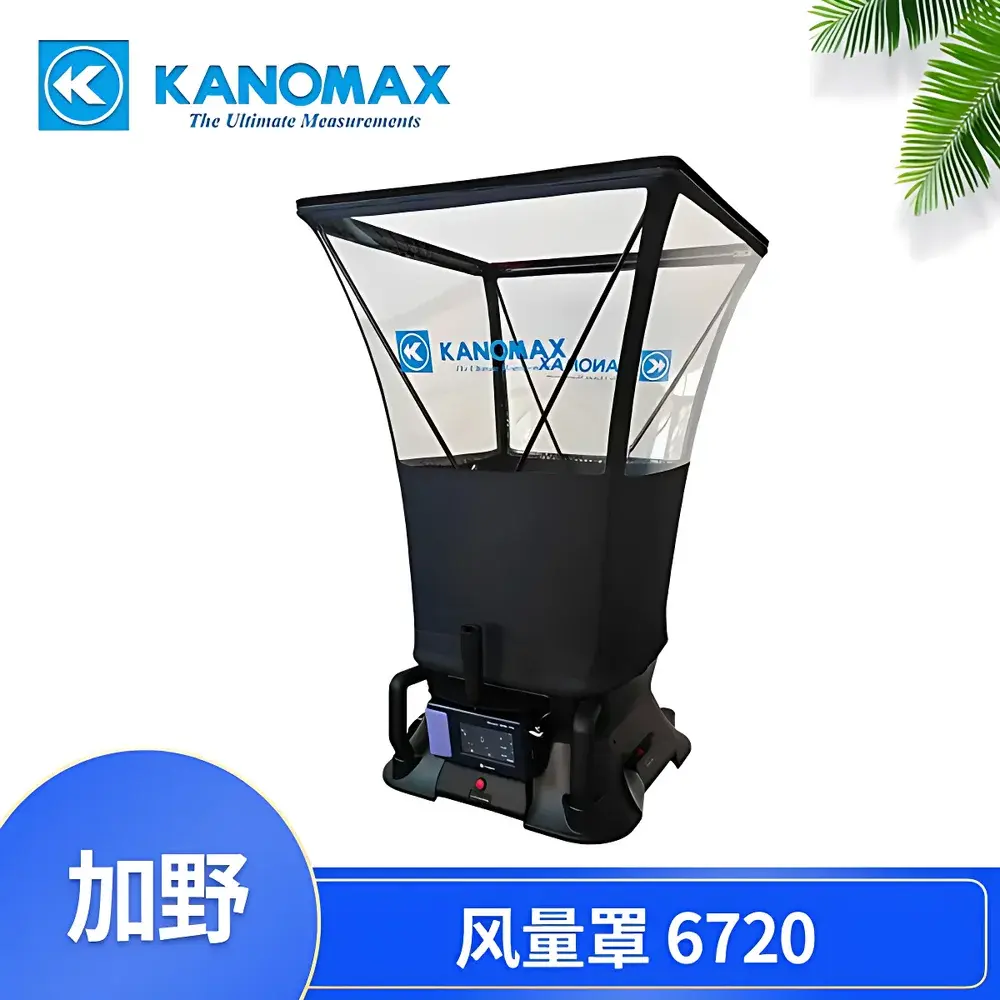
Kanomax 6720 Air Flow Hood
| Brand | Kanomax |
|---|---|
| Origin | Japan |
| Model | 6720 |
| Air Flow Range | 40–4300 m³/h |
| Accuracy | ±3% of reading ±8 m³/h |
| Air Velocity Range (with Pitot tube) | 0.15–40 m/s |
| Air Velocity Range (with Matrix Sensor) | 0.15–15 m/s |
| Velocity Accuracy | ±3% of reading ±0.05 m/s |
| Differential Pressure Range | −2500 to +2500 Pa |
| DP Accuracy | ±1.5% of reading ±0.25 Pa |
| Temperature Range | 0–60 °C |
| Temp Accuracy | ±0.5 °C |
| Humidity Range | 0–100 %RH |
| RH Accuracy | ±3 %RH (10–90 %RH) |
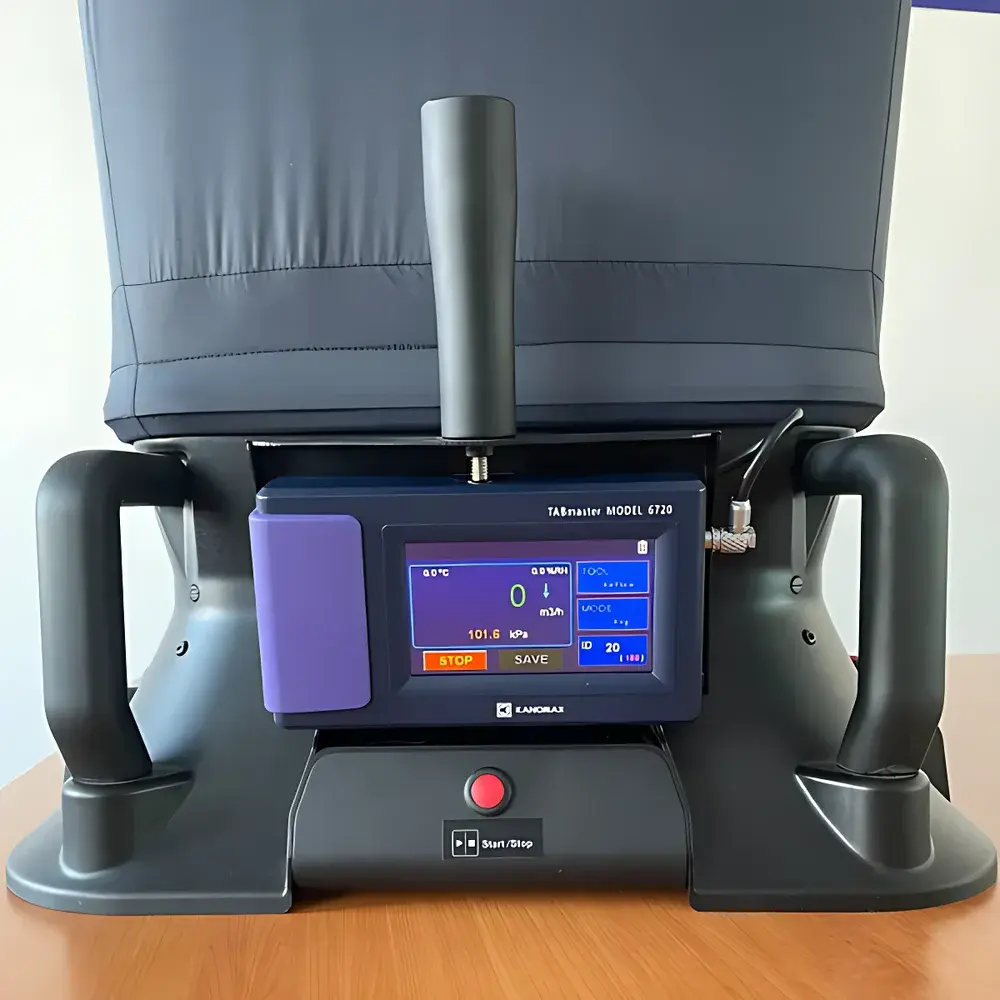
| Display | 4.3-inch full-color touchscreen LCD |
| Backpressure Compensation | Yes |
| Data Storage Capacity | 8,000 records (instrument), 10,000 records (mobile app) |
| Power Supply | 4 × AA batteries (up to 9 h), DC 5 V adapter |
| Standard Hood Size | 610 × 610 mm |
| Weight | 3.6 kg |
| Compliance | Designed for HVAC commissioning, ISO 14644-3, ISO 14644-4, EN 12599, ASHRAE Guideline 12, USP <797>, FDA 21 CFR Part 11 (via software audit trail) |
Overview
The Kanomax 6720 Air Flow Hood is an integrated, handheld volumetric airflow measurement system engineered for precision and field robustness in HVAC commissioning, cleanroom validation, and laboratory containment verification. It operates on the principle of multi-point velocity integration across a calibrated capture hood aperture—using either a removable 16-point matrix sensor array or an optional Pitot-static probe—to compute volumetric flow (m³/h) from averaged velocity profiles, corrected in real time for backpressure, ambient temperature, and barometric pressure. Unlike single-point anemometers, the 6720 eliminates spatial averaging errors by capturing simultaneous velocity data at 16 discrete locations across its standard 610 × 610 mm hood face. Its dual-mode capability—as both an air flow hood and a standalone differential pressure meter or matrix-based anemometer—enables flexible deployment across supply diffusers, exhaust grilles, fume hoods, biosafety cabinets (Class I/II), and duct terminations.
Key Features
- Real-time simultaneous measurement of volumetric airflow (40–4300 m³/h), air velocity (0.15–40 m/s with Pitot tube; 0.15–15 m/s with matrix), differential pressure (±2500 Pa), temperature (0–60 °C), and relative humidity (0–100 %RH)
- Integrated backpressure compensation algorithm that dynamically adjusts flow calculations based on measured static pressure differential across the hood—critical for accurate readings at low-flow or high-resistance outlets
- 16-point evenly distributed pressure taps with individual calibration coefficients, enabling K-factor optimization per tap and minimizing systematic bias in non-uniform velocity fields
- 4.3-inch full-color capacitive touchscreen with intuitive icon-driven interface, real-time trend graphs, and on-device statistical processing (min/max/avg/cumulative values)
- Bluetooth 4.2 LE connectivity supporting bidirectional communication with iOS/Android mobile devices via Kanomax’s certified FieldLink™ app—enabling remote configuration, live data streaming, and secure export (CSV/PDF)
- Dual storage architecture: 8,000 measurement sets retained onboard; up to 10,000 stored via app with timestamped metadata, operator ID, location tagging, and electronic signature support
- Transparent polycarbonate viewing window allows visual confirmation of hood-to-grille seal integrity prior to measurement—reducing operator-induced leakage error
Sample Compatibility & Compliance
The Kanomax 6720 is validated for use across diverse HVAC and containment systems including VAV boxes, terminal HEPA filters, laminar flow hoods, and ISO Class 5–8 cleanrooms. Its modular hood design supports interchangeable sizes (610 × 610 mm standard; optional 305 × 1220 mm, 915 × 915 mm, etc.) to match common grille geometries without requiring extrapolation or correction factors. The instrument meets traceability requirements per ISO/IEC 17025 when used with NIST-traceable calibration certificates (available separately). Its firmware and FieldLink™ app support audit trail logging compliant with FDA 21 CFR Part 11 (electronic records and signatures), GLP, and GMP environments—featuring user authentication, immutable timestamps, and change history for all critical parameters (e.g., K-factor, units, compensation settings). It aligns with test methodologies specified in ISO 14644-3 (cleanroom testing), EN 12599 (HVAC system acceptance), and ASHRAE Guideline 12 (infection control).
Software & Data Management
FieldLink™ software provides full lifecycle data governance: pre-test setup (test plan import, site mapping, pass/fail thresholds), real-time visualization (dual-axis plots, histogram overlays), post-test analysis (statistical summaries, deviation heatmaps), and regulatory-grade reporting. All exported files include embedded metadata: instrument serial number, sensor calibration expiry dates, environmental conditions at time of measurement, and operator credentials. USB-C and Bluetooth protocols support encrypted data transfer; no cloud upload occurs unless explicitly initiated by the user. Audit logs record every parameter modification—including K-factor adjustments—with user ID and timestamp, satisfying internal QA review and external inspection requirements.
Applications
- HVAC system balancing and TAB (Testing, Adjusting, Balancing) per NEBB and AABC standards
- Cleanroom air change rate validation under ISO 14644-3 Annex B
- Biosafety cabinet inflow/exhaust velocity verification per NSF/ANSI 49 and EN 12469
- Fume hood face velocity surveys meeting OSHA 1910.1200 and ANSI Z9.5
- LEED EQ Credit 1 commissioning documentation for ventilation performance
- Pharmaceutical facility qualification (IQ/OQ) of air handling units and isolators per EU GMP Annex 1
FAQ
What calibration standards does the 6720 comply with?
The 6720 is factory-calibrated against NIST-traceable reference standards for airflow, pressure, temperature, and humidity. Optional annual recalibration services include ISO 17025-accredited certificates with uncertainty budgets.
Can the 6720 measure both supply and exhaust airflow?
Yes—it automatically detects flow direction and classifies inlet vs. outlet mode using differential pressure polarity and integrated flow logic; no manual mode switching is required.
Is the matrix sensor interchangeable with other Kanomax models?
The 16-point matrix is mechanically and electrically compatible only with the 6720 platform; it is not cross-compatible with 6710 or 6705 due to revised signal conditioning and firmware architecture.
Does the device support custom K-factor input for non-standard hoods?
Yes—users may define and store up to 10 user-defined K-factors per hood size, each associated with specific geometry, mesh type, and installation configuration.
How is data integrity ensured during Bluetooth transmission?
All Bluetooth sessions use AES-128 encryption; packet-level checksums and automatic retransmission prevent corruption. FieldLink™ app enforces write-once logging—once saved, records cannot be edited or deleted without administrative override and full audit trail generation.







