
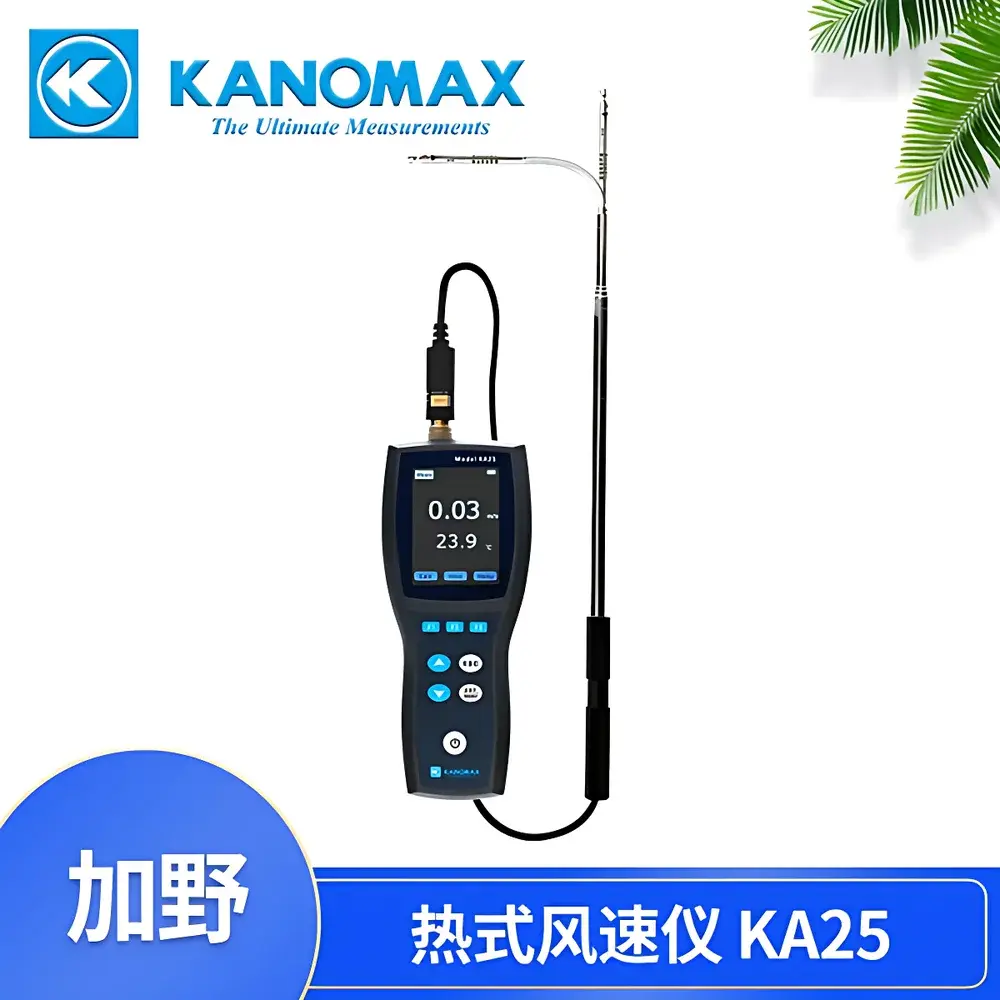
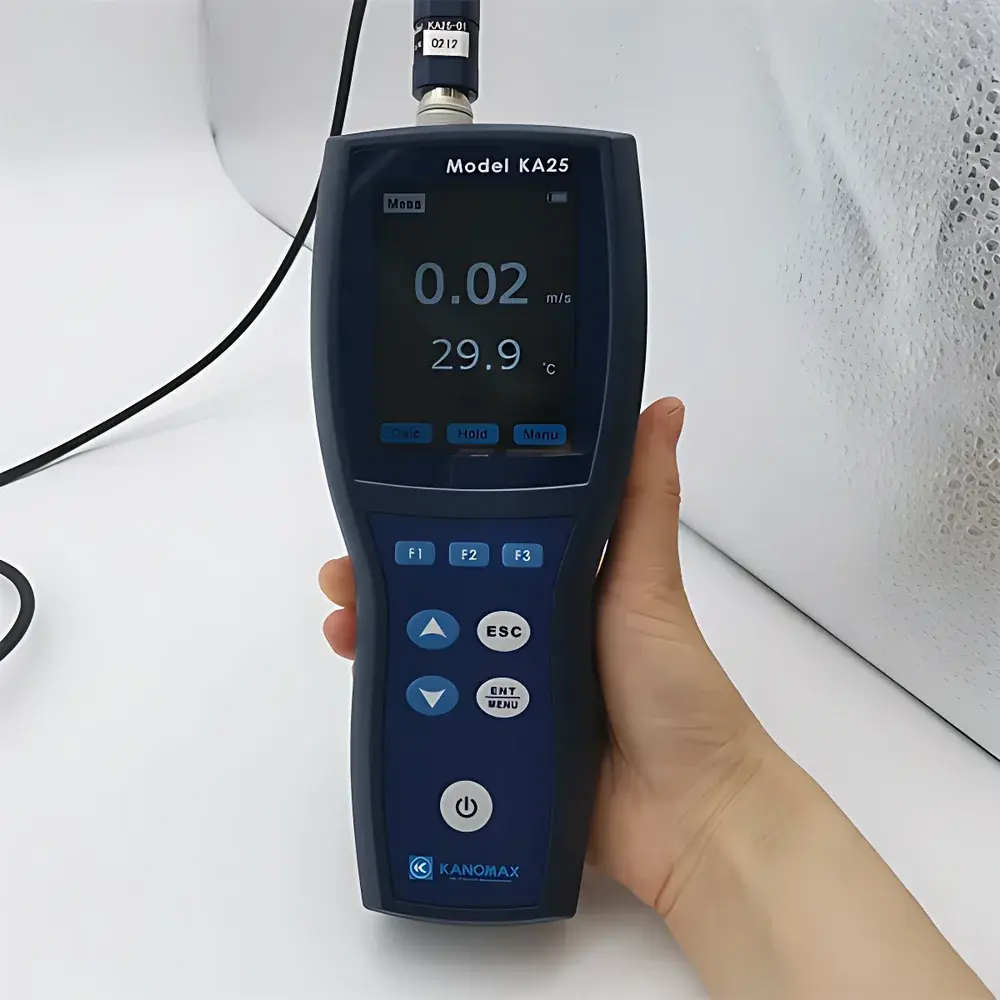
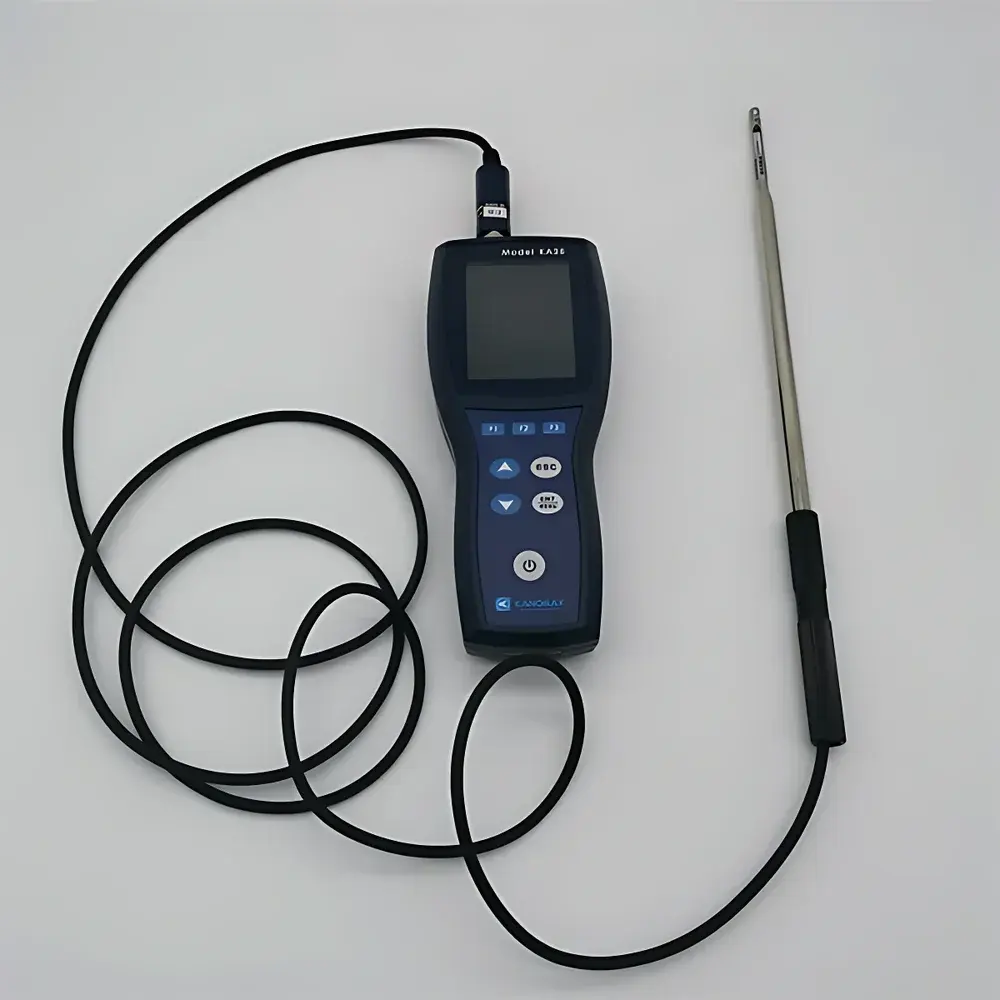
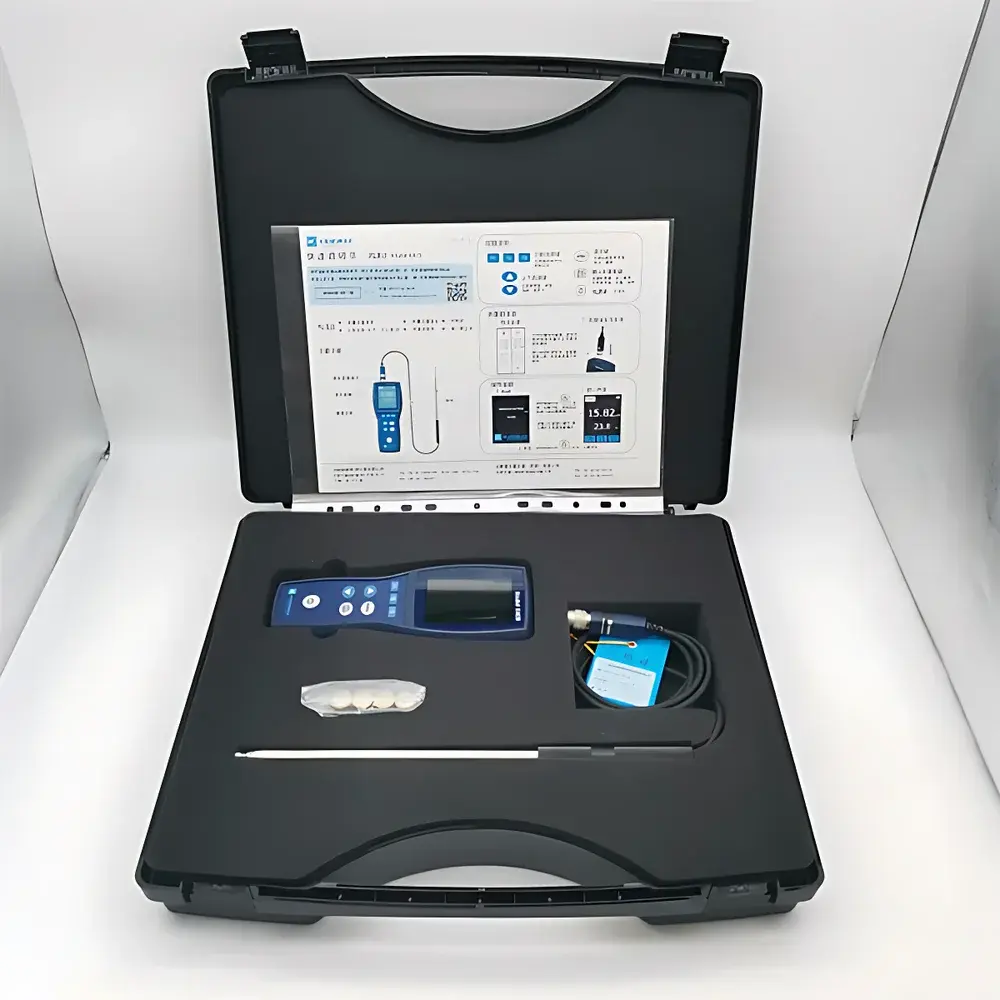
Kanomax KA25 Thermal Anemometer & Air Flow Meter
| Brand | Kanomax |
|---|---|
| Origin | Liaoning, China |
| Manufacturer Type | Authorized Distributor |
| Product Category | Domestic |
| Model | KA25 |
| Instrument Type | Thermal Anemometer |
| Resolution | ±(3% of reading + 0.03 m/s) |
| Measurement Range | 0.01–20.0 m/s |
| Accuracy | ±(3% of reading + 0.03 m/s) |
| Operating Temperature (Probe) | −20 to +70 °C |
| Temperature Accuracy | ±0.5 °C (at v > 0.5 m/s) |
| Temperature Resolution | 0.1 °C |
| Air Velocity Response Time | ~1 s (90% response at 1 m/s) |
| Temperature Response Time | ~30 s (90% response at 1 m/s) |
| Pipe Types Supported | Rectangular and Circular |
| Dimension Input Range | 0.1–255.0 cm |
| Air Volume Resolution | 1 m³/h |
| Data Hold Function | Yes |
| Time Constant Options | 1 s / 5 s / 10 s / 20 s |
| Display | Triple-level backlight LCD |
| Power Supply | 4 × AA alkaline batteries |
| Battery Life | Approx. 15 hours (1 m/s, 20 °C) |
| Body Dimensions | 200 × 85 × 40 mm |
| Probe Dimensions | Φ6 mm (sensor) / Φ14 mm (handle) × 294–1060 mm (telescoping & bendable) |
| Cable Length | 2000 mm |
| Operating Environment (Body) | 5–40 °C |
| Storage Temperature | −20 to +60 °C |
| Weight | ~220 g (without batteries) |
Overview
The Kanomax KA25 Thermal Anemometer & Air Flow Meter is a portable, handheld instrument engineered for precision measurement of air velocity and temperature in HVAC commissioning, indoor air quality (IAQ) assessment, cleanroom validation, and industrial ventilation system audits. Based on constant-temperature anemometry (CTA), the KA25 employs a thermally sensitive platinum resistance sensor that maintains a fixed temperature differential relative to ambient air; convective heat loss from the sensor is directly correlated to local air velocity via calibrated thermal transfer models. This principle ensures stable, low-drift performance across its full dynamic range of 0.01–20.0 m/s—critical for laminar flow characterization in ducts, fume hoods, and biosafety cabinets. The integrated temperature sensor (NTC thermistor) enables simultaneous dual-parameter acquisition, supporting real-time volumetric airflow calculation when cross-sectional dimensions are entered manually.
Key Features
- Telescoping and bendable probe (294–1060 mm length, Φ6 mm sensor tip) for access to confined or irregular duct geometries
- Real-time volumetric air flow computation (m³/h) with user-input rectangular or circular duct dimensions (0.1–255.0 cm)
- Configurable time constant (1/5/10/20 s) to optimize response dynamics for transient or steady-state flows
- On-device statistical analysis: min/max/average values with data hold and auto-hold functionality
- Triple-level adjustable backlight LCD for legibility under low-light or high-glare conditions
- Auto power-off (3/5/10 min options) and battery-level indicator to maximize field operational uptime
- Rugged, ergonomic housing (200 × 85 × 40 mm, ~220 g) designed for single-hand operation during extended surveys
Sample Compatibility & Compliance
The KA25 is validated for use with clean, non-corrosive, particle-free ambient air—making it suitable for ISO 14644-3 classified cleanrooms, ASHRAE 62.1-compliant ventilation verification, and laboratory fume hood face velocity checks per ANSI/ASHRAE Standard 110. It is not intended for saturated, oily, or chemically aggressive airstreams. While the device itself does not carry CE or UKCA marking, its measurement methodology aligns with fundamental principles referenced in ISO 16813 (HVAC performance testing) and ASTM D5465 (standard practice for measuring air velocity in ducts). The instrument supports GLP-aligned documentation workflows through manual data recording and timestamped statistical outputs.
Software & Data Management
The KA25 operates as a standalone field instrument with no proprietary PC software or Bluetooth connectivity. All measurements—including instantaneous velocity, temperature, computed airflow, and statistical aggregates—are displayed and retained locally on the device’s memory during active session. Data export requires manual transcription or photography of the LCD screen. For regulated environments requiring audit trails, users may integrate KA25 readings into validated electronic lab notebooks (ELNs) or LIMS platforms using documented SOPs for manual data entry, including operator ID, location tag, calibration status, and environmental conditions. The device supports traceability through its built-in calibration reminder function and configurable auto-shutdown settings that reduce risk of unattended drift.
Applications
- HVAC duct balancing and total system airflow verification
- Cleanroom air change rate (ACH) estimation and ISO Class compliance spot-checks
- Fume hood and biosafety cabinet face velocity mapping per NIH Guidelines and EN 14175
- Industrial exhaust system performance monitoring and energy efficiency audits
- Classroom and office IAQ baseline surveys per ASHRAE Standard 62.1
- Validation of laminar flow hoods and critical process enclosures in pharmaceutical manufacturing
FAQ
What is the recommended recalibration interval for the KA25?
Kanomax recommends annual calibration against NIST-traceable standards for applications requiring regulatory compliance; field verification using a reference anemometer is advised before each critical measurement campaign.
Can the KA25 measure airflow in round ducts with diameters less than 10 cm?
Yes—the instrument accepts diameter inputs from 0.1 cm upward; however, accuracy assumes fully developed flow profiles, so measurements in very small ducts (<5 cm) should be interpreted with awareness of boundary layer effects.
Is the probe resistant to condensation or high humidity?
The probe is rated for operation up to 70 °C and −20 °C but is not IP-rated for moisture ingress; prolonged exposure to condensing environments may affect sensor stability and require post-exposure stabilization time.
Does the KA25 support averaging across multiple duct traverse points?
No—the device computes statistics only over time-series sampling at a fixed location; multi-point traverse averaging must be performed externally using recorded min/avg/max values.
How does the time constant setting affect measurement uncertainty?
A longer time constant (e.g., 20 s) reduces short-term noise but increases lag in rapidly changing flows; for turbulent or pulsating systems, a 1–5 s setting is typically optimal to preserve dynamic fidelity while maintaining readability.







